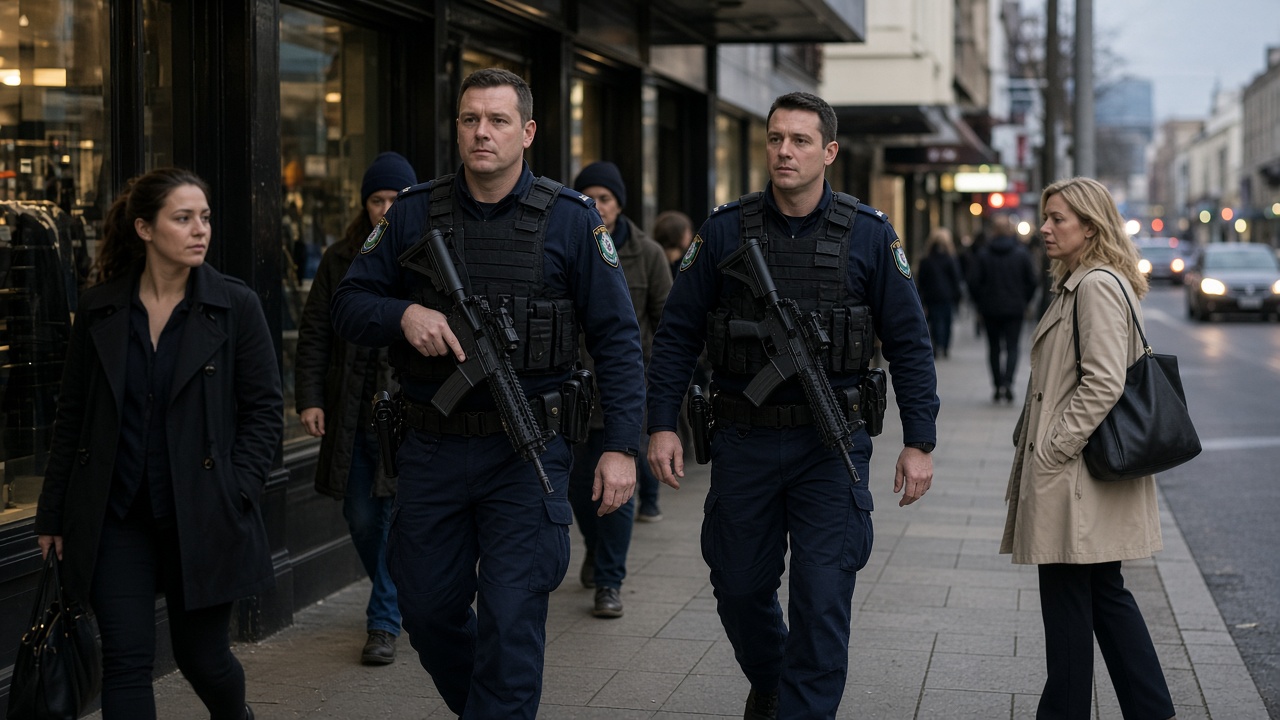
Officers carrying long-barrel rifles started visible patrols across Sydney on Sunday as New South Wales police activated the Armed Response Command, a unit created after a December 2025 mass shooting at a Hanukkah celebration on Bondi Beach killed 15 people. Police Minister Yasmin Catley said the first deployments began at 6 a.m., covering Liverpool, Parramatta, the eastern suburbs and the central business district.
What the unit is supposed to do
The command is budgeted at A$94.3 million and is expected to grow to 250 officers by 2027, supported by civilian staff and a round-the-clock operations centre in Surry Hills. Commander Detective Superintendent Andrew Evans said the teams are trained for active armed offender incidents, not routine traffic stops, and will appear at crowded public spaces, sporting venues, major events and places of worship to deter attacks and respond within minutes.
Officers carry shortened Australian Combat Assault Rifles selected after field testing, according to NSW Police. They travel in purpose-built BMW X5 and Toyota LandCruiser vehicles fitted with technology that feeds real-time intelligence from the operations centre. Evans told reporters that training lasted six and a half months and included rifle work, high-speed driving and tactical first aid.
A visible shift for Sydney
Australia has historically kept general-duty police unarmed or lightly armed, which makes the sight of patrol-ready rifles in tourist areas unusual. The BBC reported officers outside Luna Park and other busy locations on Sunday, noting that Jewish community leaders welcomed the added capability while civil liberties groups asked for safeguards.
Alex Ryvchin, co-chief executive of the Executive Council of Australian Jewry, told media that no one wants military-style weapons on everyday streets, but that body bags would be worse. Amnesty International Australia urged the Minns government to guarantee the unit would not intimidate peaceful protesters, pointing to ministerial comments that left deployment decisions to police commanders based on risk.
Link to Bondi and prior operations
Two gunmen opened fire at Bondi Beach on 14 December 2025 during a Jewish festival, killing 15 people including a 10-year-old girl, in an attack police have described as antisemitic and inspired by Islamic State ideology. The new command is explicitly modeled on armed response teams in Europe, the United Kingdom and the United States, the Sydney Morning Herald reported, with Evans warning that popular tourist precincts remain vulnerable to terrorism.
The Armed Response Command will gradually take over high-visibility duties from Operation Shelter, which NSW launched in 2023 amid rising antisemitic and Islamophobic incidents. Both operations will overlap initially before Shelter scales back, the government said. Police Commissioner Mal Lanyon has said he did not expect the new unit to manage protests, leaving that role to public order teams, though Catley declined to rule out protest deployments if commanders judged the risk high enough.
What residents should expect
7NEWS reported that patrols would run on a 24/7 basis as staffing ramps up, with Evans emphasizing deterrence through visibility rather than constant tactical entries. The unit’s priority remains preserving life during short-duration attacks like the roughly six-minute Bondi shooting before police killed the offenders.
For businesses and schools near Sunday’s deployment zones, the immediate effect was chiefly psychological: more police presence, sirens less frequent than during a live incident, but rifles in plain view. Tourism operators in the eastern suburbs face a delicate messaging task, reassuring visitors that the patrols are preventive while acknowledging the December trauma.
NSW opposition and federal lawmakers will scrutinize cost and oversight in coming weeks, especially whether the operations centre’s intelligence sharing respects privacy law. For now, the Minns government is treating the launch as a down payment on a permanent capability, not a temporary surge. Evans said the command would expand patrol geography as more trained officers finish the pipeline through 2027.