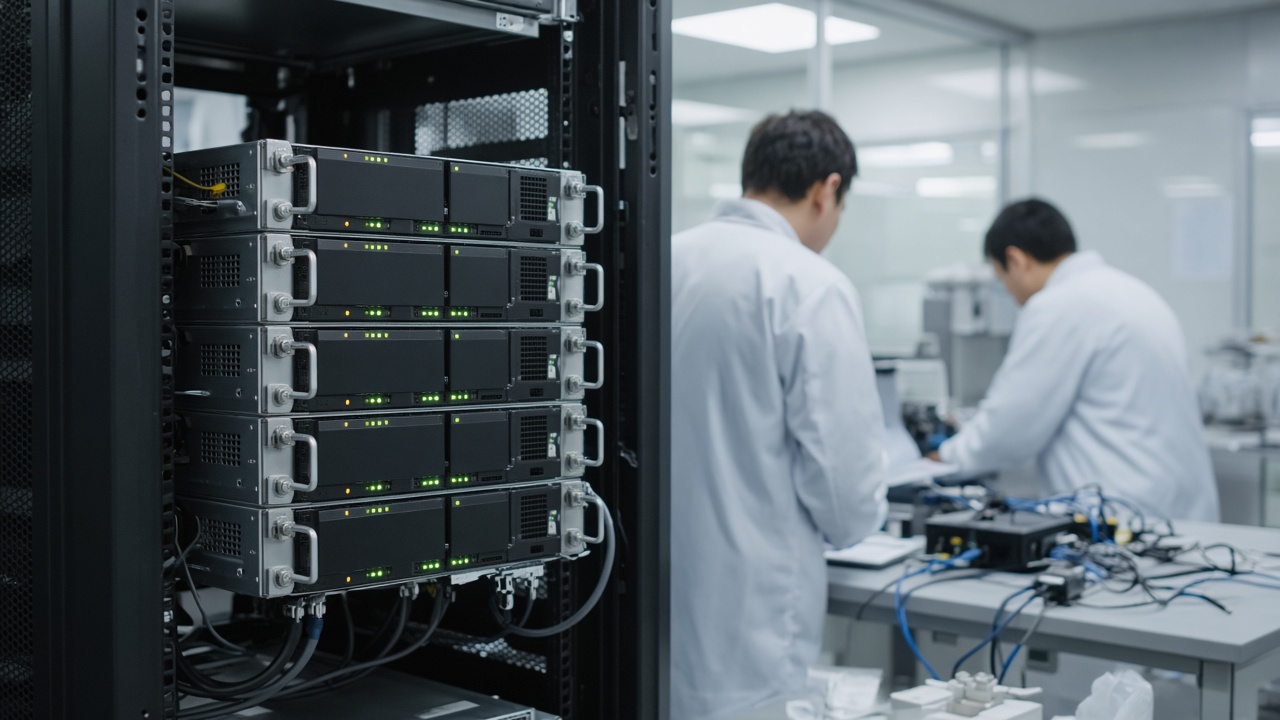
Rebellions delivered ATOM inference accelerator cards to two Seoul large-language-model startups Monday following on-premise benchmarks that showed lower power draw than GPU racks on batch Korean-English translation jobs, a niche where domestic firms pitch sovereign AI stacks to agencies wary of foreign cloud dependence.
Benchmark claims
The startups tested 7-billion-parameter models running nightly document summarization for legal and media clients. Rebellions said ATOM cards sustained higher tokens per watt when memory bandwidth matched model size, though training workloads still favor GPUs. Independent reviewers have not published third-party numbers; customers relied on internal meters and wall-power logs.
Deployment model
Both startups install cards in colocation racks near Yeouido fiber hubs to keep latency low for banking-adjacent clients. Rebellions provides firmware updates and remote diagnostics; customers maintain physical security. One startup pairs ATOM with open-weight models; the other fine-tunes proprietary weights kept air-gapped from vendor support logins.
Policy angle
Government AI procurement guidelines increasingly mention domestic silicon options, though awards still allow foreign GPUs when benchmarks win. Rebellions hopes early startup wins become reference cases for ministry pilots. Competitors FuriosaAI and Sapeon market similar cards; buyers run bake-offs rather than sole-source picks.
Software stack
PyTorch and ONNX runtime ports shipped with the cards, but engineers said operator training took two weeks because tooling differs from CUDA habits. Rebellions funded onsite support during initial integration. Startups warned that missing kernels for exotic attention layers could force hybrid racks mixing GPUs for fallback.
Funding and supply
Rebellions raised venture rounds tied to domestic foundry partnerships; supply timelines remain tighter than Nvidia channels. The two shipments this week are small volume but carry marketing weight ahead of investor days. Export controls on advanced GPUs make local cards attractive even if raw performance trails frontier accelerators.
What’s next
Customers will publish case studies if production error rates stay flat through December. Rebellions plans a developer conference in Gangnam to showcase multi-card scaling. For Seoul’s LLM scene, the delivery is less about bragging rights than about proving on-prem inference economics can survive won-denominated cloud bills and power caps in commercial data centers.
Power and cooling
Colocation providers said ATOM racks draw less power than GPU servers for the tested translation batches, allowing startups to stay within existing breaker limits without facility upgrades. Cooling still matters; one startup added hot-aisle containment after baseline thermal photos showed recirculation. Data center operators ask for liability waivers when customers mix vendor cards with modified firmware.
Ecosystem effects
Pangyo meetups this week featured demos comparing latency for Hangul tokenization across silicon options. Venture capitalists said hardware wins must translate to SaaS margins before follow-on rounds. University labs requested loaner cards for thesis projects on efficient inference, a pipeline Rebellions supports to seed hiring pipelines.
Long-term roadmap
Rebellions told customers a next-generation card is sampling in the lab with higher memory bandwidth, though timelines depend on foundry yield learning. Startups said they will rebid cloud contracts if on-prem inference costs beat hyperscaler reserved instances for steady-state translation loads. Government cloud procurement lists may add ATOM-class devices as approved SKUs after KISA security reviews mirror those completed for GPU servers.
Talent and hiring
Both startups hiring inference engineers said ATOM experience now appears in job posts alongside CUDA skills. Rebellions expanded an internship pipeline with KAIST and SNU labs to feed driver development. If production error rates stay low, venture investors may fund larger card purchases in 2027 rather than renewing cloud GPU leases.
Benchmark transparency
Rebellions invited a university lab to witness power measurements on one customer rack, a step toward third-party validation investors requested after marketing claims circulated online.
Seoul analysts said the development fits the Monday morning news cycle but leaves follow-up disclosures to official channels rather than speculation in online forums.
Trading desks noted liquidity remained normal outside the affected product line, suggesting investors treated the headline as idiosyncratic rather than systemic for the brokerage sector as a whole.
Customers confirmed the shipment cleared customs Friday.