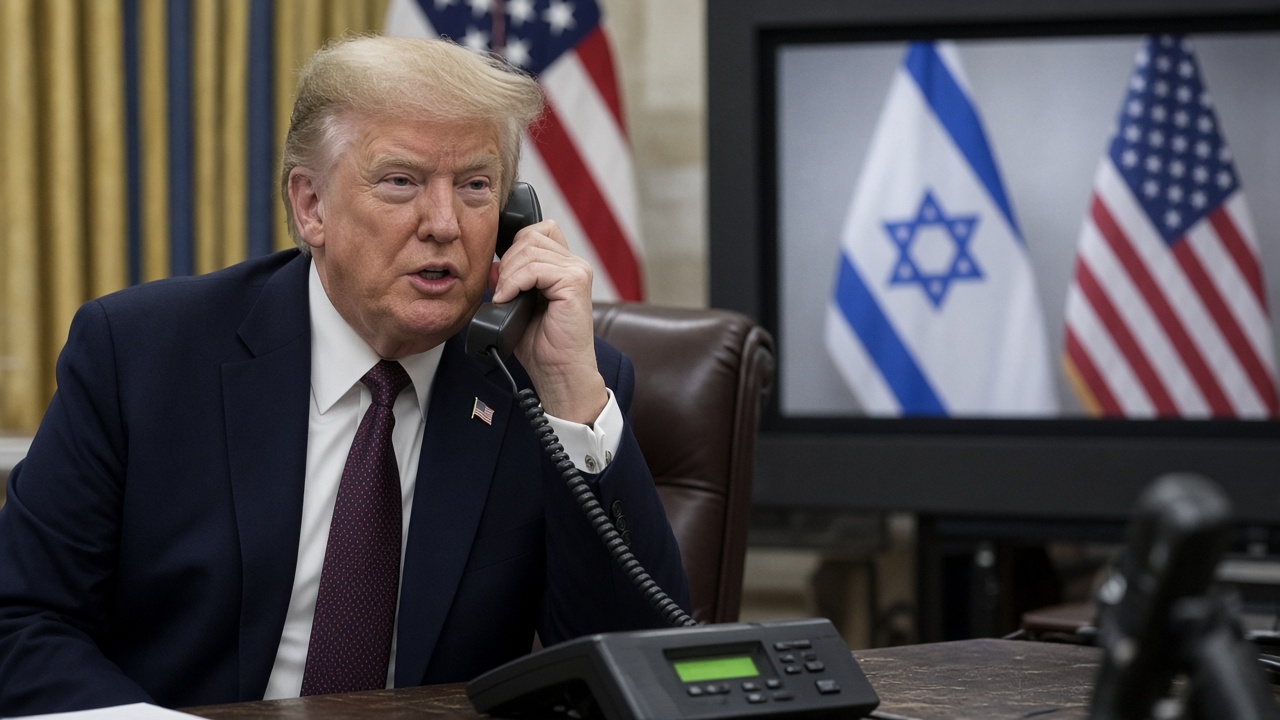
President Donald Trump said Tuesday that the United States will stop sending cash military aid to Israel after the end of this year, describing a deal he said he reached months ago with Prime Minister Benjamin Netanyahu to wind down roughly four billion dollars in annual support.
Trump disclosed the plan in a telephone interview with Fox & Friends as voters across the country cast midterm ballots. He said Netanyahu had raised the idea first, arguing that Israel had become wealthy enough that continuing the transfers had become a political liability for Washington as well as for Jerusalem.
What Trump said on the call
Trump told the program that he and Netanyahu agreed to halt the payments even though Israel remains a close ally. “We made a deal months ago that we’re stopping,” he said, adding that the money would be “cut off at the end of the year.” He said the United States would still help Israel if it faced a genuine emergency and that Israel could purchase weapons from American suppliers with its own funds.
The president tied the announcement to domestic criticism of U.S. support for Israel, citing Michigan Senate candidate Abdul El-Sayed as an example of opponents who use aid levels as a campaign weapon. Trump said Netanyahu understood that dynamic and preferred to remove the talking point. Netanyahu’s office declined to comment to several outlets Tuesday, and the Israeli foreign ministry had not confirmed the arrangement by early afternoon Eastern time.
Which dollars are in play
Trump did not specify which accounts or programs he meant. Analysts immediately pointed to the ten-year memorandum of understanding signed in 2016 that provides Israel about 3.8 billion dollars a year in foreign military financing and missile-defense grants. That pact runs through fiscal year 2028 and is implemented through annual congressional appropriations, not a single presidential switch.
Congress has already appropriated military assistance for Israel through September 2027, according to budget specialists who track the pipeline. A memorandum of understanding expresses executive intent, but lawmakers must still vote the money each year. That means Trump cannot simply zero out the transfers by decree without either withholding congressionally approved funds—a step that triggers legal and political fights—or persuading Congress to change future bills.
What would not necessarily stop
Even a phaseout of grant aid would not sever every financial link. Israel holds billions of dollars in U.S. loan guarantees, buys hardware through foreign military sales, and participates in joint research programs. The House-passed fiscal 2027 National Defense Authorization Act includes a section deepening U.S.-Israeli cooperation on counter-drone systems, artificial intelligence, and missile defense, a separate track from the foreign military financing line Trump referenced.
Since the October 2023 Hamas attack, supplemental packages have pushed total U.S. security spending for Israel well above the baseline memorandum figure. Think tanks that monitor arms transfers estimate that emergency tranches added tens of billions of dollars beyond the steady 3.8 billion annual grant.
Reaction and timing
White House spokespeople did not immediately release written guidance clarifying whether Trump meant calendar year 2026 or fiscal year 2026, which ends later. PolitiFact and other fact-checking outlets noted the gap between Trump’s “end of this year” language and the memorandum’s 2028 expiration.
Former homeland security officials said a hard cutoff by December 31 was unlikely because several long-lead weapons programs cannot be restructured in weeks. Thomas Warrick, who directs the Future of Department of Homeland Security Project at the Atlantic Council, told Al Jazeera he expected any drawdown to stretch into 2027 while missile-defense and counter-drone projects shift to sales contracts.
On Capitol Hill, leaders in both parties had not scheduled immediate hearings Tuesday, but aides said any attempt to block appropriated funds would surface quickly once the new Congress convenes in January. For now, the headline is declarative; the mechanics remain contested.