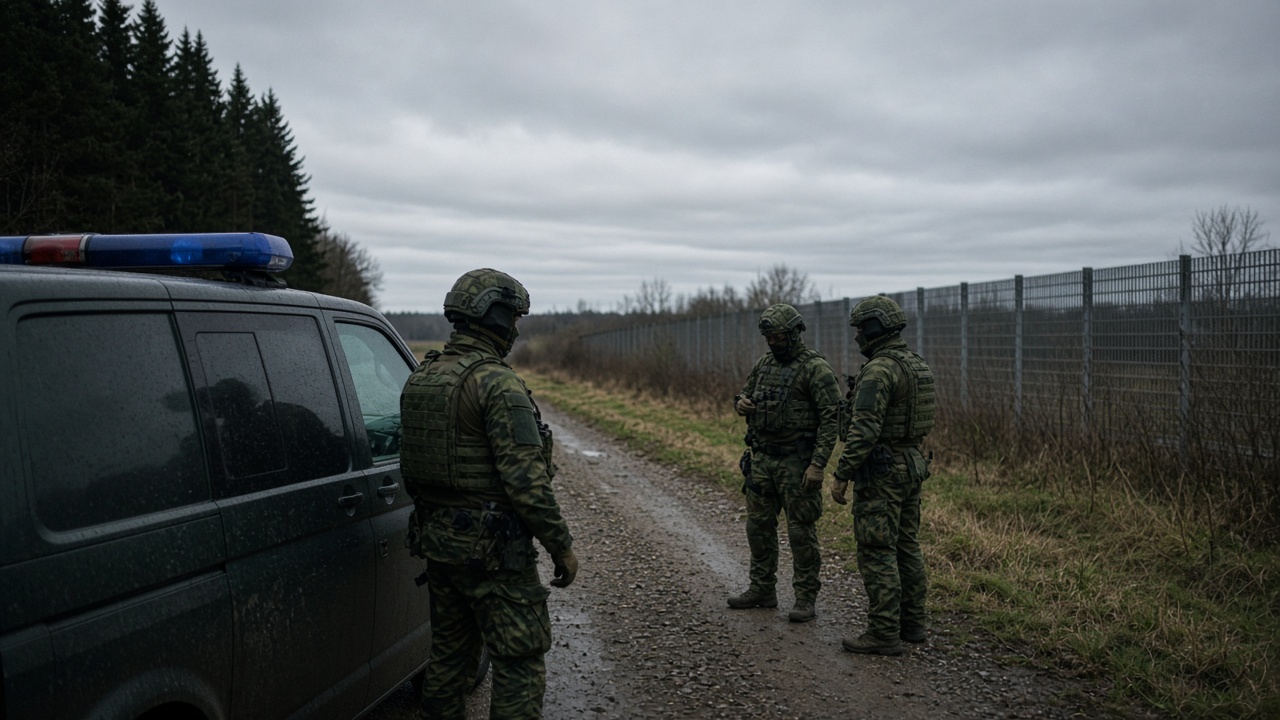
Poland deployed counterterrorism police and additional border units to northeastern provinces facing Russia’s Kaliningrad exclave on Monday after intelligence services warned that sabotage or armed incursions could follow in the coming days, national police chief Marek Boroń told broadcasters including RMF FM and TVP World.
What triggered the mobilization
Boroń said a “large group” of officers, including personnel transferred from other voivodeships, is securing the Warmian-Masurian and Podlaskie regions alongside the military, border guard and domestic intelligence. A coordination centre at National Police Headquarters is running the operation, which Polish media reported began after the Military Intelligence Service and allied agencies passed warnings late last week.
According to security sources cited by RMF FM and Notes From Poland, the alerts raised the possibility of border violations by armed groups as well as classic sabotage against infrastructure. Police spokeswoman Katarzyna Nowak told TVN that operational details remain classified, but headquarters linked the deployment to hybrid threats attributed to Russian and Belarusian services that have targeted Poland with arson, rail interference and airspace incursions in recent years.
Kyiv Independent and Anadolu Agency recaps noted that Poland’s deputy police commander had ordered provincial commanders to full readiness from 2–8 November before the Kaliningrad-focused units moved. That order fed speculation on Polish social media, but the national force issued a written denial tying the alert level to external sabotage chatter rather than domestic court protests.
How Warsaw is separating crises
The timing overlaps with domestic tension around Poland’s Constitutional Tribunal, where riot police secured the court last week amid protests over a government-backed judges’ bloc. Boroń and the national police press office denied that a separate readiness order covering 2–8 November was about Warsaw street politics, insisting it responded to external sabotage warnings instead.
Kaliningrad sits on the Baltic Sea between Poland and Lithuania, both NATO members, and sits near the Suwałki Gap land corridor that connects the Baltic states to the rest of the alliance. An Anadolu Agency recap noted that Lithuania also reinforced its Kaliningrad frontier in October, citing concerns about hostile foreign activity.
Notes From Poland traced a series of prior provocations Warsaw has publicized, including a Russian helicopter that crossed from Kaliningrad into Polish airspace for roughly 42 seconds in September and a Kh-101 cruise missile fragment that landed in eastern Poland in July after traversing Ukrainian airspace. Each incident fed parliamentary debate over whether NATO’s eastern flank needs permanent garrison increases beyond the brigades already slated for 2026.
What happens next
Polish officials have not disclosed whether any cross-border incident materialized on Monday or Tuesday. Boroń said the priority is protecting residents and facilities in border districts while intelligence continues to assess whether the warnings reflect an imminent operation or broader Russian pressure during NATO’s eastern flank buildup.
Western capitals have repeatedly cautioned that Moscow may escalate hybrid attacks while conventional fighting continues in Ukraine. For Poland, Monday’s deployment is less a declaration of martial law than a visible signal that Warsaw treats sabotage chatter from Kaliningrad as a live operational file—not a drill on paper.
Retailers and rail operators in Podlaskie told local outlets they received no public evacuation guidance, suggesting authorities aim to keep daily commerce moving while covert teams watch for anomalies along freight lines that feed the Suwałki corridor. If the intelligence warning expires without incident, Poland still faces the longer task of hardening refrigeration, power substations and border sensors against repeat attacks modeled on the supermarket freezer intrusions that hit France and Belgium earlier this autumn.