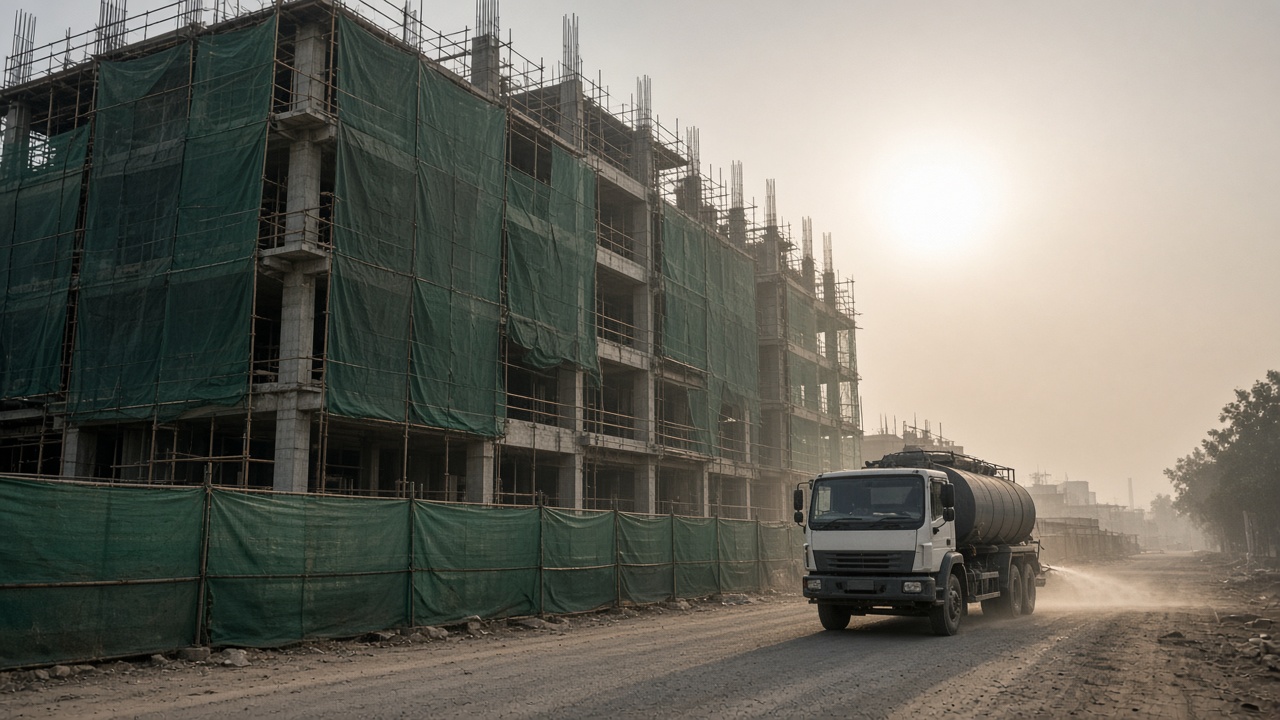
The Commission for Air Quality Management left Stage II of the Graded Response Action Plan active across Delhi-NCR Tuesday as the Central Pollution Control Board’s 24-hour average for Delhi sat in the very poor band, triggering intensified construction dust enforcement and mechanised road cleaning in NCR towns while stopping short of the Stage III construction halt that CAQM invoked only after readings later crossed into severe territory.
What Stage II requires
CAQM’s October order invoking Stage II, still in force alongside Stage I poor-air actions, directs urban local bodies in Delhi, Gurugram, Faridabad, Ghaziabad and Gautam Buddh Nagar to run daily mechanical sweeping and water sprinkling on heavy corridors, deploy dust suppressants before peak traffic, and intensify inspections for dust control at construction and demolition sites without yet imposing the blanket C&D shutdown that Stage III lists. Pollution control boards in Delhi-NCR must coordinate hotspot remediation when monitors flag sustained PM2.5 spikes.
Press Information Bureau releases summarising sub-committee meetings noted that higher stages remain available if IMD and IITM forecasts show AQI sustaining above thresholds; early November readings in the high 300s kept agencies on Stage II rails even as politicians debated whether staggered office hours should arrive before severe air.
Construction limits on the ground
Indian Express reporting from NCR sites described teams issuing notices where barricades, sprinkler schedules or green netting failed compliance, while allowing less dust-intensive interior works to continue under Stage II—a narrower leash than the Stage III list that later barred earthwork, batching plants and open-trench utilities except on exempt public projects. Developers in Gurugram and Noida told InfoHandle that inspection frequency doubled even when cranes still turned on permitted pours, because commissioners treat non-compliance closures as easier levers than economy-wide halts.
Traffic police identified congestion corridors for municipal sweeping shifts; parking fee increases under Stage II aimed to trim private car trips while metro and CNG bus fleets added peak-frequency runs. Coal and firewood bans in open eateries and restrictions on diesel generator sets except for emergency services rounded out the very-poor package citizens saw before Diwali residue burning layered on top.
Why Stage III waited
When Delhi’s rolling average later approached 400, CAQM invoked Stage III’s nine-point plan, including the construction categories PIB bulletins enumerated for severe air. Revocation came only after sustained improvement toward the high 300s, with Stage I and II actions remaining mandatory under the modified November schedule. Sites closed for violations could not reopen without commission approval—a rule inspectors cited during Stage II sweeps to pressure compliance before severe thresholds arrived.
What NCR towns report
Ghaziabad and Faridabad corporations posted nightly sprinkling logs; Gautam Buddh Nagar directed real-estate projects to register dust-control nodal officers reachable within two hours of complaints. DPCC teams paired with Delhi municipal engineers at Anand Vihar and Dwarka hotspots where truck ingress raised PM counts. None of that eliminates farm-fire plumes or calm-wind traps, but it explains why construction crews felt Stage II as inspection heat long before headline bans.
What is still unknown
CAQM has not published a consolidated compliance scorecard by municipality for Stage II inspections, leaving residents to judge enforcement through anecdotal site closures. IITM forecast accuracy for multi-day very poor spells will determine whether Stage III toggles become less disruptive under the revised GRAP timetable PIB described late November.
Until then, NCR construction faces a split regime: Stage II limits train dust at active sites; Stage III later threatened to halt entire categories. Early November sat in the uncomfortable middle—air bad enough to sweep roads twice, not yet severe enough for the full C&D stop press releases remember.