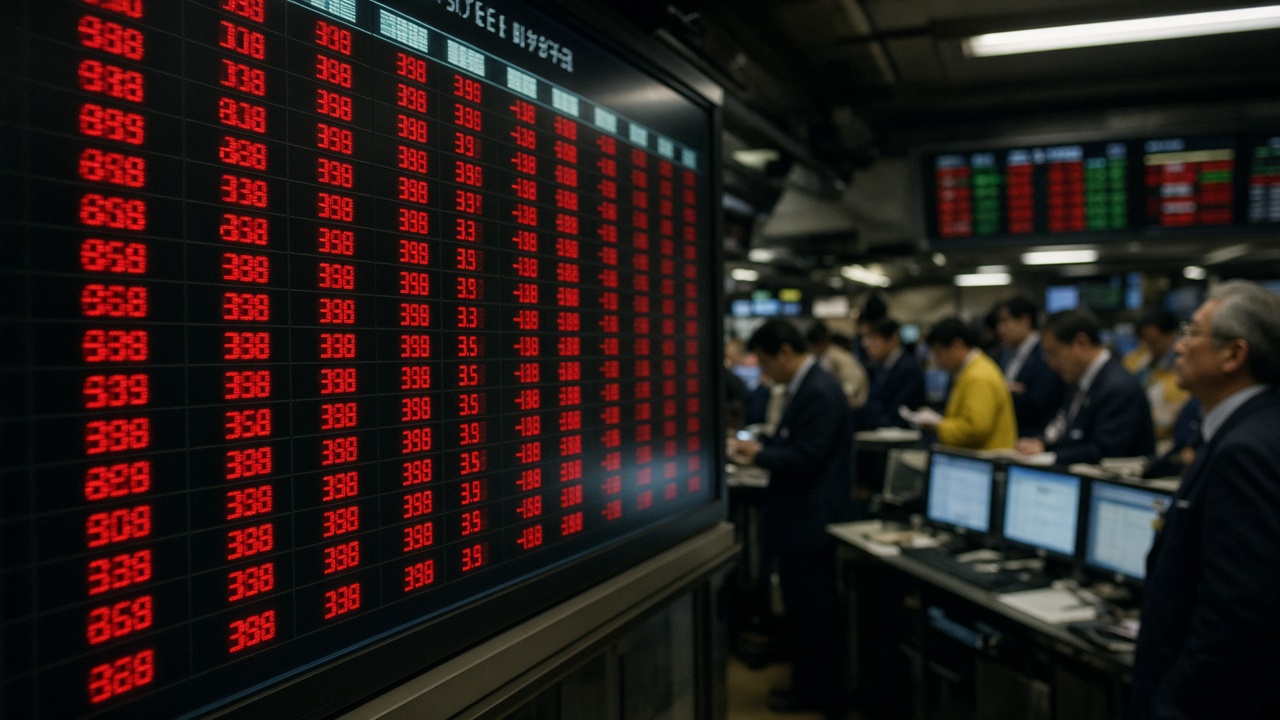
TOKYO — Japanese equities opened sharply lower Wednesday after a public holiday, with the Nikkei 225 dropping 3.56 percent to 60,835.36 by midday as investors reacted to early U.S. midterm returns and renewed questions about artificial-intelligence spending.
The broader Topix index fell 2.49 percent to 3,832.27. Dealers said the Nikkei’s first close below 61,000 in about three months reflected a risk-off move concentrated in semiconductor equipment, memory makers and the conglomerates most exposed to the global AI trade rather than a wholesale exit from Japanese shares.
Who led the losses
Memory chip maker Kioxia Holdings slumped about 10 percent, among the steepest moves on the board. SoftBank Group, which has large technology investments, lost roughly 7 percent. Chip-testing equipment maker Advantest fell 6.4 percent and Tokyo Electron dropped about 5 percent, according to market data cited by Reuters and Kyodo News.
Suppliers tied to data-centre cabling also sold off: Fujikura and Furukawa Electric were down about 8 percent and 9 percent respectively in morning trade. Of the 225 Nikkei components, 130 declined and 95 rose, a breadth pattern dealers described as a targeted rotation out of AI proxies.
What traders said they were watching in Washington
Reports during Japan’s Tuesday holiday suggested Democrats could regain the U.S. House of Representatives and remain competitive for the Senate as ballots were counted. Portfolio managers in Tokyo told Reuters that outcome fed concern that a Democratic-led Congress could tighten regulation of AI infrastructure and data-centre construction, slowing the capex cycle that has lifted Japanese chip names this year.
The link is indirect but familiar on the TSE: U.S. policy shifts on tech regulation and fiscal spending often move Nasdaq futures overnight, and Japan’s heaviest AI weights follow that cue. Nasdaq 100 futures were softer as Tokyo traded, and the dollar weakened to the upper 157-yen range as the yen strengthened alongside the equity slide.
Earnings and holidays added friction
Markets were closed Tuesday for a Japanese national holiday, so Wednesday’s session was the first chance to price both the midterm stream and a bruising U.S. technology earnings week. The Philadelphia semiconductor index had already fallen sharply before the break, and reports that major U.S. technology firms were seeking additional funding revived debate about whether AI capital expenditure can keep outpacing profits.
No chamber had been formally called by midday Tokyo time, and prediction markets — where billions of dollars have been wagered on congressional control — can move faster than official counts. Traders cautioned that a reversal in late U.S. tallies could unwind part of the morning move before Tokyo’s close.
What would change the tape
Analysts said confirmation of a split Congress rather than a Democratic sweep could stabilise AI names if investors conclude gridlock would slow regulatory change. Conversely, a clearer-than-expected Republican hold might revive the AI rally but would also reprice yen and defence-linked exporters tied to Trump-era fiscal plans.
For now, the story on the floor is price action: Kioxia and SoftBank leading a 2,246-point Nikkei drop tied to Washington’s first midterm signals, with Tokyo traders treating U.S. AI policy as a near-term risk factor alongside earnings and funding costs.