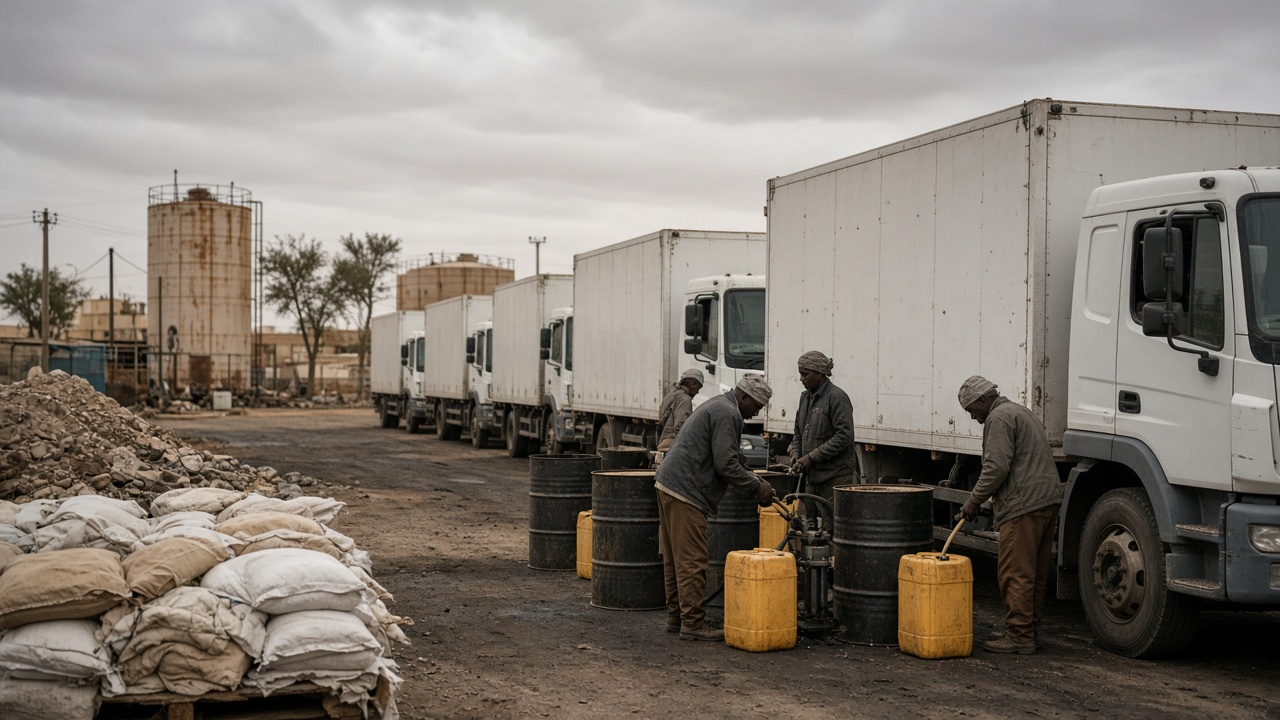
Hundreds of United Nations relief trucks are stuck in Sudan because there is no fuel to move them, Denise Brown, the UN resident and humanitarian coordinator, told UN News on Monday, as an intensifying wave of drone strikes disables power stations and leaves clinics without electricity.
Strikes hit energy, then everything else
Brown described two weeks of drone attacks that appear to target civilian energy infrastructure, a pattern she said likely violates international humanitarian law. World Health Organization staff visiting a hospital just outside Khartoum watched the lights go out during a strike; the facility had no generator or solar backup, so treatment for 25 dialysis patients stopped immediately, she said.
Similar disruptions hit maternity wards and operating theaters, while long fuel queues in the capital stretch for kilometers. Tuk-tuk drivers who depend on daily wages told aid workers they were waiting several days in a row for gasoline, losing income each time, Brown said. Markets and displacement sites have also been struck, widening the civilian toll beyond the grid itself.
The Soufan Center noted in a Nov. 4 brief that strikes on Sudan’s power network have left the national grid near collapse, with consequences for water pumping and cold storage of vaccines far from the front lines.
A fleet that cannot roll
The UN maintains a large supply chain for food, nutrition products and shelter, but Brown said the immediate bottleneck is diesel. Without it, convoys cannot reach people displaced by fighting or by recent rainfall deficits in Darfur and Kordofan, where farmers are already moving in search of food.
World Food Programme officials told her that seven convoys have been hit this year alone, destroying both lives and rations meant for the hungriest populations. Visa and permit bottlenecks have eased, Brown added, yet those gains mean little if tankers never arrive. She said she recently visited a camp in Blue Nile where residents asked for food and she could only ask them to wait.
Pressure inside and outside Sudan
Secretary-General António Guterres condemned the drone campaign in a statement over the weekend, calling on the Sudanese Armed Forces and Rapid Support Forces to protect civilians and agree to a cessation of hostilities as a first step toward peace. UN special envoy Pekka Haavisto, meanwhile, told The National that Quintet mediators expect talks with Rapid Support Forces-aligned political groups before Christmas, even as SAF commander Abdel Fattah al-Burhan continues to reject ceasefire proposals.
Brown said her message to donors is blunt: funding cuts are already forcing the World Food Programme to shrink rations and beneficiary lists. “This is not about politics,” she said. “This is about people.” For now, the people waiting on those stranded trucks have no timetable for when the engines start again.
Haavisto said Quintet envoys still hope to meet Rapid Support Forces-aligned politicians in Addis Ababa before year-end, but neither army has publicly accepted a pause in fighting while those talks are arranged.