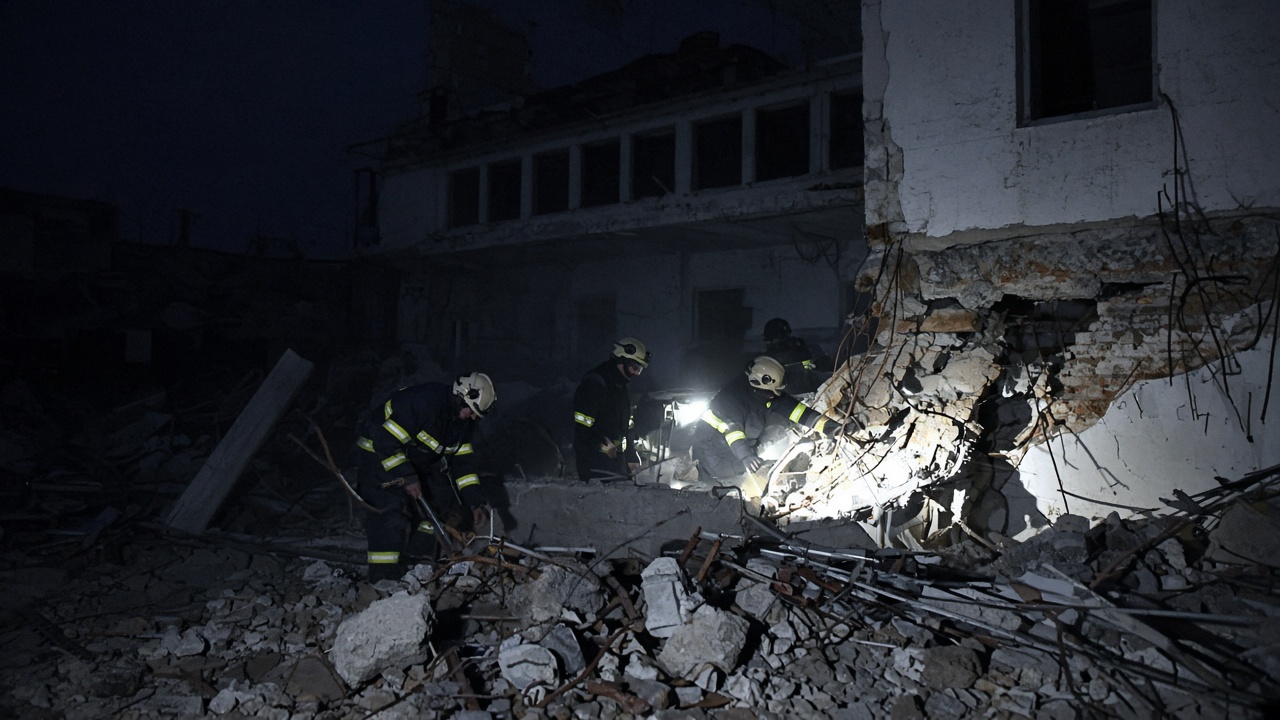
Rescue crews in southeastern Ukraine were still cutting through collapsed concrete on Wednesday after Russian glide bombs hit a former school building that local authorities had turned into a weekly aid hub, killing at least 33 people and leaving more than 50 unaccounted for under the rubble, President Volodymyr Zelenskyy said.
The strike in Komyshuvakha, a front-line village in Zaporizhzhia region, landed as diplomats from Ukraine, the United States and European capitals gathered in Brussels to discuss reconstruction and security guarantees ahead of U.S.-mediated talks in Abu Dhabi next week. Zelenskyy described the attack as one of the largest mass killings of the war and linked it directly to the expiry of a six-day humanitarian pause near Oleshky in neighboring Kherson region.
Double tap on a publicized distribution
Regional officials said nine heavy aerial bombs struck on Monday as residents arrived for a scheduled distribution at the site, which Ukraine said had not held classes for months. Zelenskyy said the first wave hit as people were gathering, followed by a second strike on the shelter beneath the building—a reinforced basement funded with European support that was meant to keep pupils safe during earlier bombardments.
Five people were pulled alive from the debris, he said, while search teams—including units that had lost colleagues in the same attack—continued to work in dangerous conditions. Zaporizhzhia Governor Mykhailo Semikin said the scale of the destruction made it difficult to establish a final toll. Local media reported that the roof collapsed onto people who had rushed underground when the first bombs fell.
Ukraine's national police said four community officers and two rescue workers were among the dead, killed while guiding civilians toward the shelter or responding to the initial blast. The pattern matched what Ukrainian and Western officials have long called a "double tap," in which a second strike targets first responders.
Claims, law and the timing of the truce
Russia's defense ministry said the strike targeted Ukrainian military units and that 25 servicemen were killed. Independent reporting from the scene has not substantiated a military use of the building, and the United Nations human rights monitoring mission in Ukraine said the timing and location of the aid distribution had been well publicized.
"Either the Russian armed forces knew that there was a humanitarian distribution taking place, or they failed to take the most basic steps to find out what was happening in this village," mission head Danielle Bell said in a statement. "In either case, this attack seems to have violated the most fundamental principles of international humanitarian law."
Zelenskyy said Ukraine had offered to extend the Oleshky-area ceasefire that allowed evacuations and aid deliveries, and portrayed the Komyshuvakha bombing as Moscow's answer. The assault came amid a broader Russian campaign on Tuesday against energy infrastructure that knocked out power across large parts of the country, compounding winter pressure on civilians far from the front.
What happens next
With more than 50 people still feared trapped, Ukrainian emergency services were racing against limited daylight and continued air alerts in Zaporizhzhia. Zelenskyy, speaking after meetings with Chancellor Friedrich Merz in Berlin, said the attack underscored why Kyiv is pressing for European participation in any settlement talks, even as Washington prepares a separate three-way meeting with Russia in the United Arab Emirates.
Ukrainian negotiator Rustem Umerov said teams in Brussels would continue work on the Prosperity Plan for postwar recovery while a dedicated session on security guarantees was set for Thursday. None of that diplomacy has slowed the tempo of strikes on the ground, and aid workers warned that highly visible distribution sites near the front remain exposed whenever local truces expire without broader de-escalation.