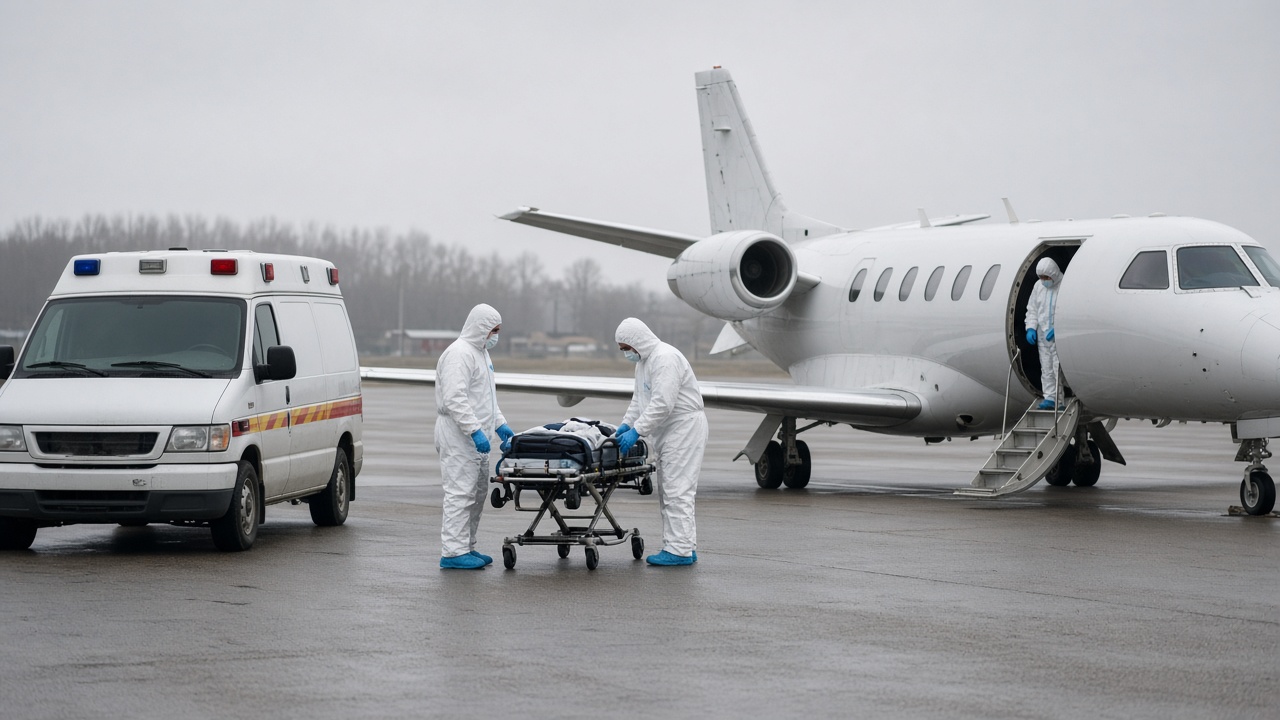
A British healthcare worker who tested positive for Ebola while supporting the outbreak response in the Democratic Republic of Congo is being flown to the United Kingdom for specialist treatment, the government confirmed Wednesday as medics prepared high-consequence isolation beds.
Officials said the patient—sent to Congo by a humanitarian organization and not publicly identified—is in stable condition and would travel on a dedicated medical evacuation before transfer in a specialist ambulance to one of the NHS units equipped for viral hemorrhagic fevers.
How the UK will treat the case
Reporting citing an internal government document indicated arrival on Wednesday or Thursday, with care delivered at a “high consequence infectious disease” centre. Sky News reported that only two NHS sites routinely handle such cases: the Royal Free Hospital in London and the Royal Victoria Infirmary in Newcastle.
A UK government spokesperson said established protocols were already activated. “The UK has well-established procedures for dealing with cases like this, and those processes have been activated,” the statement read. “The risk to the UK public from Ebola remains low.”
Reuters, which saw the planning document, quoted authorities as saying they did not expect serious public-health impact in Britain and anticipated no disruption to international travel or trade. The World Health Organization said it has supported several medical evacuations at the request of partners and governments.
Outbreak scale—and why workers face danger
The Congo epidemic is the second-largest on record, with more than 10,000 confirmed cases and nearly 5,000 deaths reported by late October. It is the first infection involving a British national in this outbreak, though several other Europeans have fallen ill while working in the region.
Dr. Damien Tully, associate professor at the Medical Research Council and London School of Hygiene and Tropical Medicine Uganda Research Unit, told broadcasters the news was “deeply concerning, but it is not entirely unexpected,” noting that front-line clinicians treat severely ill patients even with rigorous protective gear.
Ebola spreads through direct contact with infected bodily fluids; it is fatal in about half of cases on average, though mortality varies by outbreak. Imported cases remain rare in the UK: UK Health Security Agency figures cite only four confirmed infections since 1976, including three health workers who contracted the virus while responding to the West Africa epidemic between 2014 and 2015. None of those imported cases resulted in a death on British soil.
What happens after landing
Health teams will route the patient through pre-agreed transport corridors to limit exposure, mirroring plans used in previous evacuations. Ministers have not named the receiving hospital ahead of the flight, a standard practice to protect patient privacy and avoid crowds near isolation entrances.
Officials promised further information “in due course as appropriate,” signaling that clinical updates may lag behind the aircraft’s arrival. For now, the public-health message is unchanged: the evacuation reflects duty of care to a citizen and worker, not a widening domestic outbreak—and the NHS units receiving the flight have trained for exactly this scenario for more than a decade.