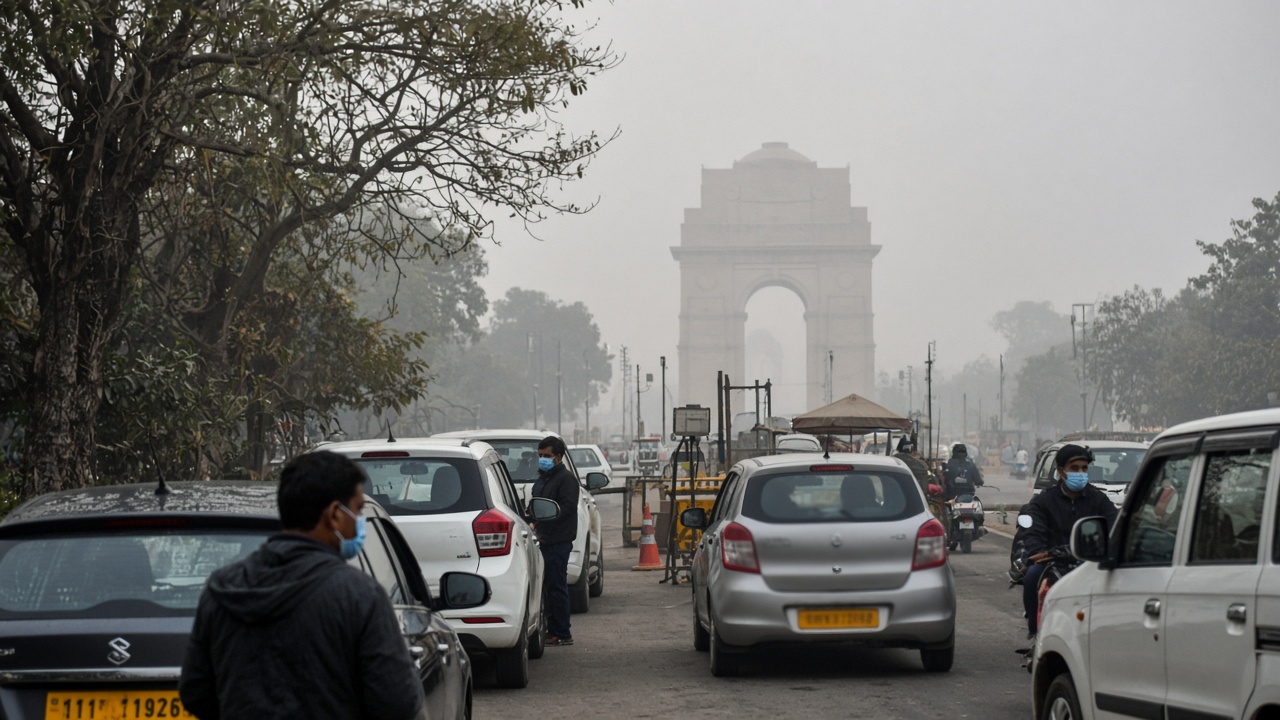
Delhi’s air quality index touched 482 at 8:01 a.m. Thursday, keeping the capital in the severe band as the Commission for Air Quality Management enforced Stage II curbs under the Graded Response Action Plan. Central Pollution Control Board data showed seven stations above 400, led by Punjabi Bagh at 446, while India Gate and Okhla Phase-2 remained in the upper very poor range despite government claims that stubble-burning incidents in neighbouring states have fallen compared with last year.
Where the plume is worst
Monitoring posts in Narela, Rohini, RK Puram, Bawana, North Campus and Patparganj all registered severe readings, according to CPCB’s public dashboard. Meteorologists said light winds and dropping overnight temperatures trapped particulates close to the surface, a pattern familiar each November but sharper this week because festival-season traffic and construction dust have returned before crop-residue controls fully bite.
Union Environment Minister Bhupender Yadav told reporters Tuesday that the CAQM is tracking wind speed and direction hourly. He reiterated that roughly 40 percent of paddy stubble in Punjab, Haryana and Uttar Pradesh has moved through ex-situ management this season, yet conceded that weather still dominates short-term spikes.
GRAP Stage II in practice
Stage II triggers diesel generator bans in Delhi and surrounding industrial clusters, intensified mechanical sweeping, and restrictions on heavy vehicles entering the capital unless they carry essential goods. Delhi Police conducted checks at the Ghazipur border before dawn Thursday, stopping trucks without valid permits, according to ANI footage circulated on news wires.
The Delhi government has not yet escalated to Stage III, which would suspend construction and introduce odd-even road rationing, but officials said they will review hourly AQI trends through the Diwali week when green-cracker sales resumed in Sadar Bazar after a court limited the ban to three days.
Hospital corridors fill
Dr Saurabh Mittal, a pulmonologist at All India Institute of Medical Sciences, told Times of India that clinics are seeing both exacerbations among chronic patients and first-time cough cases among residents who were asymptomatic earlier in the season. Inhaler doses are being stepped up, he said, and some patients now require short courses of oral steroids.
Parents in east Delhi reported keeping primary-school children indoors even where classes remain open, while delivery workers said smog masks sold out at several metro-station kiosks. CAQM officials promised another review Friday; until winds strengthen, physicians warn the severe band could persist through the long holiday weekend.
Regional coordination
Haryana and Uttar Pradesh pollution boards said they activated additional fire counts in paddy belts after satellite hotspots rose Sunday, though officials in Chandigarh cautioned that calm winds can overwhelm field-level gains within hours. The Supreme Court’s ongoing monitoring of crop-burning penalties means state chief secretaries must file compliance affidavits next week; Delhi’s environment department said it will cite Thursday’s readings if neighbouring states miss targets.