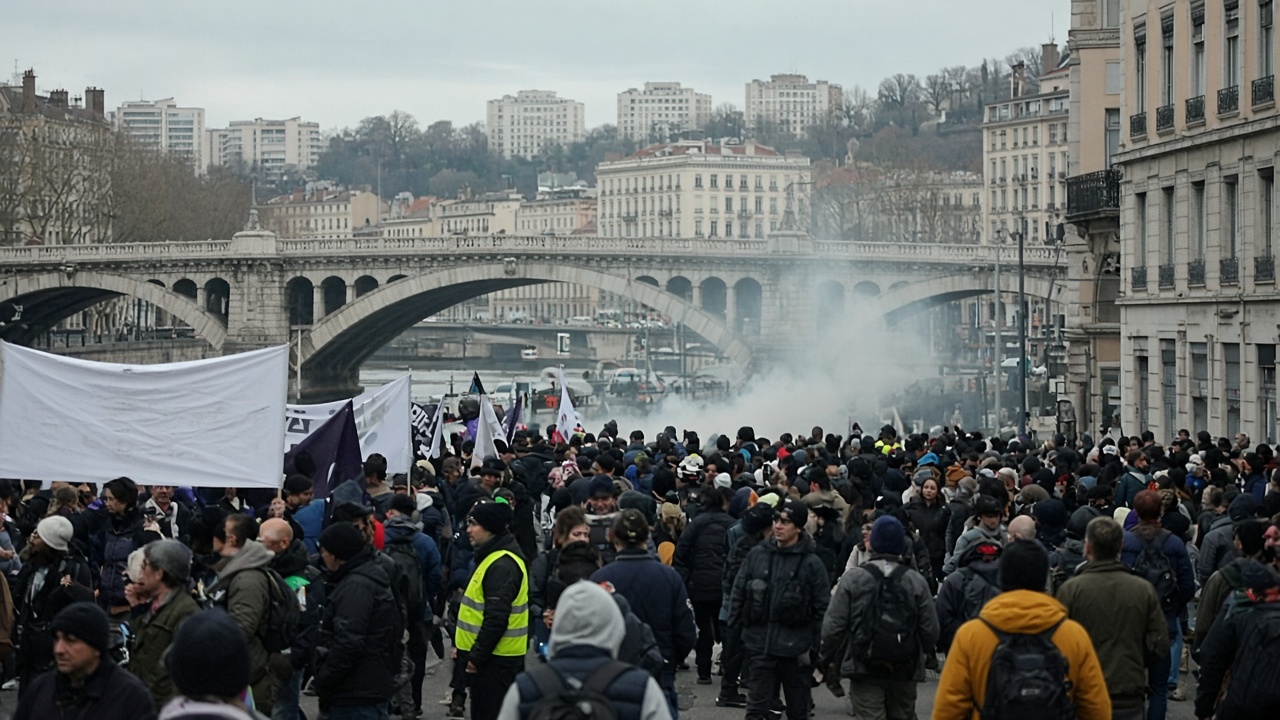
Tens of thousands of workers marched through Lyon on Thursday as France staged another nationwide strike over wages and the cost of living, turning the capital of the Auvergne-Rhône-Alpes region into the day’s most volatile flashpoint after authorised routes collapsed into tear-gas skirmishes. For British readers tracking Eurostar delays, school-trip cancellations and cross-Channel freight, Lyon’s unrest is a reminder that French labour battles still spill quickly into transport grids six months before Paris faces its own election calendar.
Numbers on the street
Authorities counted roughly thirty thousand five hundred demonstrators in Lyon, while the CGT union put the crowd closer to fifty-five thousand. Protesters set out from the Manufacture des Tabacs on a route imposed by the prefecture after courts rejected union appeals against bans across much of central Lyon. Banners mixed wage demands with solidarity flags as the column moved toward Place Jean-Macé, with every metro and funicular line suspended for the day.
Where it broke down
Tensions peaked near Pont Gallieni, where police said about five hundred black-clad demonstrators threw projectiles and fireworks. Riot officers charged the group and used tear gas; AFP photographers captured at least one burning car on the sidelines. The Rhône prefecture later reported forty injured—thirty-four police and six protesters—plus twenty-four arrests for mortar fire, projectile throws and insults. Five shops were damaged, and prefect Étienne Guyot condemned violence he said had blocked union leaders from marching safely at the head of the column.
A national pattern
Lyon was not alone. The interior ministry said more than two hundred seventy thousand people had demonstrated nationwide by mid-afternoon, with unions planning roughly two hundred fifty rallies. Paris closed the Eiffel Tower; NBC News reported clashes in several cities and a fire at a Toulouse school after fireworks. The day built on weeks of high-school protests and autumn strike dates as the Macron government tries to repair public finances ahead of 2027 elections.
Winegrower Martin Thiberge told AFP he joined the Lyon column because “we want to make a living from our work, to make a dignified wage”—a line that captures why unions keep calling days of action even after summer budget fights. High-school students, whose own protests have fed into the autumn calendar, marched in several cities under interior ministry scrutiny after fireworks damaged school property overnight.
Actu Lyon reported that prefecture bans on the Presqu’île remained in force until 8 p.m., forcing union stewards to corral spontaneous splinter marches that tried to reach forbidden squares. British schools with Lyon exchanges said they were reviewing Friday travel plans as SNCF warned of continued Rhône valley delays.
Downing Street and British hauliers will watch whether Thursday’s damage triggers another overnight ban on gatherings in Lyon’s Presqu’île district, and whether weekend Channel crossings see knock-on cancellations. For now the headline from France’s second city is familiar: a legitimate wage march, a hardened security perimeter, and a minority willing to torch vehicles to test how far the state will bend.