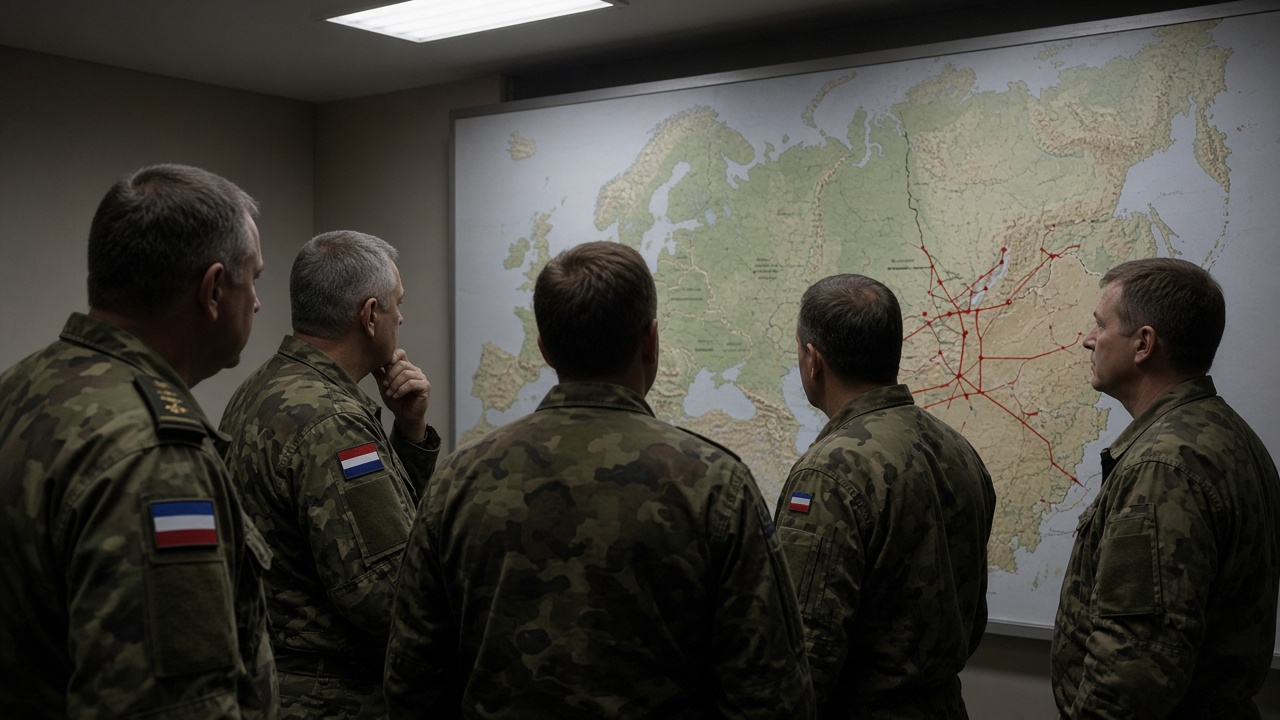
NATO military planners are sketching a response to a Russian attack on alliance territory that would not stop at the border. Under emerging defense concepts, allied forces would first blunt an opening assault, then use precision missiles and massed drones to strike Russian bases, supply hubs, and defense-industrial sites hundreds of kilometers inside Russia, according to reporting this week that cited alliance officials and a recent Wall Street Journal account.
The approach marks a break from decades of European planning focused on blocking tanks at the frontier. Supreme Allied Commander Europe Gen. Alexus Grynkewich has framed the shift as a “theory of victory” learned from Russia’s full-scale war in Ukraine: stopping an invasion requires breaking the logistics and factories that feed it, not merely slowing the first columns.
What the plans envision
Officials described a phased sequence. NATO would aim to halt the initial wave of an attack, then degrade follow-on forces by striking both front-line units and the networks that supply, command, and repair them. Potential targets extend beyond airfields and garrisons to depots, critical infrastructure, and raw-material sites that support Moscow’s war machine, with ranges cited from roughly 150 kilometers to thousands of kilometers behind the front.
The doctrine is explicitly conventional. Published summaries of the planning do not envision nuclear escalation, and NATO held its first dedicated deep-strike symposium in June to stress-test the ideas through discussions and wargames.
Weaponry at the center of the concept mixes high-end systems already in allied inventories—Tomahawk cruise missiles and Army Tactical Missile System rounds—with cheaper, scalable drones meant to overwhelm defenses. Grynkewich told an audience in Warsaw in October that allies would “layer high-end and highly effective precision munitions with an overpowering mass of affordable and scalable systems.”
Deterrence—and a political gap
Polish Maj. Gen. Ireneusz Nowak, quoted in allied media, argued that credible deterrence requires the ability to hit Russia’s defense-industrial base. “We need to treat deep precision strike as deterrence,” he said, adding that early deep strikes might have prevented the static trench warfare that defined much of Ukraine’s fight.
Analysts caution that operational slides do not equal political consent. Nico Lange, a former senior German defense official, told the Journal that a gap remains between military plans that include offensive action to defend Europe and political instincts that equate defense with barriers or a “drone wall” at the border. The open question is whether national leaders would authorize strikes deep on Russian soil in the opening hours of a crisis.
Britain and Germany are also pursuing flagship deep-strike programs with ranges above 2,000 kilometers, but internal timelines suggest those systems may not be ready until the 2032–2035 window—raising pressure to bridge the gap with existing stockpiles and interim purchases.
What changes next
For now, the reporting describes planning and messaging, not a deployed posture change. NATO spokespeople have not published a formal strategy document matching the Journal’s description, and any shift in rules of engagement would require consensus among 32 members.
Still, the direction is clear: Ukraine’s experience is forcing NATO to treat Russian rear areas as legitimate conventional targets if Moscow crosses an alliance border. Whether European capitals would act on that map in a live war remains the unsettled variable—and the one Moscow’s strategists will test in every crisis short of open fighting.