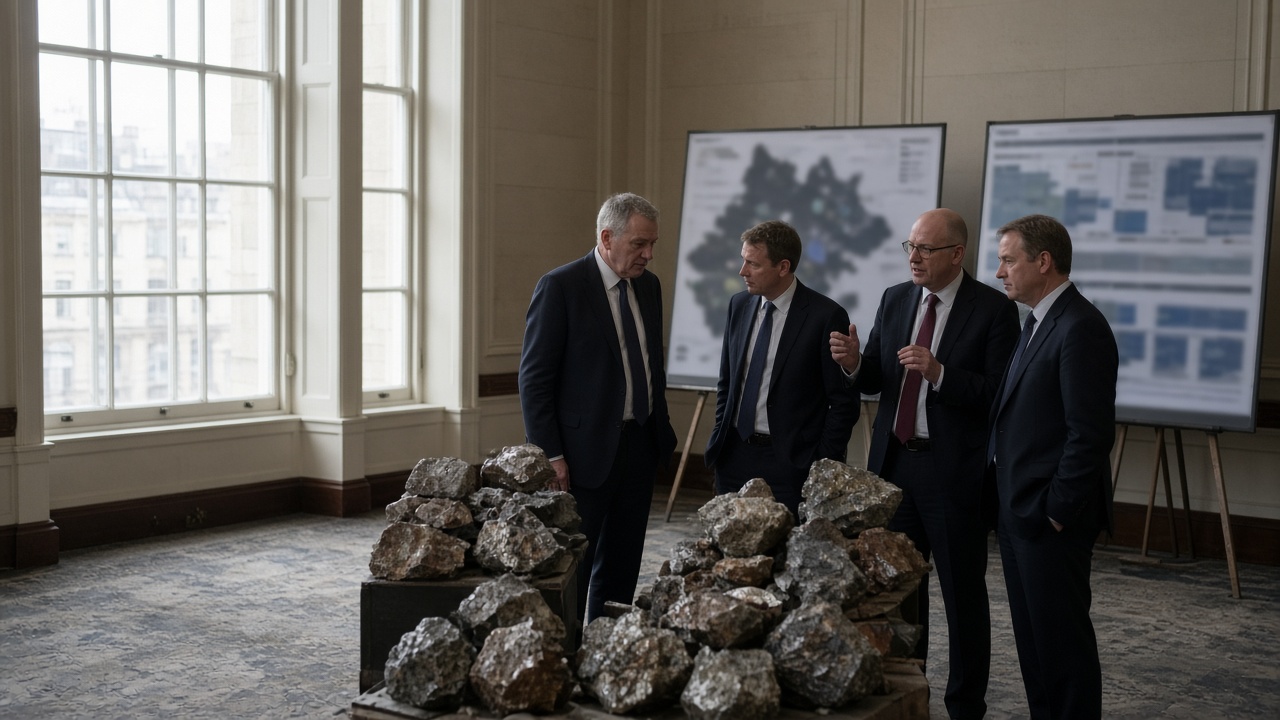
Britain is “dangerously” exposed to Chinese control of the metals and refined powders that arm jets, wire batteries, and fill server racks, according to a report published Wednesday by MPs on the Business, Innovation, Science and Trade Committee. The panel said the United Kingdom cannot re-arm, deliver net zero, or scale artificial-intelligence infrastructure unless it secures alternative supplies of copper, lithium, cobalt, rare earths, and dozens of other so-called critical minerals within the next ten to fifteen years.
What the committee found
Chair Liam Byrne told reporters that “critical minerals are the alpha of the new economy,” adding that dependence on a single refining hub is no longer a trade nuisance but a national-security choke point. The inquiry, which grew out of work by the Business and Trade Sub-Committee on Economic Security, Arms and Export Controls, concluded that China’s share of refined copper, lithium, cobalt, graphite, manganese, and rare-earth markets leaves Western manufacturers one export-control notice away from production stops.
Witnesses described the processing stage—not mining alone—as the bottleneck. Even when ore is dug outside China, much of it still travels through Chinese smelters and separation plants before reaching European factories. The Critical Minerals Association told MPs the situation was “the biggest vulnerability in the western world,” a phrase the committee quoted in its summary.
Why 2025 changed the calculus
Committee staff pointed to Beijing’s 2025 export restrictions as proof that economic coercion is already in play. Allied governments responded with subsidies, local-content rules, and buyer clubs meant to lock up future mine output for domestic industry. The report argued Britain is squeezed from both sides: vulnerable to Chinese export pressure while competing with partners that are outbidding UK projects for the same concentrates.
MPs said the government’s Vision 2035 strategy, published in November 2025, lacks the transparency Parliament needs to judge progress. They could not identify which defence platforms, grid assets, or chip fabs are most at risk, nor which early-stage mines and recyclers ministers are backing.
Ten tests and a five-part plan
The committee published ten benchmarks—covering demand forecasting, geological surveys, recycling rates, allied financing, and public reporting—and said ministers appear unable to pass any of them today. Britain still exports roughly 80 percent of its metal waste rather than reprocessing it at home, high industrial energy prices discourage domestic smelters, and outdated limits on public finance institutions block equity stakes in strategic projects, the report said.
Its proposed fix is a five-part “precision de-risking” programme: prioritize sovereign capabilities where Chinese dependence is unacceptable; merge government and industry demand forecasts; expand domestic mining, processing, and recycling; coordinate allied buyers to share the multi-billion-dollar cost of new mines; and stand up a Critical Minerals Finance Facility that can deploy grants, loans, equity, long-term offtake contracts, and price floors.
What happens next
The Department for Business and Trade did not immediately publish a line-by-line response on Wednesday, but officials have previously argued that Vision 2035 already maps priority minerals and recycling targets. Byrne said Parliament will press for quarterly disclosures listing vulnerabilities by sector and the status of finance applications. Industry groups welcomed the finance-facility idea while warning that planning delays and power prices still make UK processing sites uncompetitive against Gulf and North American rivals.
For defence contractors and AI cloud operators, the report’s message is blunt: supply-chain resilience is now as central as cyber hygiene. Without diversified refining capacity, the next diplomatic flare-up over Taiwan or Ukraine could show up first as a parts shortage on factory floors rather than as a headline about sanctions.