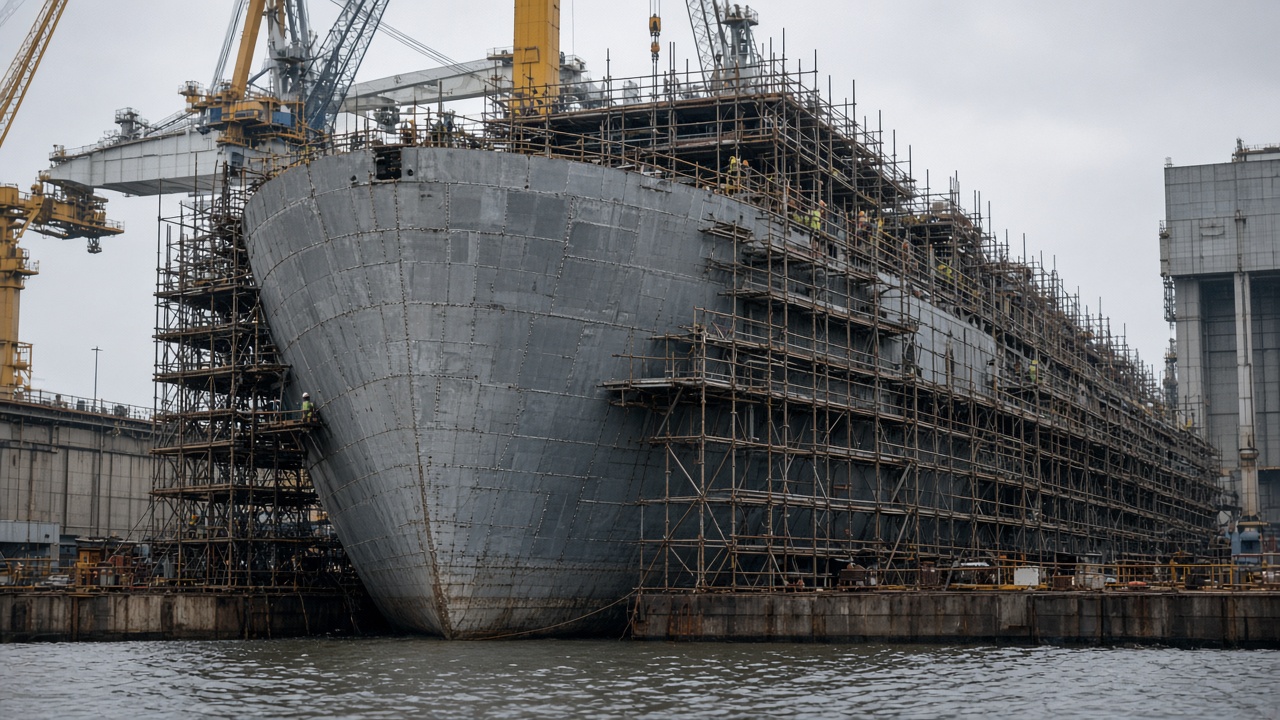
Stealth Maritime Corp. divided a $422 million four-ship tanker package on 4 November, sending two 320,000-deadweight-ton very large crude carriers to Hanwha Ocean for 356.8 billion won and two 115,000-dwt LR2 product tankers to HD Hyundai Heavy Industries for delivery in 2029 and 2030. Harry Vafias’s Athens-based group thus kept its entire 20-ship, $2.05 billion newbuilding program inside Korean yards even as Seoul equity markets sold off on U.S. midterm headlines.
How the contract split
Hanwha Ocean’s exchange filing priced the VLCC pair at roughly $267 million, about $133.5 million per hull and near 2.8 percent of the yard’s 2025 revenue in one disclosure. Industry trackers value HD Hyundai’s LR2 segment near $156 million combined, though that yard had not posted a matching notice by the Seoul close on 5 November. Splitting crude and clean-product tonnage across Hanwha and HD Hyundai reduces concentration risk for Stealth’s chartering desk when OPEC+ flows diverge from Atlantic product arbitrage.
Regulatory text listed a Bermuda-domiciled owner as counterparty, consistent with Stealth’s offshore registry pattern for long-haul crude fleets. Payment milestones were not public, but ship finance bankers said export credit discussions typically follow VLCC awards of this size within weeks.
Delivery windows
HD Hyundai targets first LR2 delivery in 2029 and the second in 2030; Hanwha Ocean must deliver both VLCCs by 30 September 2030. The stagger lets Stealth rotate ships into Middle East–Asia crude runs while keeping LR2 hulls available for European clean-product lanes that tightened after 2025 refinery outages.
Why Korean yards kept the order
Greek owners still favor Korean builders for dual-fuel ready crude tonnage even when U.S. election results whipsaw Seoul tech stocks. Korea JoongAng Daily reported that bipartisan U.S. support for naval and commercial yard capacity may accelerate eco-shipping rules without canceling existing Korea–U.S. MRO partnerships, a backdrop that helps long-dated tanker awards look insulated from one-day equity volatility.
Hanwha Ocean gains crude exposure after a year dominated by LNG and offshore wind narratives; HD Hyundai fills LR2 slots where availability is tighter than VLCC lines. Neither yard tied the contract to election commentary in public remarks.
Financing and steel risk
Stealth must line up pre-delivery financing four years ahead; Korean export credit agencies often anchor similar Greek deals though this filing named no lenders. Shareholders will watch Hanwha margin guidance on early-2030 delivery, plate steel input costs, and whether Stealth exercises options for sister hulls if one-year time-charter rates stay firm.
What comes next
Until HD Hyundai publishes its LR2 notice, investors track only half the package in regulatory filings. For Geoje and Ulsan yards, the award is quiet capacity filling on a day Kospi traders watched Washington, not weld seams—yet it keeps both major Korean groups booked toward decade’s end.
Charter backdrop
One-year VLCC time-charter assessments stayed firm into November despite crude volatility, giving Stealth cover to commit to 2030 deliveries. Brokers on the Athens–Seoul circuit said Greek owners prefer split yard awards when steel inflation clauses differ between Hanwha and HD Hyundai milestone schedules, a nuance this contract appears to reflect.
Environmental specs
Both yards market dual-fuel ready hulls compatible with future ammonia or LNG retrofits, though Stealth’s filing did not mandate alternative fuel gear on delivery. Classification societies in Korea and Greece will jointly witness sea trials under the split award, adding coordination cost Stealth accepts to keep slots at top-tier builders.
Equity read-through
Hanwha Ocean shares traded flat on the disclosure day while the Kospi plunged, suggesting investors treated the order as backlog confirmation rather than a near-term earnings surprise. HD Hyundai Heavy investors await a matching LR2 filing before modeling 2030 revenue recognition.
Stealth’s broader order book at Korean yards now covers product tankers and crude carriers through decade-end, reducing reliance on spot chartering in tight VLCC markets. Shipping bankers said pre-delivery instalment profiles for Greek owners typically start heavy on keel-laying milestones, which would land in 2027–2028 for these hulls barring design changes.
Order book context
Stealth’s active newbuilding program keeps Korean yards employed on long-dated crude and product slots while spot charter volatility remains elevated. Analysts said the split award preserves flexibility if Atlantic product spreads widen against Middle East crude benchmarks before 2030 deliveries.
Shipping bankers said pre-delivery instalment profiles for Greek owners typically start heavy on keel-laying milestones, which would land in 2027–2028 for these hulls barring design changes.