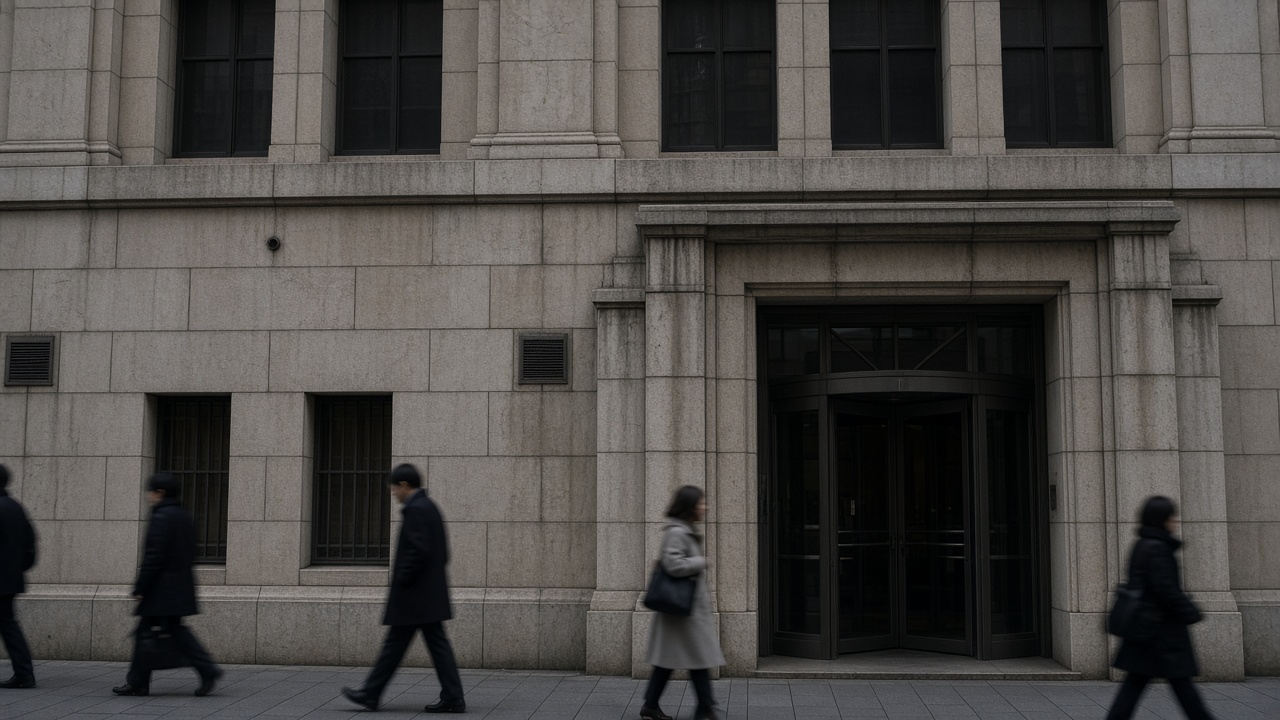
The Bank of Japan's Policy Board voted seven to two on October 30, 2025, to keep its guideline for money market operations unchanged: it will encourage the uncollateralized overnight call rate to stay at around 0.5 percent, according to the board's published statement after the two-day meeting. Board members Hajime Takata and Naoki Tamura dissented, each preferring a guideline of about 0.75 percent, a split that matters for households and exporters because it shows how far apart officials still are on the distance to a neutral policy rate.
What the statement already prices in
The October statement repeats the bank's baseline: Japan's economy is recovering moderately, but the path for prices still depends on wage behaviour, imported costs, and how overseas demand responds to trade friction. For corporate Japan, the signal is blunt—the board is willing to keep lifting rates as activity and prices improve, but it is not committing to a calendar when the next step lands.
Why the summary landed in November
A separate document, the English-language summary of opinions at the October 29–30 meeting, was released on November 10. That text is not a vote record; it is a mosaic of what individual members stressed—tariffs, foreign exchange swings, labour's opening position ahead of next year's collective bargaining round, and the risk that financial markets wobble while the policy rate remains below estimates of neutral. Taken together with the headline vote, the package reads as a institution preparing borrowers for continued tightening without pre-committing to December or January.
Household and corporate channels
For readers in Japan, the channel map is familiar. Variable-rate mortgage spreads and new fixed offers will continue to take cues from swap curves and bank funding costs, while exporters watch the yen's interaction with assumptions in earnings presentations. The board's emphasis on wage-setting means spring negotiations will again be treated as high-frequency data even for investors who do not follow HR pages—because services inflation still leans on payroll costs.
What to watch next
The Bank of Japan has telegraphed a steady drumbeat of releases—full minutes later in December will add colour, and district reports will show how manufacturers are grading order books under the current tariff schedule. Until then, Tokyo money markets will treat the half-point handle as live, with the dissent column acting as a reminder that the next move's size is not locked.
Reading the window before year-end
Money-market participants treat the interval between a summary of opinions and formal minutes as a living spreadsheet: each speech by board members in public forums, each tankan cross-check, and each large corporate wage headline can redraw the distribution of outcomes even when the policy rate prints unchanged. For regional banks, the half-point handle matters because deposit betas have lagged policy moves; every month of delayed pass-through leaves net interest margin math dependent on securities gains rather than core lending. Insurance groups with heavy foreign bond books face the mirror problem—duration extensions helped when rates overseas fell, but the yen side of the equation can erase carry if hedging costs jump on verbal intervention alone.
Manufacturers with long order cycles told investors in recent briefings that they are repricing domestic maintenance contracts and spare-parts bundles to reflect wage increases already locked in for fiscal spring. That is the granular pass-through the board references when it discusses underlying inflation—services prices that move with payroll rather than with commodity futures alone. A reader following suppliers in Hokkaido or Kyushu sees the same dynamic with logistics surcharges tied to fuel and night-shift rules rather than headline CPI.
Risk checklist for household balance sheets
Fixed-rate mortgage borrowers should still verify reset clauses that reference posted prime rates; variable borrowers need to model modest payment increases even if the call rate merely holds steady, because banks adjust spreads when wholesale funding swings. For renters, the link is slower—landlords digest refinancing costs with a lag—but renewal letters in urban wards next spring may quote wider differentials if construction cranes stay busy at the same time labour stays tight.