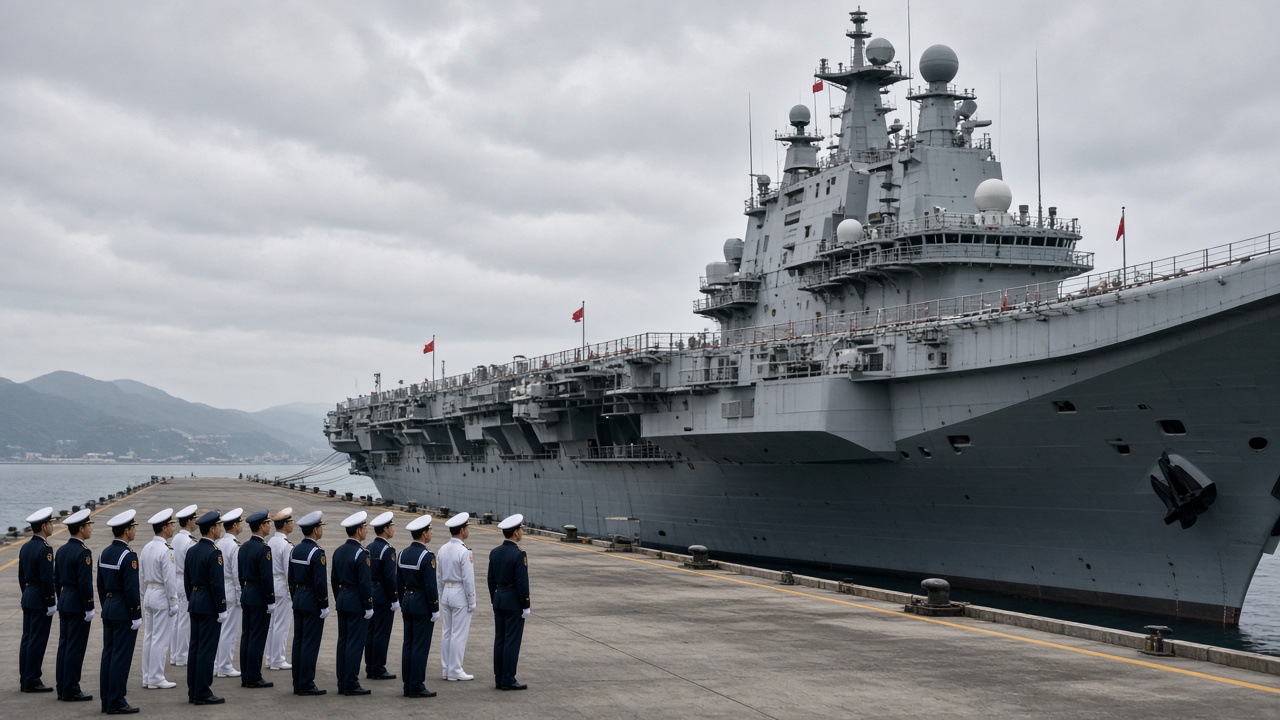
China’s navy formally commissioned the aircraft carrier Fujian at a ceremony in Sanya on Hainan island, state media reported Friday, handing Xi Jinping a third operational flattop and the first that Chinese shipyards designed and built without adapting a foreign hull.
The event, covered by the official Xinhua news agency and echoed across Chinese television, marks the fastest phase yet in a carrier program that started with the rebuilt Soviet-era Liaoning and moved to the domestically constructed Shandong before reaching the 80,000-ton Fujian. Western analysts have long watched whether Beijing could master catapult-launched recoverable flight operations; electromagnetic launch systems on the new ship signal that bet is now in the fleet, not on a drawing board.
What the commissioning changes
Unlike China’s first two carriers, which relied on ski-jump ramps limiting sortie weight, the Fujian is built around an electromagnetic aircraft launch system similar in concept to the U.S. Navy’s newest Ford-class ships. That architecture lets the ship embark heavier fighters, longer-range patrol aircraft, and eventually early-warning planes that ski jumps cannot reliably host.
Commissioning is not the same as declaring full combat readiness. Crews must certify deck cycles, integrate air wings, and stress-test power plants that feed both propulsion and the launch catapults. U.S. Indo-Pacific Command officials have said in congressional testimony that they expect several years of workups before the Fujian patrols beyond China’s near seas, but they treat the hull itself as a milestone that compresses the learning curve for a fourth carrier already reported under construction.
Signals for Taiwan and the first island chain
Taiwan’s defense ministry said it was tracking the ceremony and would adjust maritime patrol patterns around the Taiwan Strait. Japan’s government, which has documented increased PLAN transits east of Okinawa, noted the Sanya base sits on routes toward the Bashi Channel. Neither capital issued a formal protest, but both released statements describing the carrier as an extension of Beijing’s capability to project power past coastal waters.
The U.S. State Department did not immediately comment Friday. Independent analysts at the Center for Strategic and International Studies said the Fujian does not by itself overturn regional balances—American forward-deployed carriers and allied submarines still outnumber Chinese flattops—but it narrows the gap in how quickly China can sustain air operations far from shore.
Industrial and political context
Xi’s presence at the Sanya pier underscored how central the program is to his military-modernization narrative. Shipbuilders at Jiangnan Changxing, where the Fujian was assembled, have promoted the project as proof that sanctions and export controls have not blocked advanced warship work. Satellite imagery firms have tracked continued activity at the yard, suggesting modular construction techniques that could shorten intervals between hulls.
For export partners, the commissioning lands amid renewed friction over South China Sea encounters and U.S. restrictions on chip technology. Beijing has paired naval milestones with diplomatic outreach in the Pacific, offering port calls that U.S. officials describe as attempts to normalize PLAN presence where American allies once patrolled alone.
What comes next
Chinese military commentators quoted by state outlets said the next task is certifying fighter squadrons—likely including the J-35 naval stealth airframe shown in recent propaganda footage. Western intelligence officials say they are watching whether the PLAN stations the Fujian with the South Sea Fleet facing Taiwan or rotates it with the East Sea Fleet near Japan.
Either way, Friday’s ceremony converts a decade of incremental tests into a commissioned warship. Navies across the Pacific will now calibrate exercise schedules, submarine patrols, and port diplomacy around a Chinese carrier fleet that no longer depends on imported designs.