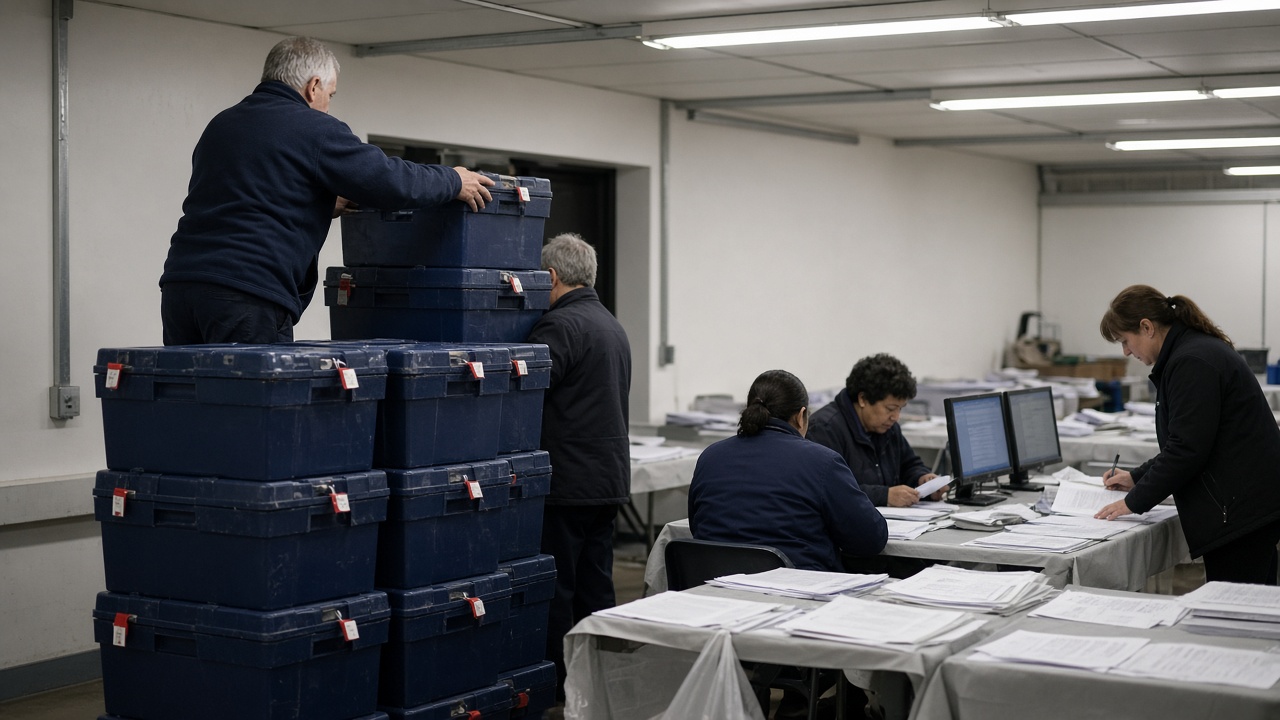
New Zealand’s election night ended in a statistical dead heat on Saturday, leaving Australian ministers to parse partial results that could preserve Christopher Luxon’s three-party government—or hand Chris Hipkins a path back to power—without a firm headcount until late November.
With more than 98 percent of ordinary votes processed, the Electoral Commission showed National and Labour each drawing about 29.3 percent of the party vote, a near tie unprecedented in the mixed-member proportional era. Seat projections still gave Luxon’s National-led bloc an initial majority of 67 in an enlarged 131-seat Parliament because of electorate wins and overhang seats, but leaders on both sides refused to declare victory while special votes, including a large overseas cohort in Australia, remain unopened.
Why the trans-Tasman calendar matters now
Prime Minister Anthony Albanese has long avoided commenting on New Zealand campaigns, saying Canberra will work with whichever government Wellington forms. Diplomats nonetheless kept a live feed on the count because the two economies are fused through the Closer Economic Relations agreement, shared Five Eyes intelligence channels and synchronized Pacific aid packages.
Foreign Minister Penny Wong’s department had staff monitoring Electoral Commission releases from Wellington alongside Treasury officers who track dairy quotas, carbon-linked trade rules and reciprocal tourism flows. A hung Parliament would not halt day-to-day consular work, but it would delay signature moments—defense ministerial talks, Pacific Islands Forum coordination and energy grid studies—that Australian officials scheduled assuming a stable Luxon ministry.
Overseas ballots from Australia could move the math
The commission estimated that roughly 700,000 special votes, including postal and overseas ballots, will not be tallied until 27 November. Australian outlets cited commission data showing about three-quarters of eligible overseas voters live in Australia, a pool that has grown by tens of thousands since the 2023 election.
Luxon told supporters in Auckland that the outcome was “too close to call,” while Hipkins told Labour faithful that “every vote matters” before special ballots are counted. Australian political strategists watching Wellington said expatriate turnout historically leans toward centre-left tickets, a pattern that could narrow Luxon’s provisional majority even if his coalition partners ACT and New Zealand First both gained party-vote share.
Pacific policy stakes for Canberra
Whoever governs will inherit Pacific portfolios crowded with Chinese lending scrutiny, climate relocation funds and policing pacts that Australia co-finances. Luxon’s government has aligned with Canberra on AUKUS-adjacent technology talks without joining the pact, while Hipkins campaigned on closer climate diplomacy and sharper rhetorical distance from Washington on some security ventures.
The centrist Opportunity Party crossed the five percent threshold for the first time, capturing seven list seats and adding a potential kingmaker to any coalition math. Australian officials who recently hosted Pacific leaders at CHOGM said a fractured New Zealand Parliament could slow joint patrol commitments even if day-to-day customs enforcement continues uninterrupted.
Until the special vote announcement, Albanese’s team is likely to issue only boilerplate congratulations while back channels stay open to National, Labour and minor party negotiators. For Australian exporters and defence planners, the next three weeks are a waiting game on the country’s most integrated security and trade partner—a reminder that elections across the Tasman no longer end at midnight on polling day.