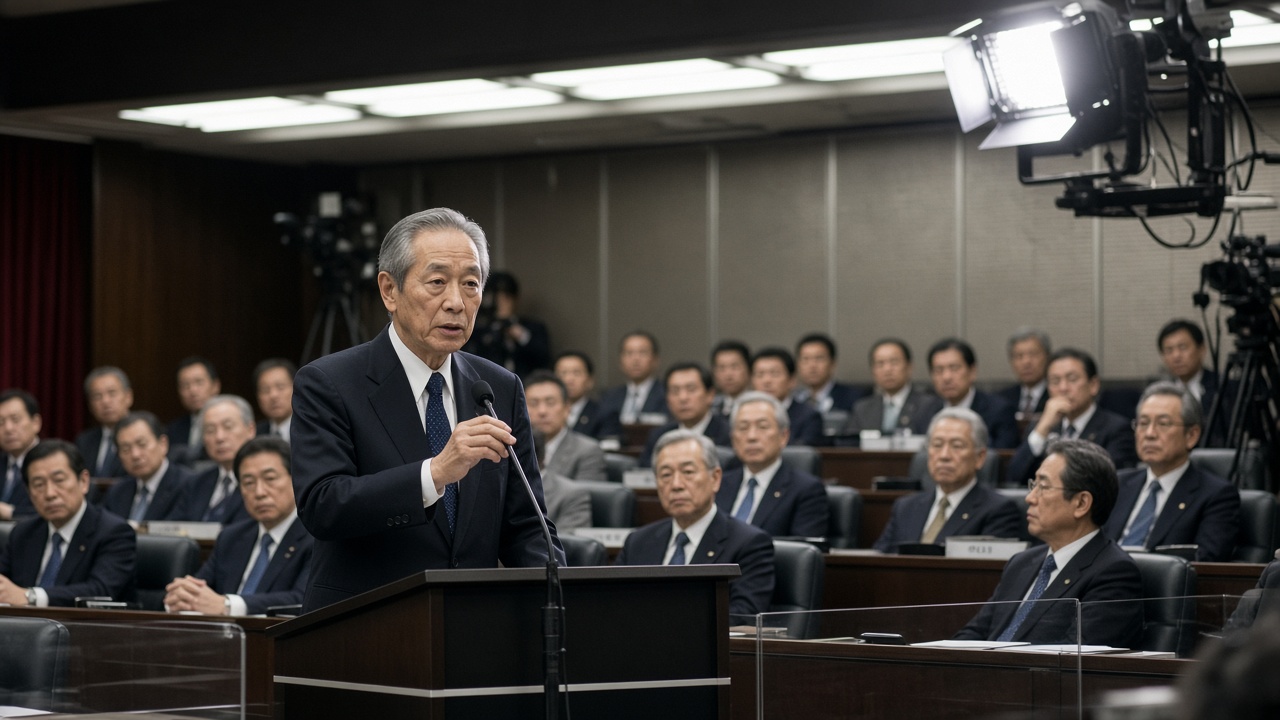
Prime Minister Sanae Takaichi told Japan’s House of Representatives on Friday that a Chinese attack on Taiwan accompanied by the use of armed force—especially naval blockades conducted with warships—could qualify as a “survival-threatening situation” under Tokyo’s 2015 security legislation, a threshold that permits limited collective self-defense operations by the Self-Defense Forces.
The remarks, delivered during a budget committee session, were among the most explicit a sitting Japanese premier has offered on when the Taiwan Strait might cross into constitutionally contested terrain for the SDF. They landed hours after North Korea test-fired a ballistic missile toward the Sea of Japan, underscoring how northeast Asian security crises are stacking atop one another in a single news cycle.
How Japanese law defines the threshold
Japan’s 2015 security laws added the concept of a sonritsu kiki jitai—literally a situation that threatens the nation’s survival—even when Japanese territory is not directly attacked. The statute allows the cabinet, with Diet notification, to authorize SDF deployments when a close ally such as the United States is under armed assault in a way that simultaneously endangers Japanese citizens and the country’s existence.
Opposition lawmaker Katsuya Okada, a former foreign minister, pressed Takaichi for concrete examples. She replied that scenarios involving warships enforcing a blockade, combined with other military measures, “could constitute a situation involving the exercise of force,” whereas civilian vessels arrayed to impede traffic without combat orders would not automatically meet the bar.
What Takaichi said about Taiwan
Takaichi stressed that any judgment would depend on “the individual concrete situation” at the moment, with the government synthesizing intelligence from the Defense Ministry, the Coast Guard and partner agencies. Still, she added that if Taiwan enters a “severe situation,” Tokyo must “assume the worst case.”
She walked through a hypothetical in which China uses warships to seal off the Taiwan Strait, the United States dispatches forces to break the cordon, and Beijing attempts to stop American intervention. In that chain, she said, Japan might conclude that its survival was at risk because attacks on U.S. assets could quickly escalate into strikes on bases in Okinawa and ballistic-missile exchanges across the first island chain.
When asked whether unmanned aircraft or cyber-only campaigns would count, Takaichi declined to offer blanket rules, saying only that “if it accompanies other circumstances” beyond nuisance blockades, the legal analysis could shift. Her wording left room for future interpretation while signaling to Beijing that naval combat scenarios are squarely on Tokyo’s planning slate.
Regional and domestic fallout
Beijing routinely protests any Japanese leader who links Taiwan’s defense to Japan’s own security, and China’s foreign ministry has previously warned Tokyo not to “meddle” in cross-strait affairs. Taiwan’s foreign ministry welcomed what it described as clarity from a key partner, while opposition parties in Tokyo said Takaichi was deepening constitutional ambiguity just weeks into her premiership.
Inside the LDP, hawks praised the remarks as overdue honesty about geography: Japan’s southwestern islands sit fewer than 70 miles from Taiwan at their closest point, and roughly 90 percent of Japan’s energy imports pass through sea lanes vulnerable to blockade. Pacifist groups scheduled weekend rallies in Okinawa, citing fear that rhetorical thresholds precede base expansions.
What comes next in the Diet
Budget committee debate is expected to continue through November as Takaichi’s cabinet seeks supplemental spending for missile defenses and stockpiles. Defense officials said they would not discuss operational plans in open session, but acknowledged that tabletop exercises this autumn modeled Taiwan contingencies for the first time with explicit cabinet participation.
For now, the legal trigger remains untested. Takaichi’s answers did not announce new troop deployments or amend alliance guidelines with Washington. They did, however, put Japan’s electorate on notice that a Taiwan crisis fought with live munitions at sea would be treated as a question of Japanese survival—not a distant television war.