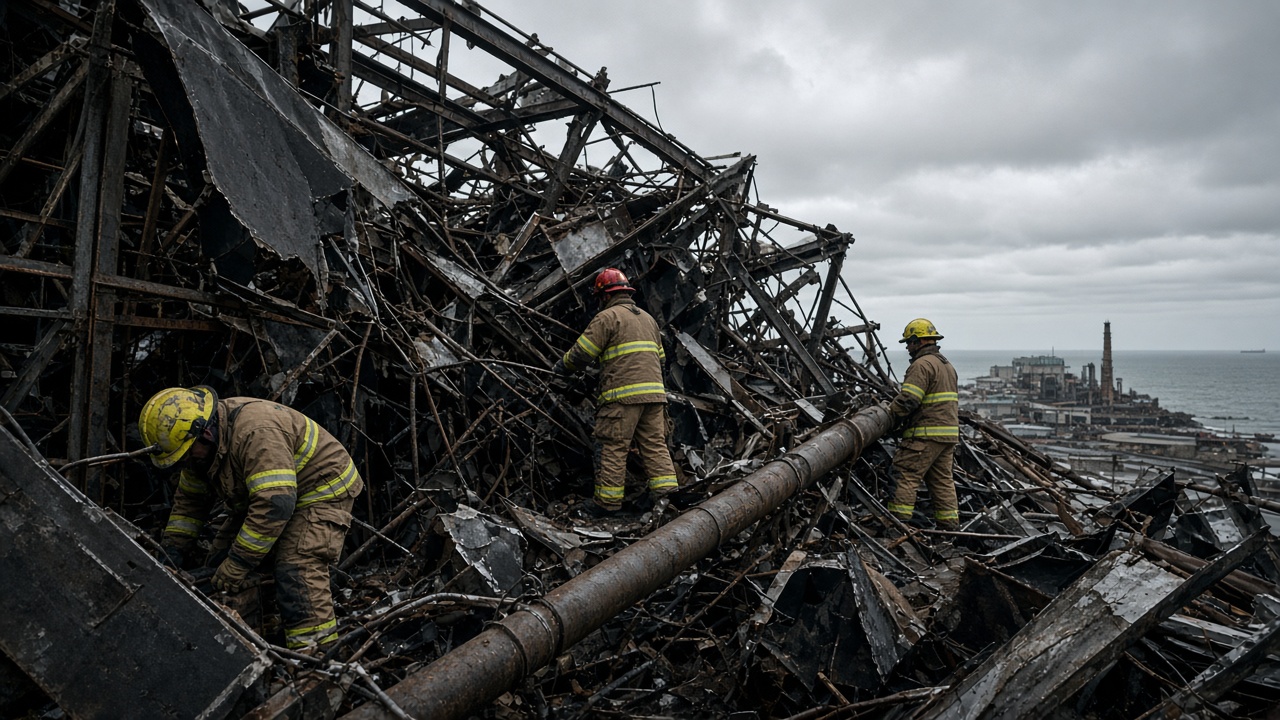
A boiler tower undergoing demolition at Korea East-West Power’s Ulsan thermal plant collapsed Thursday evening, killing three subcontractor workers and leaving two others missing as of Friday afternoon, according to South Korean fire officials who have spent more than 24 hours cutting through twisted steel to reach survivors.
The accident at the state-run utility’s southeastern complex halted one of the region’s largest ongoing industrial teardowns and revived scrutiny of how Korea handles high-risk dismantling projects at legacy coal and oil units. Labor unions demanded an immediate national inspection of similar demolitions after nine workers were initially reported trapped; two were rescued before dawn, while a 44-year-old man died after going into cardiac arrest as rescuers neared his position.
What failed at the plant
Fire officials said the structure stood roughly 60 meters tall and was being dismantled with controlled explosives as part of a modernization program. When supports gave way, a cascade of girders buried crews working on lower levels. Kim Jeong-sik, an official at the Ulsan Nambu Fire Station, told reporters that responders had to traverse about 30 meters of debris to reach the collapse zone, complicating timelines in the cramped boiler yard.
Korea East-West Power, a subsidiary of the state power holding company, said it suspended all demolition activities company-wide pending a preliminary review. The Ministry of Employment and Labor dispatched investigators to secure CCTV and work logs from the prime contractor and its subcontractor, whose names were not immediately released.
The human toll
By midday Friday, three fatalities were confirmed: one worker who died while still trapped and two who were pulled out and could not be revived. Authorities said operations continued for two additional victims presumed dead, while two others remained unaccounted for. Families gathered at the plant gate as ambulances shuttled between the site and Ulsan University Hospital.
Rescue commander Kim described medics administering painkillers and warming blankets to the 44-year-old victim during an hours-long extraction attempt that ultimately failed around 5 a.m. “He eventually passed away,” Kim said, a detail that angered union advocates who argue that demolition night shifts often lack sufficient medical staging on-site.
Energy context in Ulsan
Ulsan hosts a cluster of heavy industry and petrochemical plants, and the East-West Power site has long supplied electricity to factories that feed the city’s export economy. The tower collapse does not appear to have disrupted grid stability—generation units unrelated to the dismantling continued operating—but officials warned that ash handling and fuel lines near the boiler yard would remain offline until structural engineers certify adjacent equipment.
President Lee Jae Myung’s office issued a brief statement urging “a swift and transparent investigation,” while opposition lawmakers called for parliamentary hearings on outsourcing practices in the public power sector. Similar teardowns are scheduled at aging units nationwide as Korea accelerates gas and renewable additions; the accident is likely to surface in those permitting debates next week.
What investigators will examine
Early questions focus on whether explosive charges were sequenced correctly, whether wind loads were underestimated during recent typhoon activity in the South Sea, and whether subcontractor crews received adequate briefings on evacuation routes. The labor ministry’s serious-accident bureau can impose work stoppages and refer executives for prosecution when negligence is proved.
For families still waiting at the barricades, the immediate demand is simpler: account for every missing name before demolition resumes anywhere in the country. Fire officials said they would continue round-the-clock shifts until the rubble pile is cleared or declared exhaustive, even as cold rain moved into the southeast overnight.