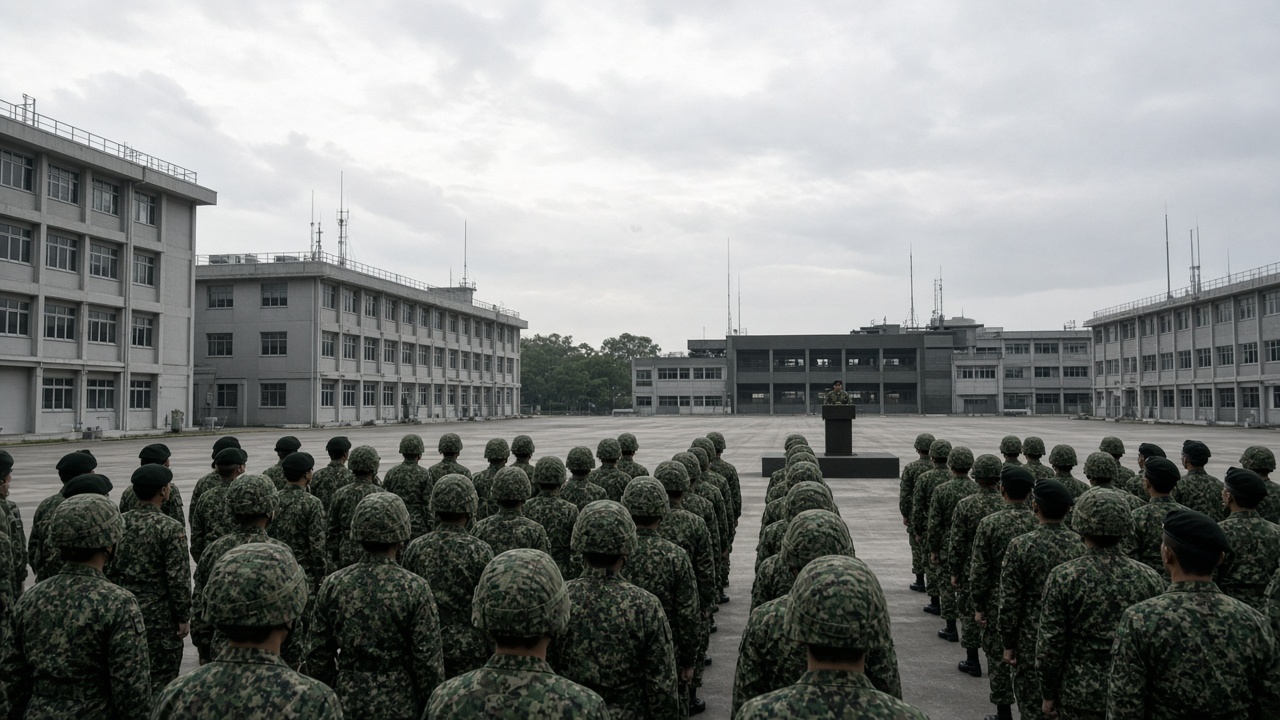
The Singapore Armed Forces’ Digital and Intelligence Service inaugurated its Training Command at Bukit Panjang Camp on 6 November, centralising schools that prepare Guardians for intelligence work, cyber defence and the data-heavy tasks the fourth service now shares with the Army, Navy and Air Force.
Chief of Digital and Intelligence Service Major-General Lee Yi-Jin officiated the ceremony with senior DIS and SAF commanders in attendance. Military Expert 7 Steven Lim, previously head of the DIS Training Department, took command of DTCOM, which absorbs imagery, joint intelligence and cyber schools previously scattered across the SAF.
Six domains, one training spine
Mindef said DTCOM will deliver programmes across intelligence, cybersecurity, digital operations, command-and-control networks, electronic protection and information defence. Training is meant to run from foundational skills through leadership courses, with Advanced School for Continuous Education and Development providing informal pathways and industry partnerships.
The Intelligence Training Institute now houses the Imagery and Geospatial School and Joint Intelligence School, relocated from the Military Intelligence Institute. The Intelligence Technology and Analysis School, slated for April 2027, will train analysts to use cloud platforms, large data sets and AI models to surface threats faster. An Open-Source Training Wing in the same launch window will standardise how personnel harvest publicly available material for situational reports.
Why the SAF merged the schools now
Lee told reporters the DIS needed a single owner for competency frameworks as hostile actors accelerate cyber and information campaigns. Consolidation also lets DTCOM rotate operationally ready national servicemen through refresher blocks without duplicating instructors across camps.
MINDEF’s fact sheet noted additional digital and engineering schools are planned over the next few years, suggesting AI coursework will eventually sit beside traditional signals and imagery syllabi. ASCEND will broker ties with institutes of higher learning so specialists can pick up vendor certifications between deployments.
Commercial and regional context
The launch follows a week in which two consumer-facing Singapore organisations disclosed customer-data breaches, underscoring demand for domestic cyber talent. DIS leaders did not link DTCOM directly to those incidents, but emphasised that Home Team agencies and the SAF share sensor feeds that require analysts comfortable with machine-assisted triage.
For investors watching defence-adjacent technology firms, DTCOM’s April 2027 schools may expand vendor opportunities in training simulators and secure cloud stacks, though MINDEF did not announce procurement figures at the inauguration. The command’s near-term deliverable is a graduated pipeline of Guardians who can rotate between cyber incident response and all-source intelligence billets without retraining from scratch.