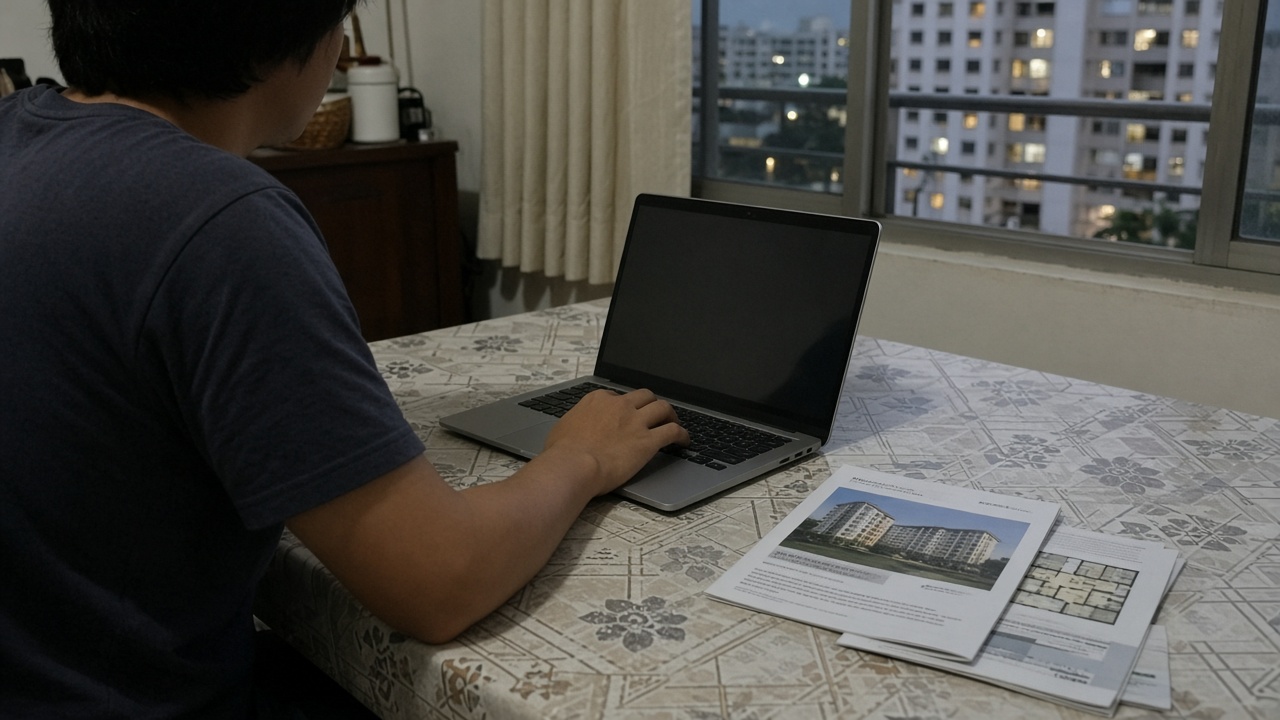
Singapore’s November Build-To-Order window leaves four days for online applications, with HDB updating live ballot odds showing Tengah’s Plantation Dew project drawing 4.6 first-timer family applications for each 2-room flexi flat as of 7 November.
The exercise offers 7,964 units across seven projects in Bedok, Geylang, Sembawang, Tengah, Toa Payoh and Yishun—the last launch of 2026 and the first since income ceilings rose to S$16,000 for families and S$8,000 for singles in August. Applicants need a valid HDB Flat Eligibility letter and pay a S$10 administrative fee per submission.
Reading the rate tables
HDB refreshes application counts at 8am, noon and 5pm daily during the eight-day window. Plantation Dew’s loftier odds contrast with Sembawang Anchor, where several flat types sit below one application per unit, suggesting ballot competition is highly project-specific. Toa Payoh Hillside, the sole Prime project beside Caldecott MRT, shows 4.1 first-timer applications for each four-room flat and carries an 11 percent subsidy recovery on resale.
Median 2-room flexi demand across towns stood at 2.8 applications per unit on the latest update, while three-room and larger flats posted a 1.8 median among first-timer families. Second-timer families face stiffer queues, with a median 11.3 applications on bigger flat types.
Digital process constraints
HDB temporarily suspended new HFE letter applications during the sales exercise to prioritise processing for current bidders, a workflow choice that pushes undecided households to wait until 12 November if they lack eligibility paperwork. The portal encourages applicants to chase projects under the median rate rather than clustering on hot towns.
Ballot outcomes land in January 2027, with flat booking from March. Option fees range from S$500 for 2-room flexi units to S$2,000 for four-room and five-room types, payable through AXS with debit cards or eNETS subject to bank limits.
Why the tech desk cares
The sales exercise is effectively a high-traffic state web service: tens of thousands of concurrent users checking rate tables that HDB publishes via APIs on the Flat Portal. Any latency during the 11.59pm deadline could skew perceived application rates, which is why the agency batches updates instead of streaming real-time counts.
For PropTech watchers, the rate dashboard is also a transparency experiment—applicants adjust choices daily based on published odds, a feedback loop older balloting systems lacked. With 23,928 flats launched across 2026 including balance flats, the November tranche caps a record supply year, and the live odds offer a data-rich picture of where young households believe value still exists before the ballot computer runs on 12 November.