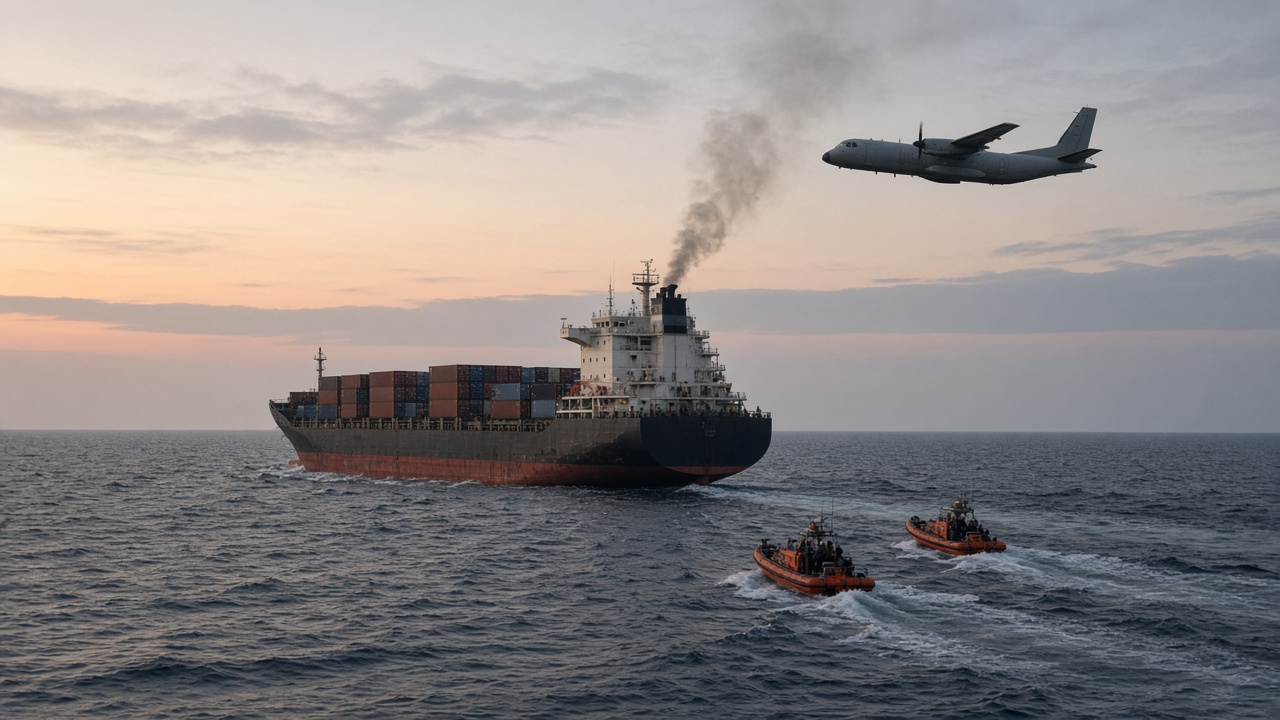
U.S. Central Command disabled a commercial cargo ship in the Gulf of Oman on Saturday after accusing its crew of repeatedly trying to run Washington's naval blockade against Iran, marking the fifth merchant vessel the Pentagon says it has struck since enforcement escalated in July.
An American military aircraft fired precision munitions at the stern of the St. Kitts and Nevis-flagged M/V Huda, CENTCOM said in a public release. The command said it had ordered the crew to leave targeted spaces before the strike. The vessel had attempted to leave regional waters after visiting an Iranian port, according to the statement posted on Nov. 7.
What CENTCOM says happened
CENTCOM framed the action as enforcement of a blockade that has redirected 147 compliant commercial vessels since July while disabling five that refused orders. The command also said U.S. forces had previously destroyed 10 Iranian commercial oil tankers it linked to a Revolutionary Guard shadow network.
The Huda incident unfolded as maritime tensions in the Gulf of Oman and Strait of Hormuz remain elevated. Iranian state media separately reported overnight blasts and mine incidents involving tankers, claims that could not be independently verified at the time of publication. Mariners were warned to heed blockade notices from U.S. forces.
Crew rescued after fire
Reporting on Sunday pointed to a subsequent rescue phase. The United Arab Emirates National Guard recovered 22 people from the burning ship on Nov. 8, according to accounts citing Emirati officials and CENTCOM's timeline. The St. Kitts flag registry identifies the Huda as a general cargo ship; CENTCOM did not publish a full damage assessment in its initial release.
The strike lands one day after CENTCOM announced Task Force Iron Gate, a Tampa-based unit aimed at disrupting Iranian weapons and sanctioned goods moving overland and across the Caspian Sea. Admiral Brad Cooper, the CENTCOM commander, has described the maritime blockade as preventing more than $25 billion in Iranian crude exports in recent months, a figure that rests on U.S. government accounting rather than open shipping data.
Commercial shipping under pressure
Insurance underwriters and charterers have watched the Gulf of Oman closely since the blockade expanded. Each disabled hull raises questions about warning protocols, civilian crew safety and whether shippers can reroute without triggering another enforcement action. CENTCOM's statement emphasized that targeted spaces were to be abandoned before munitions were released, but third-party confirmation of warning timing was not available in the first hours after the strike.
The Huda case also intersects with diplomatic messaging from Tehran. Senior Iranian security officials have warned Washington against restarting major hostilities after U.S. midterm elections shifted congressional control. For now, the immediate factual record is narrow: a St. Kitts-flagged freighter visited Iran, tried to depart, was struck at the stern, caught fire, and saw its full complement of 22 mariners extracted by Emirati responders.
What happens next
CENTCOM did not say whether the Huda would be towed, scrapped or investigated as evidence. Flag-state authorities in St. Kitts and Nevis had not issued a public statement in the first cycle of reporting. Shipping databases and regional coast guards may publish track and safety updates as the week opens.
Washington is expected to defend the strike as lawful enforcement of executive orders behind the blockade. Iran and allied media are likely to cast it as an attack on civilian commerce. Neutral observers, including Gulf port states that assisted the rescue, will balance security partnerships with the risk of further incidents along one of the world's busiest energy corridors.