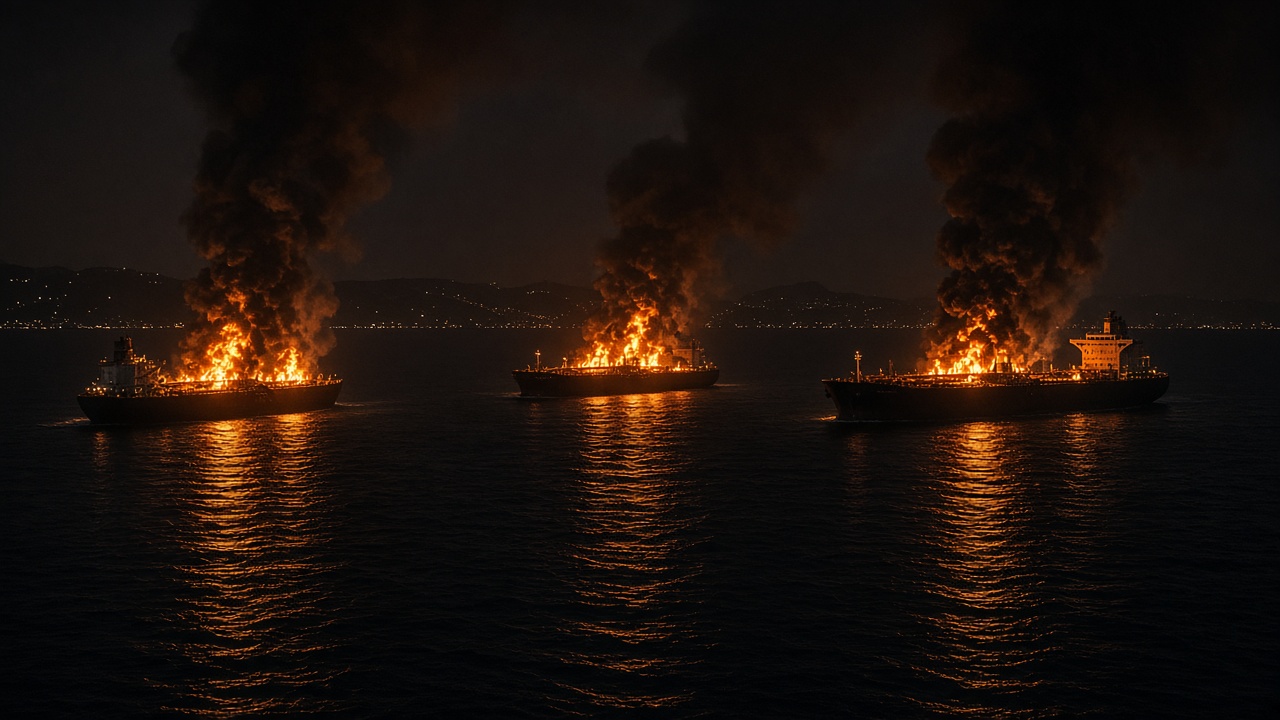
Iran's Islamic Revolutionary Guard Corps said Sunday that three oil tankers "exploded and caught fire" while sailing in what it called an illegal transit channel in the Strait of Hormuz, escalating the maritime front of a wider conflict that has already choked insurance markets and rerouted crude cargoes around the Gulf.
In a statement carried by state media, the Guards said the vessels were among those that had refused to follow Iranian rules for passing the narrow waterway. The corps did not name the ships, their flags, or the condition of their crews. Iranian authorities have repeatedly warned that tankers moving outside approved lanes risk enforcement action, though Sunday's bulletin was unusually explicit about simultaneous casualties.
Parallel warnings from maritime monitors
Britain's UK Maritime Trade Operations agency, which logs security incidents for commercial shippers, reported separately that a tanker was on fire in the strait off Khasab, Oman, and that its crew had been evacuated. UKMTO also noted another vessel struck by an "unknown projectile" on Saturday. Neither agency attributed the events to a particular state actor in its public notices, but the timing overlapped with the Guards' announcement and with a weekend of heavier military activity across the wider Middle East.
France 24 and other regional broadcasters framed the Hormuz fires as part of a combustible weekend that also saw missile intercepts over Riyadh and continuing airstrikes in Yemen. For insurers and charterers, the key question is whether Sunday's incidents represent a new pattern of multi-vessel enforcement rather than isolated strikes on single hulls.
Why Hormuz traffic matters
The strait remains one of the world's most heavily trafficked oil chokepoints. Even modest disruption can ripple into freight rates and refinery planning because there are few practical alternatives for moving large volumes of crude and condensate out of the Gulf. Since earlier phases of the Iran crisis, many operators have tightened AIS reporting, added armed guards, or hugged Omani waters—but Iranian officials have cast some of those routes as non-compliant.
Washington and its partners have spent months trying to shield commercial traffic while also maintaining pressure on Tehran's weapons trade. A U.S. Central Command task force announced last week is tasked with disrupting land corridors for sanctioned goods, a signal that the campaign is no longer purely maritime. Sunday's tanker fires suggest the sea lane itself is still the most visible flashpoint for markets.
What shippers are watching next
Classification societies and P&I clubs typically wait for operator statements, flag-state investigations, and satellite imagery before adjusting war-risk premiums. If the three vessels named by Iran—or the ships UKMTO referenced—are confirmed as total losses or crew evacuations, underwriters may move quickly. Conversely, if the incidents involve partial fires with salvage underway, the price shock could be shorter.
Diplomatic channels remain open in pockets: regional capitals including Doha have publicly denied reports that U.S.–Iran talks have fully collapsed. Yet on the water, the Guards' message was unambiguous—non-compliance in Hormuz carries immediate consequences. For now, the strait is functioning, but every owner with a fixture due this week is re-reading routing clauses and checking whether their hull policies still cover the "illegal channel" language Tehran cites.