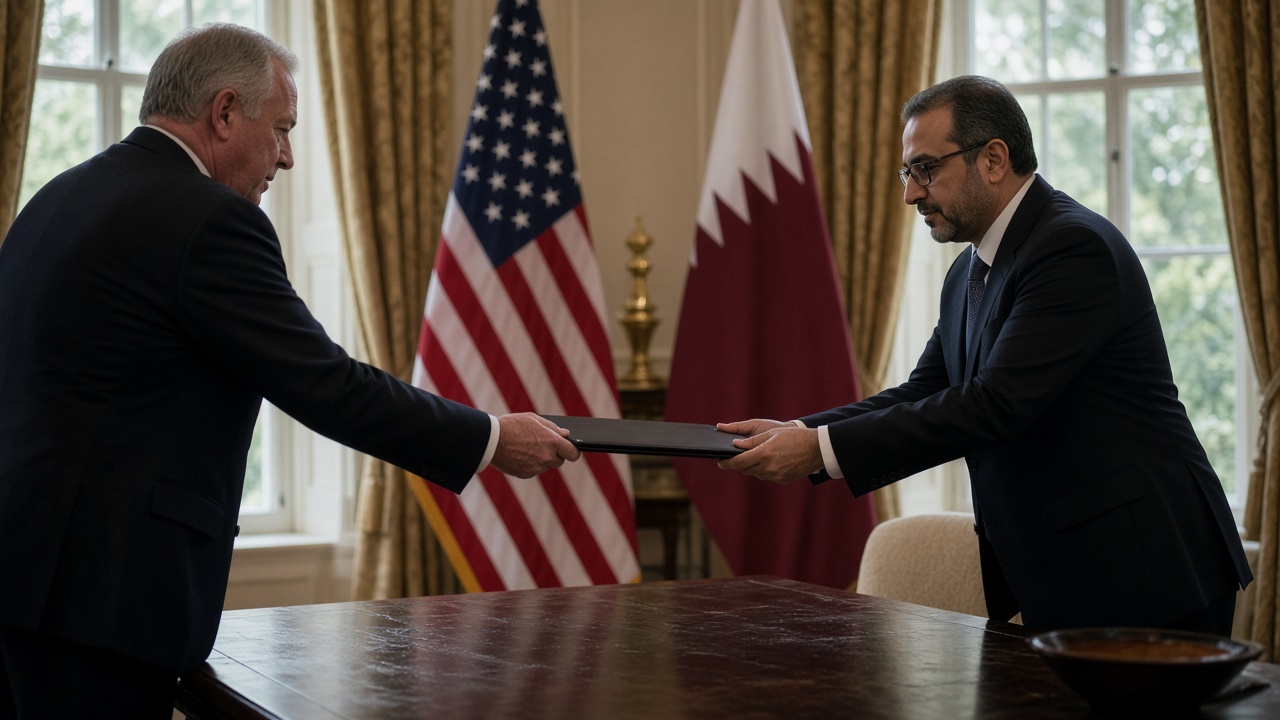
President Donald Trump will meet Qatari Prime Minister Sheikh Mohammed bin Abdulrahman Al Thani in the Oval Office on Monday, giving Doha a high-profile stage to press new proposals in the stalled U.S.–Iran negotiations even as the White House says Washington’s land blockade on Iranian supply routes is already in effect.
Qatar has served as a primary back channel since the conflict widened, and the Associated Press reported that Doha arrived in Washington with ideas aimed at lowering regional tensions and keeping diplomacy ahead of further military escalation. The timing matters: Trump told reporters he expects to speak with China’s Xi Jinping and Russia’s Vladimir Putin at next week’s Asia-Pacific Economic Cooperation summit about Iran’s nuclear file and the war, framing the Qatar visit as one piece of a broader push to stitch together great-power cover for whatever deal might emerge.
What changed on the ground
On Sunday, Trump said in a televised interview that renewed U.S. strikes on Iran would be “highly unlikely” if talks make progress on Tehran’s nuclear programme and on reopening the Strait of Hormuz, though he stopped short of taking force off the table entirely. Separately, he told Al Jazeera’s live coverage that the administration’s latest blockade on Iran’s land supply routes is now operational — a step that tightens economic pressure while negotiators trade paper.
The dual message — blockade on, bombs presumably on pause — reflects how the White House is trying to sell simultaneous coercion and diplomacy to allies whose oil lanes and airspace still absorb spillover from missile and drone exchanges. Iraqi Foreign Minister Fuad Hussein told Al Jazeera that Baghdad has reached understandings with Washington to route Iraqi crude through a Hormuz corridor near Oman, underscoring how partial reopenings, not a full ceasefire, are already shaping energy math across the Gulf.
What Doha is carrying into the meeting
Neither the White House nor Qatar’s foreign ministry published a full text of Doha’s newest ideas ahead of the Oval Office session, but Gulf diplomats familiar with the talks say the package is likely to touch on sequencing: staged sanctions relief tied to verified nuclear steps, monitored traffic through Hormuz, and guarantees that humanitarian cargoes can move by land while the blockade remains politically intact. Trump’s public comments suggest he will accept progress only if Tehran agrees to terms he can describe as “very strong,” leaving little room for a face-saving half-measure.
Iranian officials, meanwhile, have continued to warn of severe retaliation if bombing resumes, a rhetorical line that keeps markets edgy even when presidents pronounce strikes unlikely. For Qatar, the risk is familiar: mediators get credit when talks inch forward and blame when either side walks away. Monday’s meeting is a bet that personal diplomacy at the top can keep the channel open while lower-level military incidents — including drone strikes on energy infrastructure in Iraqi Kurdistan over the weekend — threaten to pull negotiators back toward crisis mode.
What to watch after Monday
Congressional leaders from both parties are watching whether any framework addresses Hormuz in writing or only in communique language, a distinction that matters for insurers, tanker owners, and Asian buyers still rerouting barrels. European capitals, still absorbing Sunday’s Houthi claims of strikes on Saudi oil sites and Riyadh infrastructure, want evidence that Gulf security assurances are part of the bargain, not an afterthought.
Trump’s APEC conversations with Xi and Putin could either accelerate a synchronized offer to Tehran or splinter if Beijing and Moscow read Washington’s blockade as a unilateral stranglehold. For now, the calendar is doing the talking: a Qatari prime minister in Washington, a land blockade declared active, and a president publicly betting that diplomacy can still outrun the next salvo if the terms are harsh enough to sell at home.