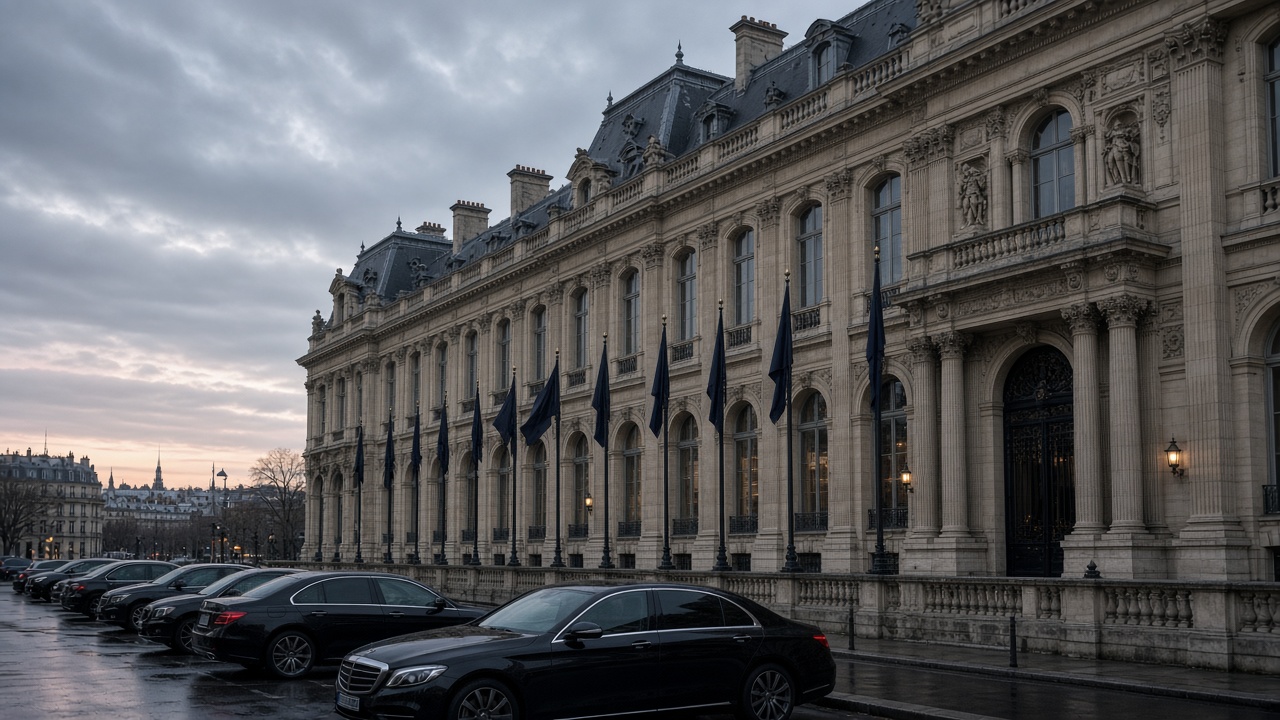
Foreign Minister Takeshi Iwaya opened Japan's participation in a G7 foreign ministers' meeting in Paris on Monday after France shifted the venue from Marseille to the capital's Quai d'Orsay district, compressing security and lodging plans for delegations already juggling the Paris Peace Forum calendar.
The two-day session, running through Tuesday under France's presidency, covers Ukraine support, Middle East stability, Indo-Pacific security, and coordinated artificial-intelligence safeguards—agenda items Tokyo treats as linked to chip supply chains and energy routes that affect Japanese households.
Venue change
Organizers cited logistical and operational reasons for moving from Marseille, where a parallel G7 ports network event on maritime drug interdiction still convenes. Diplomats received updated accreditations Friday limiting press access to sessions at the Hôtel du Ministre. Japanese embassy staff rebooked hotel blocks and motorcade routes through central Paris, a scramble that MOFA officials said did not alter Iwaya's bilateral meeting schedule with European and North American counterparts.
Japan priorities
Iwaya's briefing books emphasize maintaining G7 unity on Ukraine financing and sanctions implementation, a topic that influences yen funding costs when investors gauge geopolitical risk premia. Tokyo also plans to reinforce free and open Indo-Pacific language adopted at prior summits, especially as North Korean missile tests and South China Sea encounters continue. On AI, Japan aligns with initiatives launched at the Évian leaders' meeting and September United Nations Security Council discussions on frontier-model risks.
AI security thread
French hosts listed AI safety as a closing agenda pillar, noting accelerating frontier models that strain collective resilience. Japan's domestic AI bill debates borrow from G7 communiqué phrasing on transparency and incident reporting. Iwaya may tout Sakana-style local pilots and corporate governance codes while urging export-control harmonization on advanced accelerators—a subtle nod to supply shocks that rocked the Nikkei last week.
Bilateral margins
MOFA schedulers held slots for side meetings with U.S., British, and Indian ministers to align ahead of year-end leader summits. Japan seeks assurances on liquefied natural gas diversification amid Middle East shipping disruptions that lift electricity bills at home. European partners want Tokyo's read on China trade statistics also due Monday, which feed into G7 conversations on industrial overcapacity.
Diet timing
Iwaya travels while the Diet is not in extended recess, requiring vice-minister coverage for routine parliamentary answers. Opposition lawmakers may question whether Paris commitments imply additional aid envelopes in supplemental budgets. The foreign minister's online remarks from prior G7 calls emphasized that Japan's contributions remain within constitutional interpretation of collective security—language he is expected to repeat if pressed on ammunition transfers.
Domestic readership
For Japan morning readers, the Paris meeting is distant yet tied to gasoline prices, coastal fishing routes, and export rules on advanced chips. A coordinated G7 AI statement could foreshadow METI procurement rules affecting municipal pilots such as Tottori's summarization trial. Failure to agree would leave companies navigating a patchwork of national labels.
What comes next
Communiqué language is unlikely to drop Monday night Tokyo time; diplomats often negotiate overnight. Investors may ignore headlines unless energy or sanctions wording surprises. Iwaya's return schedule will determine whether he briefs cabinet before Tuesday's BOJ opinion summary—two very different markets for diplomatic risk, both landing on a Tokyo week already crowded with macro and sumo headlines.
Media schedule
MOFA press officers said Iwaya may hold a short stakeout if G7 chairs issue a joint statement on AI incident reporting before Tuesday night Tokyo time. Japanese networks booked live slots around 11:00 p.m. to carry translated highlights for viewers tracking markets in the morning.
Embassy coordination
Tokyo embassy staff in Paris extended consular hours for Japanese nationals attending the Peace Forum, routing security questions through a dedicated hotline while Iwaya attends closed-door G7 working lunches near the Seine.
Diet foreign affairs committee staff scheduled a closed briefing for Wednesday to review any joint statements before they are translated for domestic distribution.
Backbench lawmakers asked whether charter-flight costs would appear in MOFA’s supplementary budget request if the session runs long.