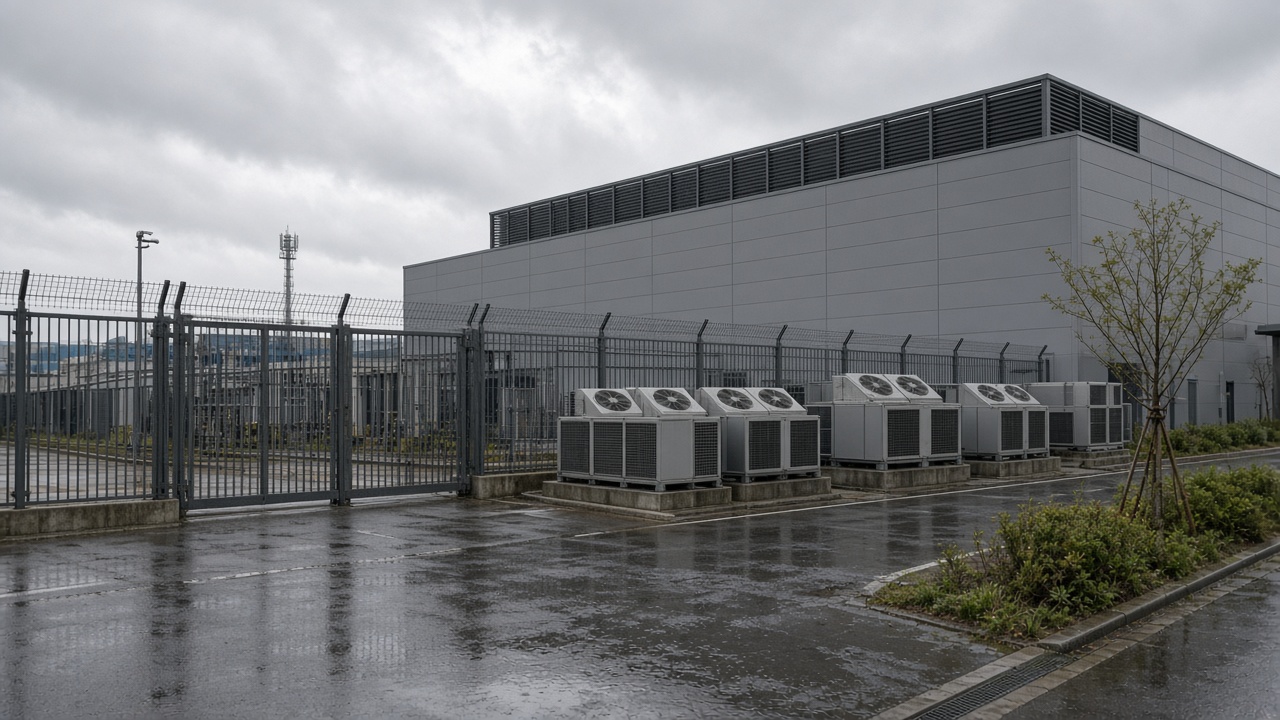
Amazon Web Services and SK Group have stacked roughly nine billion dollars of announced AI data-center commitments in South Korea, turning a series of summit-side pledges into a concrete pipeline of land, power and fiber projects across Incheon, Gyeonggi and Ulsan.
The latest layer came when AWS said it would spend an additional five billion dollars over six years on AI-focused facilities in Incheon and Gyeonggi Province, adding to a four-billion-dollar Ulsan campus plan unveiled with SK earlier in the year. If built on schedule, the combined figure would rank among the largest foreign-cloud capital programs in Northeast Asia outside Japan.
Why Korea keeps winning hyperscaler checks
Cloud executives cite three overlapping advantages: proximity to Samsung Electronics and SK hynix memory supply, a dense manufacturing base for "physical AI" pilots, and government co-funding for power and network links. President Lee Jae Myung's administration has framed AI infrastructure as a growth substitute for a shrinking workforce, and ministries are routing budget lines toward GPU purchases and national computing centers.
AWS is not alone. OpenAI and domestic conglomerates have signed memoranda to place large AI training sites in Pohang and South Jeolla Province, leveraging chip output for export-controlled gear. Nvidia's October promise to ship on the order of 260,000 Blackwell GPUs to Korean customers, including government and conglomerate buyers, set the demand backdrop for these land deals.
Site work and bottlenecks
Industry officials said Incheon and Gyeonggi parcels near existing cable landing stations remain the preferred AWS footprint because latency to Seoul financial users stays low. SK's Ulsan partnership targets coupling petrochemical-site power with high-density racks. Each path faces the same bottlenecks: ultra-high-voltage permits, backup diesel rules and local objections to water use for cooling.
Domestic telecom carriers expect backbone upgrades between new campuses and the government-planned national AI computing center in the capital region. MSIT budget documents allocate funds for GPU sharing between public and private racks, which could lower utilization risk for any single hyperscaler site.
Competition and compliance
Korean regulators still classify certain cloud regions as sensitive when public-sector workloads are involved. AWS, Google and Microsoft have pursued separate security certifications for government clients. The investment wave does not remove those gates; it adds capacity behind them.
Competitors are bidding in parallel. Naver Cloud and Kakao's data units pitch sovereign-AI hosting to municipalities and hospitals. Their selling point is local-language models and onshore custody, while U.S. clouds emphasize scale and global software marketplaces. Enterprises increasingly run dual-vendor strategies—training abroad, inferencing at home—to satisfy contractual data-residency clauses.
Timeline investors watch
Construction timelines run into 2028–2031 for several announced blocks. Equity investors trade Samsung and SK hynix on memory pricing first, but facility announcements reinforce the narrative that Korea remains a approved geography for U.S. hyperscalers despite export-control friction elsewhere in Asia.
For policymakers, the nine-billion-dollar tally is a political proof point heading into National Assembly budget hearings on the 10-trillion-won AI envelope. For operators, the next visible milestone is land conversion and power-wheeling contracts—not another press release.