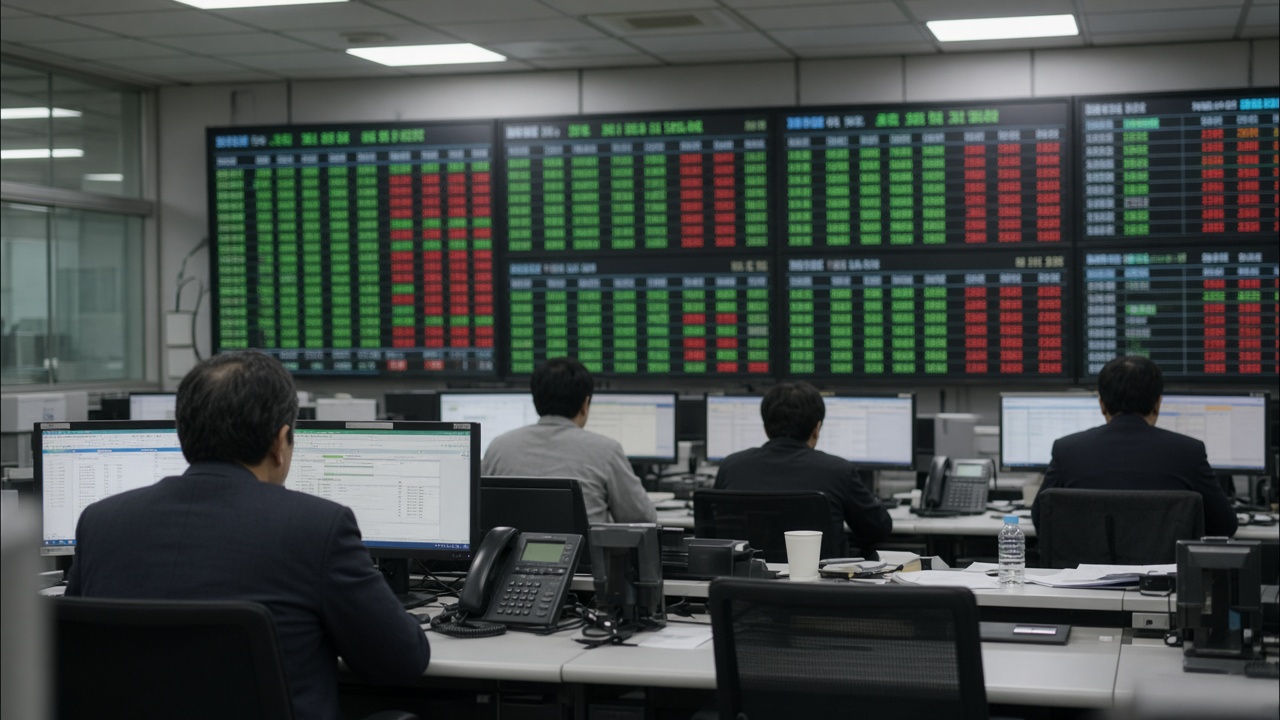
KB Financial Group shares closed at 129,000 won on Monday, up 4.28 percent, as investors priced in a faster compromise on dividend-income separate taxation than the government had floated in its original tax bill.
The move came after ruling-bloc and administration officials signaled over the weekend that the maximum rate on the new separate regime for dividend income would land closer to 25 percent than the 35 percent written into the finance ministry's draft. Brokerage analysts said that change mattered most for financial holding companies and listed chaebol parents that already pay large cash dividends and trade at persistent holding-company discounts.
Shinhan Financial Group added 1.81 percent to 78,800 won, and Hana Financial Group touched levels not seen since July during the session. SK Inc., which holds a major stake in SK hynix, rose 3.94 percent to 290,000 won. Lotte Group's holding company gained more than 5 percent on the same theme. Market data from the Korea Exchange showed institutions net-buying about 1.3 trillion won of cash equities, offsetting continued foreign selling.
What the tax change would do
Dividend-income separate taxation is designed to encourage listed companies to return more cash to shareholders instead of hoarding earnings. The government's first draft paired the new regime with strict eligibility tests: firms would need to maintain or raise cash dividends and meet payout-ratio hurdles. Opposition lawmakers have pushed for a simpler rulebook without those conditions, arguing that complexity would blunt the market effect.
Deputy Prime Minister and Finance Minister Ku Koon-hyeol told a National Assembly budget hearing that the top rate remains negotiable in the legislature. Democratic Party floor officials and People Power Party tax writers have both floated 25 percent as a workable ceiling. Ku also said the revenue effect of a lower cap could shave roughly 1.7 trillion to 1.9 trillion won from annual tax receipts, a figure analysts treated as the price of a near-term equity boost.
For KB Financial and its peers, the policy argument is straightforward. Banks and insurers already run buyback and dividend programs tied to capital rules. A lighter tax on qualified dividend income raises the after-tax yield for domestic retail holders, who still dominate turnover in Korean financials. That is why Monday's session looked like a shareholder-return trade rather than a macro re-rating.
Holding discounts and payout math
Holding-company shares often trade below the implied value of their listed subsidiaries. Investors have long asked for larger dividends from parents such as SK Inc. and Lotte Group to close that gap. Separate taxation does not erase the structural discount overnight, but it changes the calculus for boards that weigh dividends against treasury-share purchases.
Securities researchers at Mirae Asset and Kiwoom said financial groups might tilt 2026 shareholder-return plans toward cash dividends if the final law drops the top rate and softens eligibility screens. Some banks carry heavy treasury-share positions; a cleaner dividend tax lane could pull them toward higher payout ratios without running afoul of internal capital targets.
Not every large cap joined the rally. Samsung Electronics still rose with the index, but the day's leadership sat with financials and investment holding names. Chipmakers benefited from a broader rebound after last week's global AI-valuation pullback, yet the policy bid was visible in sector returns.
Assembly calendar and what traders watch next
The Basic Finance and Tax Subcommittee opens detailed work on the tax bill this week, alongside ministry-by-ministry budget review in the Budget and Settlement Special Committee. Market participants said they will watch whether opposition parties accept payout conditions or insist on unconditional separate taxation, and whether the corporate tax increases packaged with the Lee Jae Myung administration's first budget survive intact.
Currency markets offered a quieter backdrop. The won strengthened modestly to 1,451.4 per dollar at the reference fixing, easing some imported inflation pressure but not changing the export story for semiconductors. For dividend investors, the near-term signal was domestic: a political path toward a milder dividend cap, and financial stocks that finally looked like the intended beneficiaries.