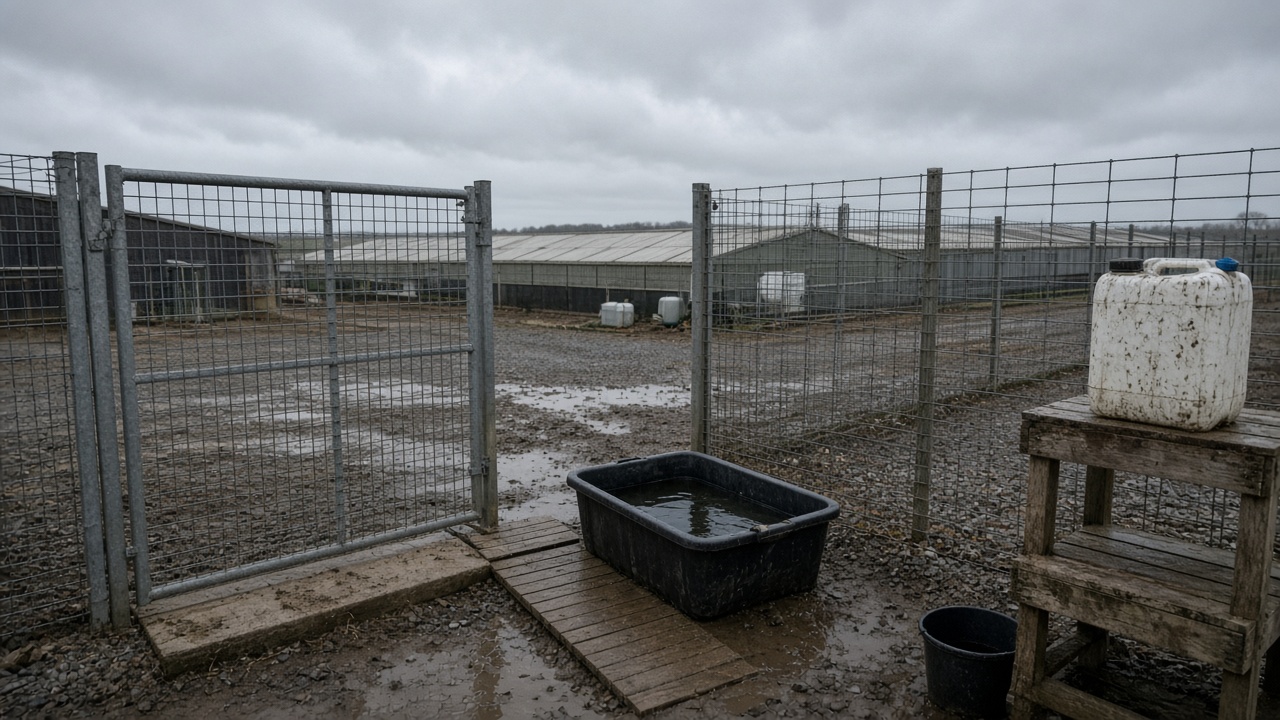
Britain’s autumn bird-flu count rose again Tuesday after the Animal and Plant Health Agency confirmed highly pathogenic avian influenza H5N1 at commercial poultry premises near Dersingham in Norfolk, triggering immediate movement restrictions and a planned cull on site.
Zones and restrictions
The BBC reported that APHA established a 1.86-mile (3 kilometre) protection zone and a 6.21-mile (10 kilometre) surveillance zone around the infected farm. All poultry on the premises will be humanely culled, the agency said. Keepers inside the zones must follow stringent biosecurity rules on top of baseline national requirements, including limits on moving birds and eggs and on human contact with flocks.
Government guidance defines the protection zone as the tightest ring, where movements are heavily controlled to stop the virus radiating into wider supply chains. The larger surveillance zone requires enhanced record-keeping and reporting so officials can trace any secondary spread across eastern England’s dense poultry corridor.
Norfolk’s first autumn case
The Dersingham detection is Norfolk’s first confirmation this autumn, according to BBC reporting, and lifts the United Kingdom’s tally for the season to five outbreaks. Free-range and commercial operators had already been on alert after earlier autumn cases elsewhere in Britain, with Defra and devolved agriculture departments publishing repeated biosecurity reminders for backyard and commercial keepers.
Norfolk’s flat farmland and proximity to the Wash make it a high-density poultry county, so a local protection zone has immediate logistics consequences for feed deliveries, egg collection routes, and contract farming rotations even before any wider national measures are considered.
Public health and food risk
UK Health Security Agency guidance, cited in BBC coverage, continues to rate the risk to the general public from avian influenza as very low, noting that sustained human-to-human transmission has not been observed. The Food Standards Agency says properly cooked poultry and eggs remain safe to eat when standard kitchen hygiene is followed.
England does not permit routine poultry vaccination against avian influenza, so control relies on rapid detection, controlled marketing suspensions inside zones, and depopulation of affected flocks. Owners outside the zones are still urged to house birds where feasible and to disinfect footwear and equipment when moving between sites.
What keepers should expect
APHA said it would publish the full legal declarations for the Dersingham zones on the government’s animal disease portal. Local keepers should register movements before any bird or egg transport, even for welfare reasons, and report unexplained mortality spikes immediately through the GB poultry register hotline.
For shoppers, retailers sourcing Norfolk eggs and meat may reroute supply within days if the protection zone persists, but national food-safety regulators do not anticipate shelf shortages solely from a single-site outbreak when surveillance protocols work as designed.
Veterinary officers said they would lift the zones only after negative surveillance sampling across neighbouring premises, a process that can run for several weeks even when no further positives appear. Until then, hobby keepers near the Wash estuary should assume any unexplained drop in egg production or sudden mortality in ducks or geese must be reported before birds are moved to new ponds or markets.