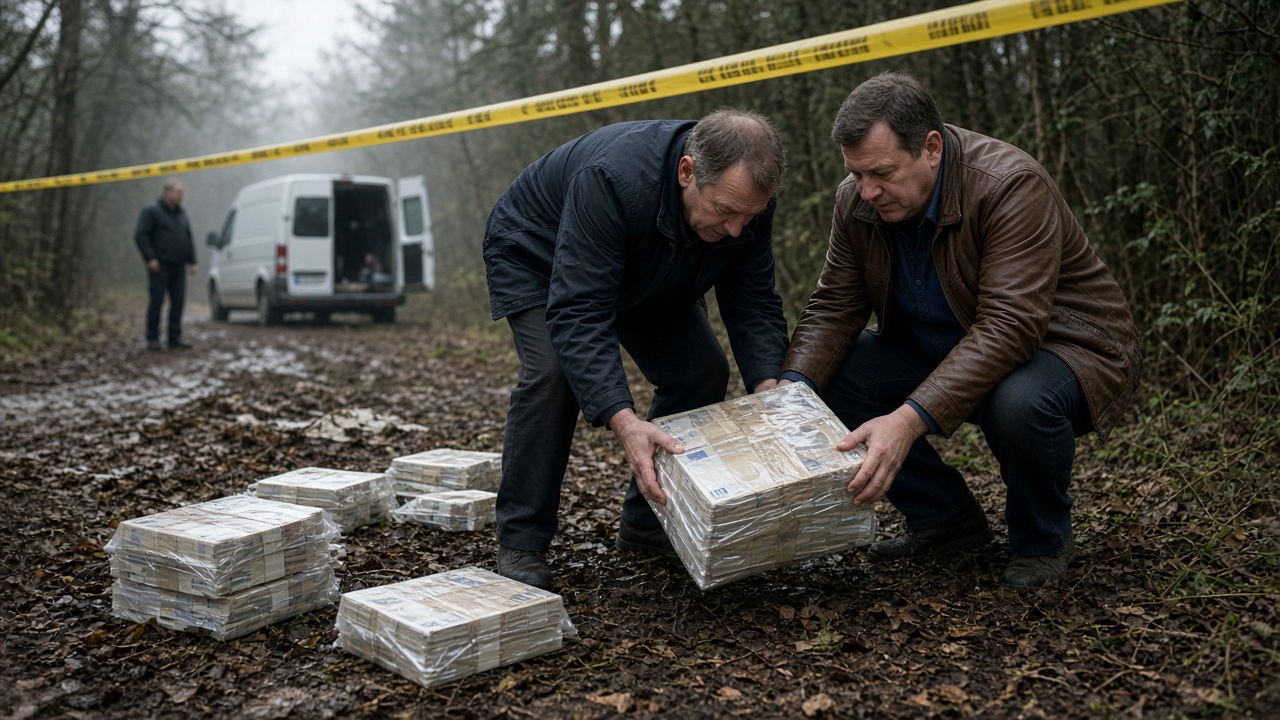
Hungarian investigators pulled more than five billion forints, 2.65 million euros and 1.26 million dollars out of forests, farm sheds and residential properties this week, the National Asset Recovery and Protection Office said, as a corruption case against former national development minister Miklós Seszták widened beyond Budapest into rural counties.
What the searches recovered
Coordinated raids on 12 and 13 November covered sites in Budapest and the counties of Pest, Békés and Nógrád, the agency said. Teams found cash buried in woodland, hidden inside agricultural buildings and warehouses, stored in homes and locked inside a high-value safe in a remote location. Staff paid the recovered sums into the Hungarian State Treasury on Friday.
The total cash count was 5,071,632,000 forints alongside the foreign currency stacks, according to the office’s public accounting. Hungarian media outlet MTI carried the same figures in its wire coverage.
How the case ties to Volánbusz contracts
Prosecutors suspect that between 2015 and 2018 Seszták and the chief executive of Hungarian National Asset Management received more than 11 billion forints in illicit payments from representatives of companies that held contracts with Volánbusz, the state bus operator, the investigation alleges. The asset-recovery office did not name additional defendants beyond Seszták and the MNV executive in its Friday statement.
Seszták has been in pre-trial detention since late September. The Buda Central District Court extended that custody through 30 January, citing the gravity of the charges and the risk that he might flee or conceal evidence, the court announced in October. An earlier search at his Kisvárda home in October turned up heavy safes more commonly used by financial firms or pawn brokers, the agency said at the time.
Why the haul matters politically
Hungary’s governing bloc has weathered years of EU scrutiny over rule-of-law spending, and large physical cash seizures play differently from ledger disputes because they offer prosecutors tangible proof for jurors and voters. Opposition lawmakers quickly framed the forest caches as evidence that patronage networks still move money outside banking channels even as Budapest negotiates access to frozen cohesion funds.
The office did not say whether additional charges would follow Friday’s seizures, and Seszták’s legal team has not commented publicly since the detention extension. Analysts in Budapest said the next procedural step is likely a formal indictment request that incorporates the new currency totals as forfeiture exhibits.
What happens next
Investigators indicated that forensic accountants will trace serial numbers and wrapping bands from the recovered notes to earlier Volánbusz invoices. The European Public Prosecutor’s Office, which can join cross-border fraud files inside the EU, has not commented on whether it will attach to the Hungarian case. For now, the asset-recovery agency said further searches remain possible while Volánbusz procurement files from the 2015–2018 window stay under court seal.