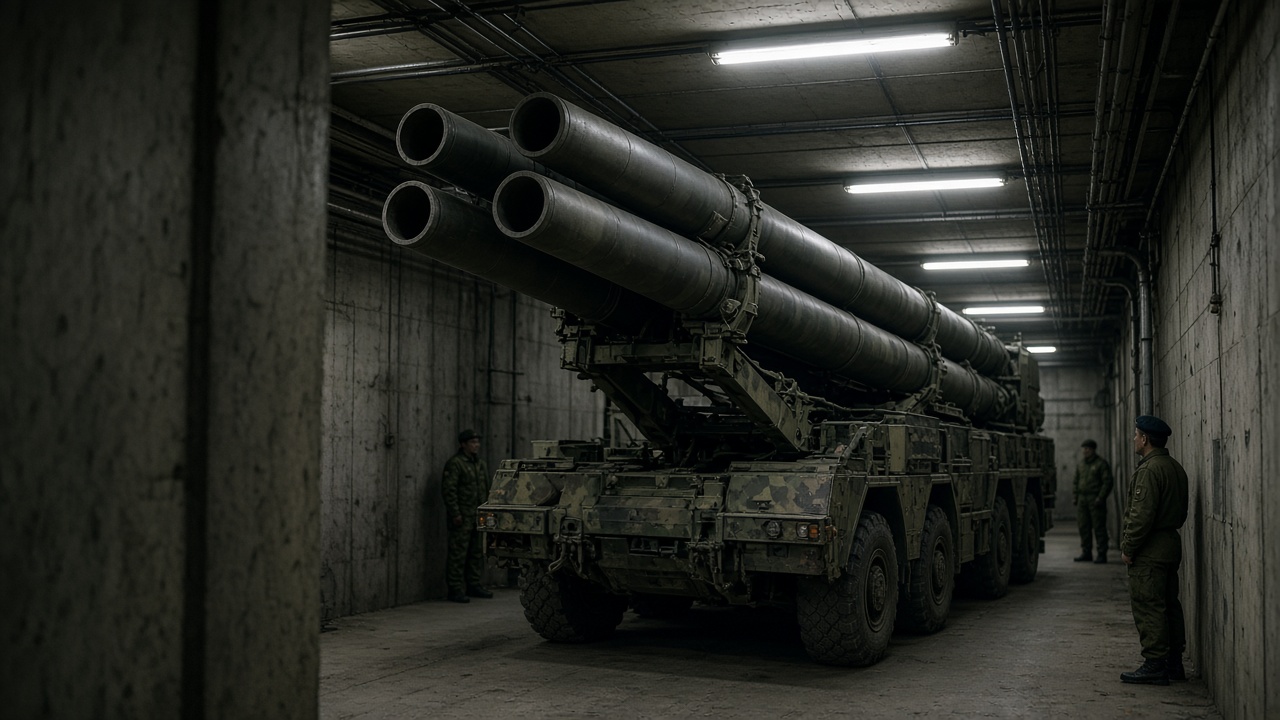
Iran’s Islamic Revolutionary Guard Corps aired footage on Saturday showing a launcher built to fire two liquid-fuel ballistic missiles from the same platform inside one of the force’s underground “missile cities,” marking the first public display of that dual-liquid configuration and arriving as tanker incidents near the Strait of Hormuz keep Gulf insurers on alert.
State television and the Tasnim news agency said Maj. Gen. Ahmad Vahidi, the Guards’ commander-in-chief, toured the undisclosed facility in his first visit to such a site. Brig. Gen. Seyyed Majid Mousavi, who leads the Aerospace Force, told reporters at the base that Iran’s capabilities had grown in the interval between two wars with the United States and Israel, without naming dates. Footage showed Vahidi walking past camouflaged tubes and briefings on guidance upgrades described as independent of GPS.
What the Guards showed on camera
Iranian media contrasted the new rig with a solid-fuel twin launcher the Aerospace Force fired on April 7, during what domestic outlets described as the closing days of the earlier conflict. Liquid-fuel missiles need longer launch preparation but can adjust velocity in flight, a combination Iranian commanders said could complicate interception by regional air defenses.
Officials also displayed missiles they said carried improved range, accuracy, and domestically built seekers. Independent analysts could not verify the specifications, and the broadcast did not geolocate the tunnel complex. The display follows a November 10 visit by armed-forces chief of staff Maj. Gen. Ali Abdollahi to another underground missile installation.
Diplomacy and shipping pressure in the same news cycle
The broadcast landed hours after Foreign Minister Abbas Araqchi told the state-owned Iran newspaper that Tehran still hoped diplomacy could halt fighting with Washington and that mediators continued to carry messages between the capitals. President Donald Trump, speaking separately, said Iran wanted a deal he would not accept, keeping negotiators on a narrow ledge even as the Guards stage capability tours for domestic audiences.
Commercial tension in the Gulf sharpened the timing. The United Kingdom Maritime Trade Operations reported separate incidents involving projectiles striking tankers near Oman’s Khasab coast, while the Associated Press documented ongoing Israeli strikes in Gaza. None of those reports directly linked the Hormuz incidents to the underground launcher, but Lloyd’s underwriters have already widened war-risk premiums on routes through the strait.
How NATO and Gulf allies are reading the tape
U.S. Central Command has not commented on the Iranian video, and the Pentagon’s public schedule for the weekend carried no fresh guidance on force posture in the region. European diplomats in Brussels said the display was expected to feature in NATO consultations on missile proliferation, though no allied statement had been released by mid-evening Pacific time.
For commanders tracking salvo sizes, a dual launcher matters because it doubles the weapons a single truck or cave mouth can release before relocating. Dispersed launchers have been central to Iranian doctrine since at least the 2019 Abqaiq attacks, and the Guards have repeatedly used televised tunnel tours to signal survivable stockpiles.
Western intelligence officials will study the footage for tube diameter, erector design, and fueling timelines to see whether the liquid system is operational or still in parade configuration. Until those assessments arrive, the practical takeaway is political: Iran is advertising renewed strike volume while its foreign ministry still claims room for mediated talks.