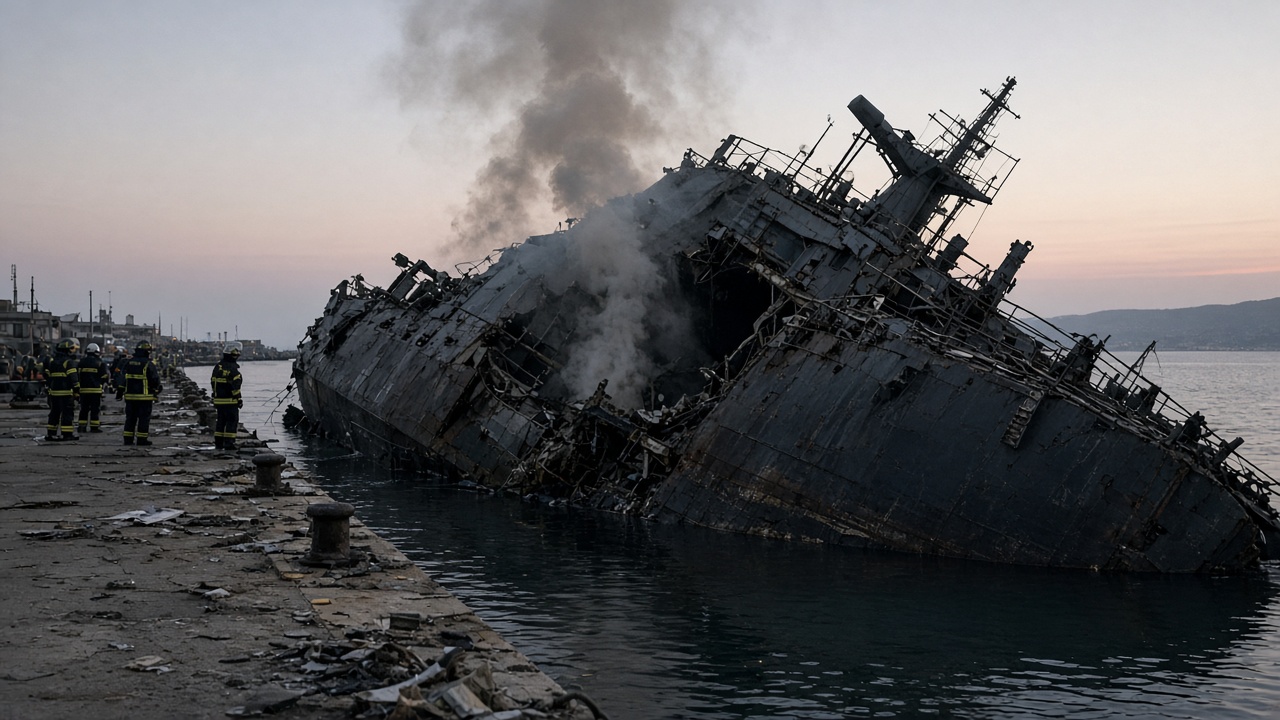
A Russian Steregushchiy-class corvette, the Merkury, sank alongside the pier at Libya’s Benghazi naval base after a series of explosions before dawn on Sunday, according to officials in the country’s eastern administration and independent imagery analysts. No group has claimed responsibility, and Russia’s defence ministry had not issued a public statement on the loss by late Sunday.
The Government of National Stability in eastern Libya said the vessel had berthed to refuel and take on supplies under an existing maritime cooperation agreement while returning toward Russian waters. State media in Benghazi quoted health officials as saying crew aboard a separate commercial vessel struck off the coast sustained minor injuries, a second incident the administration linked to the same morning’s violence at sea.
What imagery and officials describe
Planet Labs satellite frames geolocated by news organisations show a burning hull at the Benghazi port shortly after 05:47 GMT. High-resolution captures circulated by U.S.-based analytics firm Vantor depict the Merkury largely capsized by Sunday, with only the bow still visible and smoke rising from the superstructure. Debris littered the quay in those frames.
Two Libyan military officials told the Associated Press that several unmanned sea systems approached the warship, that at least four were intercepted, and that two reached the corvette and detonated. Those officials, speaking on condition of anonymity because the inquiry is ongoing, also said an early account traced the launch point to territory associated with Ukrainian operators in western Libya. That detail has not been confirmed by Libya’s eastern leadership in its formal statements.
Libyan response and legal exposure
The eastern administration condemned the strike as a violation of Libyan sovereignty and a threat to maritime safety. It said firefighters brought port-side fires under control, secured the site, and opened a joint investigation with Russian liaison officers to determine the source of the attack.
Libya remains split between rival governments, and eastern authorities have cultivated security ties with Moscow even as Ukraine’s war has spilled into grey-zone operations far from the Black Sea. Defence researchers at the Royal United Services Institute noted that Benghazi has hosted Russian naval logistics before, making the port both a symbolic target and a practical choke point for resupply.
Moscow’s silence and what comes next
Russian state media carried no acknowledgment of the sinking through Sunday evening. Western intelligence officials have long tracked Russian corvettes moving materiel and advisors through Mediterranean ports while avoiding NATO waters.
If the Merkury loss is confirmed, it would mark one of the most visible Russian surface-combatant casualties outside Ukrainian home waters since the full-scale invasion began. Maritime insurers and port authorities across North Africa will watch whether eastern Libya tightens pier access or whether a second unmanned strike against the Malta-flagged merchant vessel signals a wider campaign against Russian-linked traffic.
Late Sunday, Libyan authorities said they were coordinating with Russia to recover bodies and assess pollution risk from fuel and ammunition aboard the corvette, which regional sources said had been carrying drones and small arms in addition to standard naval stores. None of those cargo claims has been independently verified.