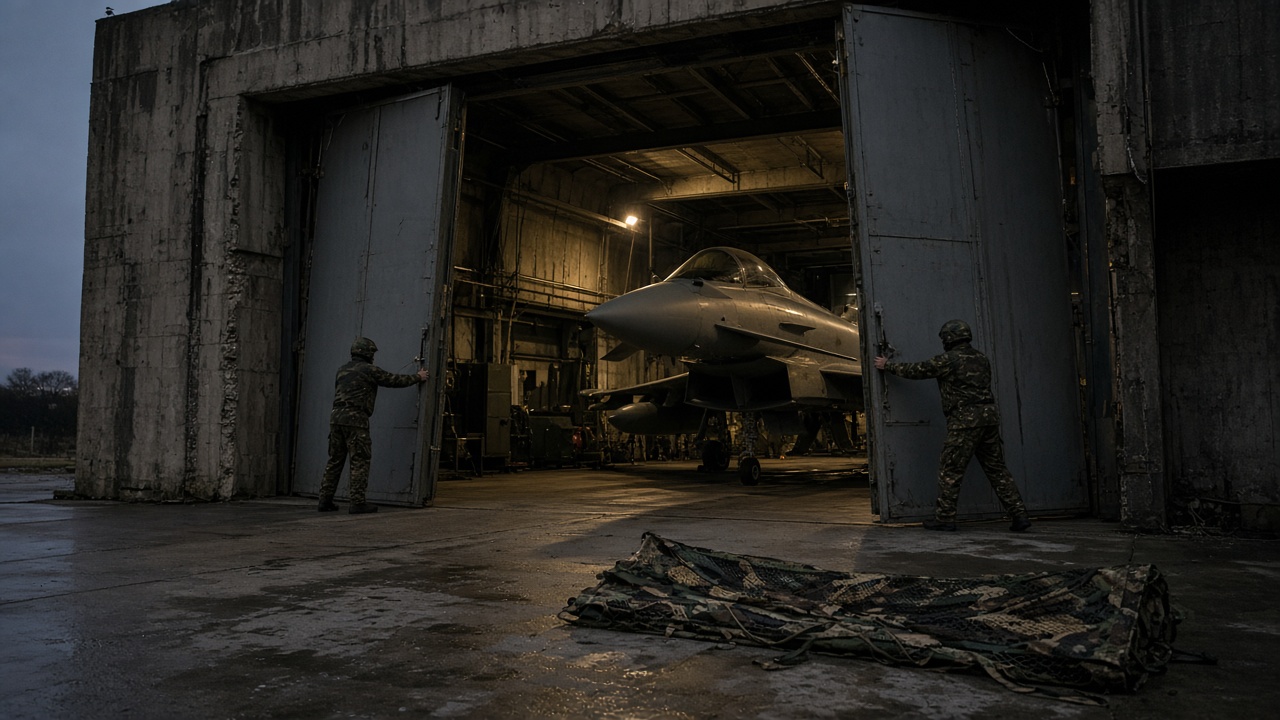
The Times and Sky News reported on Wednesday that Royal Air Force commanders have begun parking fighters inside hangars and hardened aircraft shelters overnight and plan to drape anti-drone netting over jets that must stay outside, responding to what the outlets described as elevated unmanned-aircraft risks at British bases. The Ministry of Defence did not confirm the specific measures but said it continually adapts to potential threats.
What the reports describe
Neither outlet named its sources. Both said aircraft would be shifted under cover of darkness and that netting modeled on Ukrainian field defenses would shield remaining aircraft on the flight line. The Telegraph quoted Air Chief Marshal Rich Knighton telling a Freeman Air and Space Institute audience on Tuesday that the RAF must be as ready as it can to protect aircraft and signaled more dispersion while a runway at Prestwick is rebuilt.
Justin Bronk, an airpower researcher at the Royal United Services Institute in London, told Al Jazeera the steps would be a sensible response if intelligence pointed to a credible drone threat. He noted that Coningsby, Marham and Lossiemouth still maintain Cold War-era shelters but that consolidation into super bases left too few bays for every Typhoon.
Spending and recent scares
In its statement, the MoD cited 470 million pounds of additional security funding for military sites, including surveillance and counter-drone systems, on top of 15 million pounds already spent on drone technology and restricted airspace over 44 defence locations. The figures landed a day after MI5 and the MoD issued a joint alert urging companies supplying Ukraine's military to tighten security against Russian sabotage attempts.
Britain has also weathered drone alarms at RAF Lakenheath, where the U.S. Air Force said personnel responded to suspected unauthorised drone activity in mid-November without damage, and at RAF Fairford, where authorities linked a petrol-barrel scare in September to wider Iran-related security concerns that preceded the withdrawal of American B-1 bombers.
What hardened shelter buys
Bronk told The Telegraph that nets can help but require large footprints and careful rigging so wind does not drop material onto airframes. He argued the first question for planners is whether Britain still has enough reinforced concrete: hardened shelters remain cheap insurance against one-way attack drones and limit cruise-missile damage to a single airframe per hit.
Liberal Democrat MP Mike Martin, who chairs a parliamentary rearmament group, welcomed shelter moves but warned that dispersing jets nationwide still leaves exposed aircraft vulnerable if they park in the open. Washington Post reporting on the same day noted that a ministry spokesman declined to comment on hangar orders specifically while highlighting expanded counter-drone spending.
For now, the reported overnight sheltering marks a visible shift from assumptions that base security could rely on perimeter fences alone in an era of cheap commercial drones.