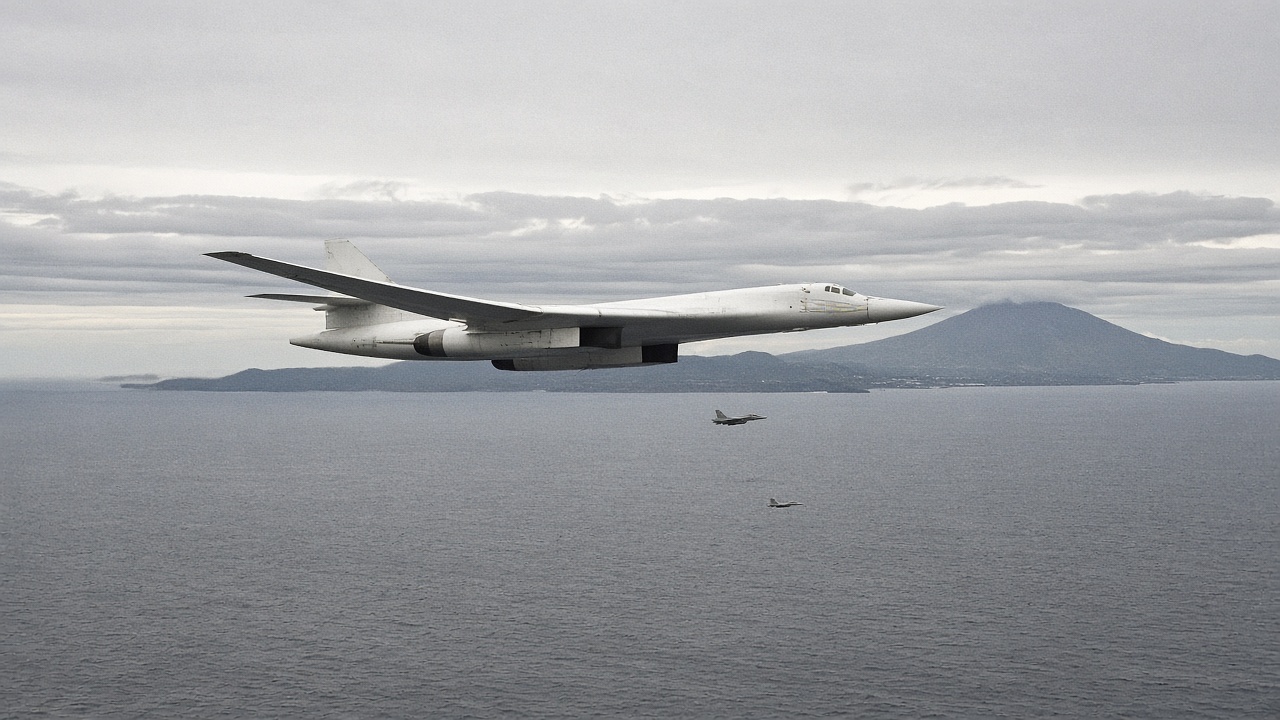
Russia's Defense Ministry released video on Tuesday showing Tu-160 strategic bombers flying over the East Sea, a day after the formation prompted South Korea's first known preemptive civil air-raid alert for Ulleung County when the aircraft closed to within roughly a nautical mile of the island's territorial airspace boundary. Seoul's Joint Chiefs of Staff said F-15K fighters scrambled from Daegu before the Russian jets turned east and left without crossing sovereign airspace.
Tuesday morning on Ulleung
The Interior and Safety Ministry sent an emergency text at 7:52 a.m. instructing Ulleung residents to shelter underground or inside sturdy buildings. Five minutes later a follow-up message lifted the warning after the aircraft moved beyond what officials called the danger zone.
North Gyeongsang Province's own lift message mistakenly referred to a suspected North Korean aircraft, which a provincial official attributed to reusing a drill template without changing the wording. The Joint Chiefs later confirmed the intruders were Russian military aircraft operating inside South Korea's air defense identification zone, not an airspace violation.
Russia's account and Seoul's protest
TASS quoted the Russian Defense Ministry saying the roughly 10-hour mission stayed over international waters and complied with airspace rules. Su-35S and Su-30SM escorts accompanied two Tu-160 bombers capable of carrying nuclear-armed cruise missiles, and the ministry said foreign fighters intercepted the bombers at points along the route.
South Korea's Defense Ministry summoned Russian air attaché Nikolai Marchenko on Tuesday to protest the KADIZ incursion and demand steps to prevent a recurrence. The Russian Embassy repeated Moscow's view that South Korea's identification zone is a unilateral line that does not bind other states.
Why the alert mattered in Seoul
BusinessKorea reported the bombers reached a point about 13 nautical miles off Ulleung, leaving barely more than a mile of margin before the 12-mile territorial limit. Military officials told reporters they judged a violation imminent because combat aircraft can close that distance in seconds.
Joint Chiefs spokesperson Jang Do-young told reporters on Tuesday that the aircraft approached to a point just before violating Ulleung airspace and that speeds made an incursion feel imminent even though none occurred. BusinessKorea noted analysts calling a nuclear-capable White Swan formation this close to the boundary unusual in recent years.
The episode arrives as KOSPI benchmarks slid again on U.S. tariff headlines and as railway unions prepare industrial action, but peninsula security desks focused on whether civil defense messaging can keep pace with fast-moving foreign bomber tracks. No shots were fired, yet the published Tu-160 footage keeps the flight visible to domestic audiences questioning how close foreign nuclear-capable bombers may fly to populated East Sea islands.