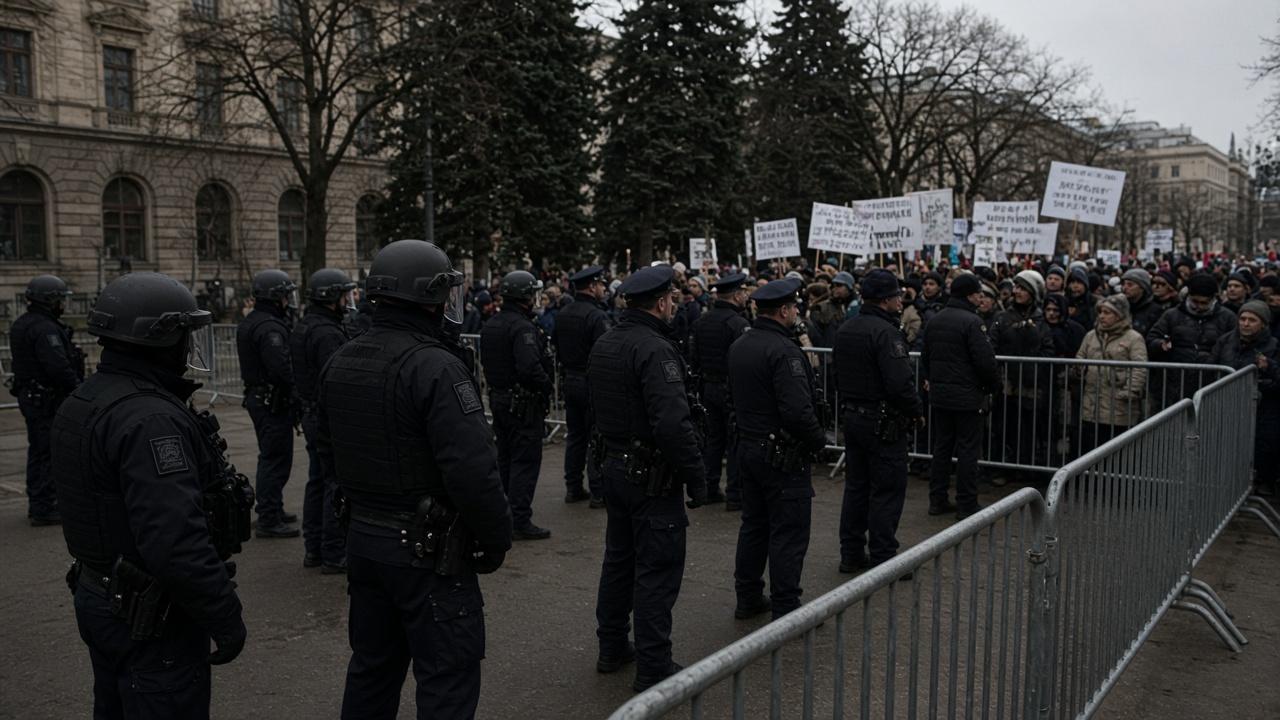
English police arrested more than 90 protesters on Saturday at Defend Our Juries demonstrations that displayed support for Palestine Action, the direct-action group proscribed under terrorism legislation in July, turning coordinated rallies into one of the country's widest single-day Terrorism Act enforcement operations in recent months.
Avon and Somerset Police said 31 people were held in Bristol on suspicion of displaying articles in support of a proscribed organisation after demonstrators gathered at College Green. Greater Manchester Police reported 34 arrests in St Peter's Square, telling reporters that officers acted after placards and banners crossed the legal line created when the Home Secretary listed Palestine Action.
Regional totals and police messaging
West Midlands Police said 25 protesters carrying signs referencing Palestine Action were arrested at Chamberlain Square in Birmingham. Chief Inspector James Littlehales said the force recognised peaceful protest, but would intervene when the public showed support for banned groups. Norfolk Police detained 10 people in Norwich on similar grounds.
Defend Our Juries framed the day as resistance to government complicity in Gaza and to the Palestine Action ban itself. Organisers said events ran in about 10 locations; police figures focused on cities where arrests occurred, not every site on the group's map.
A separate London coalition march
A different protest in London, organised by the Palestine Coalition, drew a far larger crowd that marched from Green Park toward Whitehall. The Metropolitan Police said about 100,000 people took part, according to organisers' estimates the force did not independently verify. Officers made five arrests for suspected affray and public order offences, a far smaller tally than in regional cities where Palestine Action imagery dominated.
Legal charities warned that proscription shifted once-lawful solidarity gestures into criminal territory overnight. Supporters of the ban argue it was necessary after repeated damage to defence-linked sites. Saturday's arrest counts will feed both narratives as cases move toward charging decisions and possible test litigation on protest rights.
Downing Street has not commented on the operation since numbers were released. For now, forces are standing down routes that ended without injury, while custody suites process paperwork that could keep some demonstrators in limbo for days.
How proscription changed the protest map
Home Secretary Shabana Mahmood proscribed Palestine Action under the Terrorism Act in July, placing the group alongside organisations whose support can trigger arrest on sight at demonstrations. Defend Our Juries said Saturday's rallies were designed to test that boundary by encouraging jurors and citizens to display solidarity messages the law now treats as criminal when they endorse a banned entity.
Avon and Somerset Inspector Ben Spence said the Bristol operation concluded safely and that one additional arrest related to failing to provide details under the Police Reform Act. Manchester officers said detained protesters remained in custody while enquiries continued. Legal observers urged forces to publish custody updates quickly, noting that terrorism-route detentions can carry longer initial holding periods than standard public order arrests.
Civil liberties groups are likely to monitor whether charges follow uniformly across regions or cluster in cities where senior officers spoke most forcefully on camera. Either way, the day's headcount gives ministers a measurable response to a campaign that began as courtroom solidarity and ended as a national policing story.