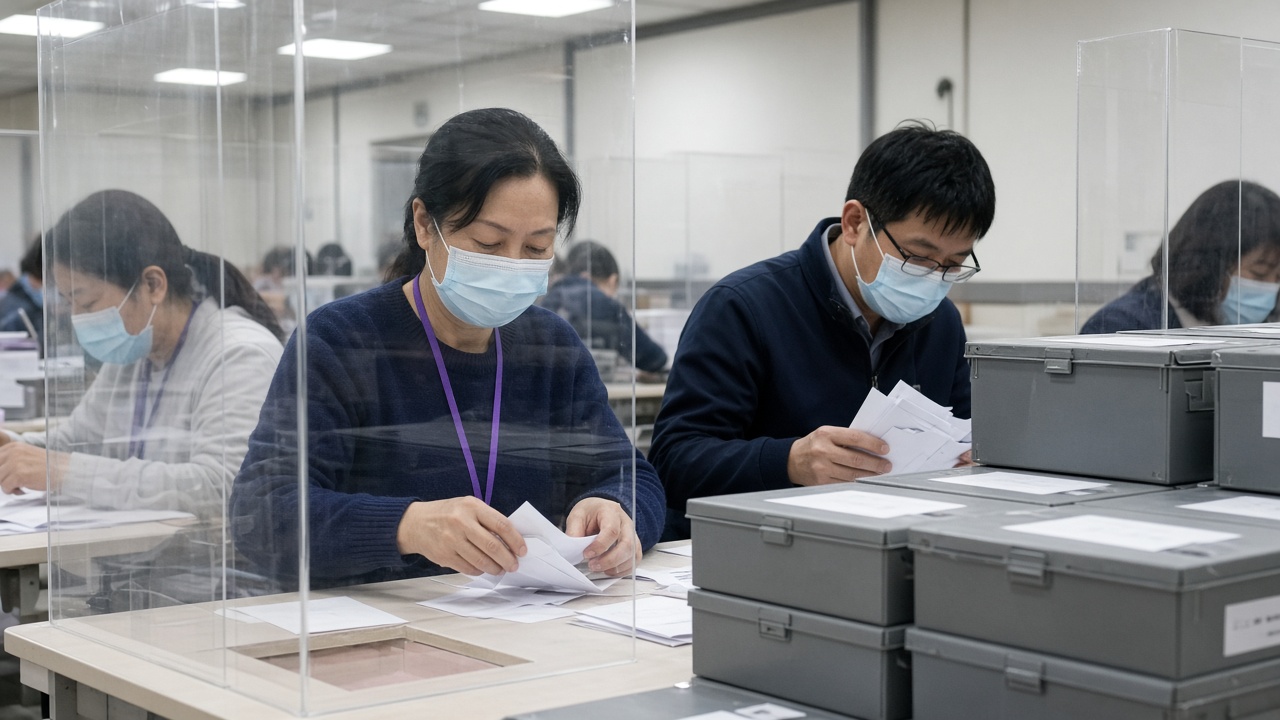
Taiwan's Central Election Commission certified on Saturday night that voters had overturned the government's "nuclear-free homeland" policy, approving a Kuomintang-led referendum question with 7,434,677 "yes" votes against 4,557,768 "no" votes. The measure cleared both required hurdles—outnumbering rejections and passing the one-quarter threshold of eligible voters—with turnout for the bundled ballot reaching 62.79 percent.
Official numbers
The commission counted 20,003,835 eligible voters for the referendum held alongside the nine-in-one local elections. Valid "yes" votes represented 37.17 percent of the entire electorate, well above the 5,000,959 votes needed to meet the one-quarter bar. The final margin was roughly 61.99 percent in favor to 38 percent opposed among valid ballots cast on the nuclear question.
The ballot asked whether the public supported "using nuclear power to boost the economy" and thereby abolishing the long-standing nuclear-free policy. It was the fourth nuclear-related referendum in eight years and the first since the legislature restored the practice of holding referendums on the same day as major elections.
Political context
Results landed hours after mayor and county races across 22 cities and counties, where the Democratic Progressive Party picked up several magistrate posts but failed to retake Taipei. Opposition chair Cheng Li-wun cited the referendum outcome Saturday as proof voters want the government to rethink energy policy, particularly for power-hungry semiconductor and artificial-intelligence plants.
President Lai Ching-te, speaking at DPP headquarters, praised the election process without endorsing the nuclear result. Executive Yuan spokesperson Michelle Lee said the Cabinet respects the vote but reiterated that the administration's underlying principles—nuclear safety, waste disposal, and social consensus—remain unchanged. She said ministers would continue prioritizing renewable expansion under the second energy transition.
What changes—and what does not
A successful referendum does not by itself restart reactors or approve new plant sites. Taiwan still has operational legal limits, waste-storage disputes, and facility reviews that opponents say were never resolved in the campaign. The National Nuclear Abolition Action Platform called the question a poorly designed "push poll" that avoided technical risks.
Supporters argue nuclear generation can stabilize prices and carbon intensity for fabs that already strain the grid. Grid operator Taipower and the Ministry of Economic Affairs will face pressure to spell out timetables for any policy shift, including Maanshan and other units idled in recent years.
Next steps
The CEC must publish formal certification documents before the result is legally final, and Yunlin and Hualien county races may still face recounts unrelated to the nuclear tally. Legislators from the KMT caucus, which initiated the question, are expected to demand executive action when the Legislative Yuan returns from recess.
For manufacturers watching power contracts, the vote signals public appetite for nuclear back on the table, but regulators have not announced new licensing steps. Investors and environmental groups now wait to see whether Lai's cabinet translates the referendum into concrete fuel-mix targets or treats it as a political ceiling on further anti-nuclear moves.