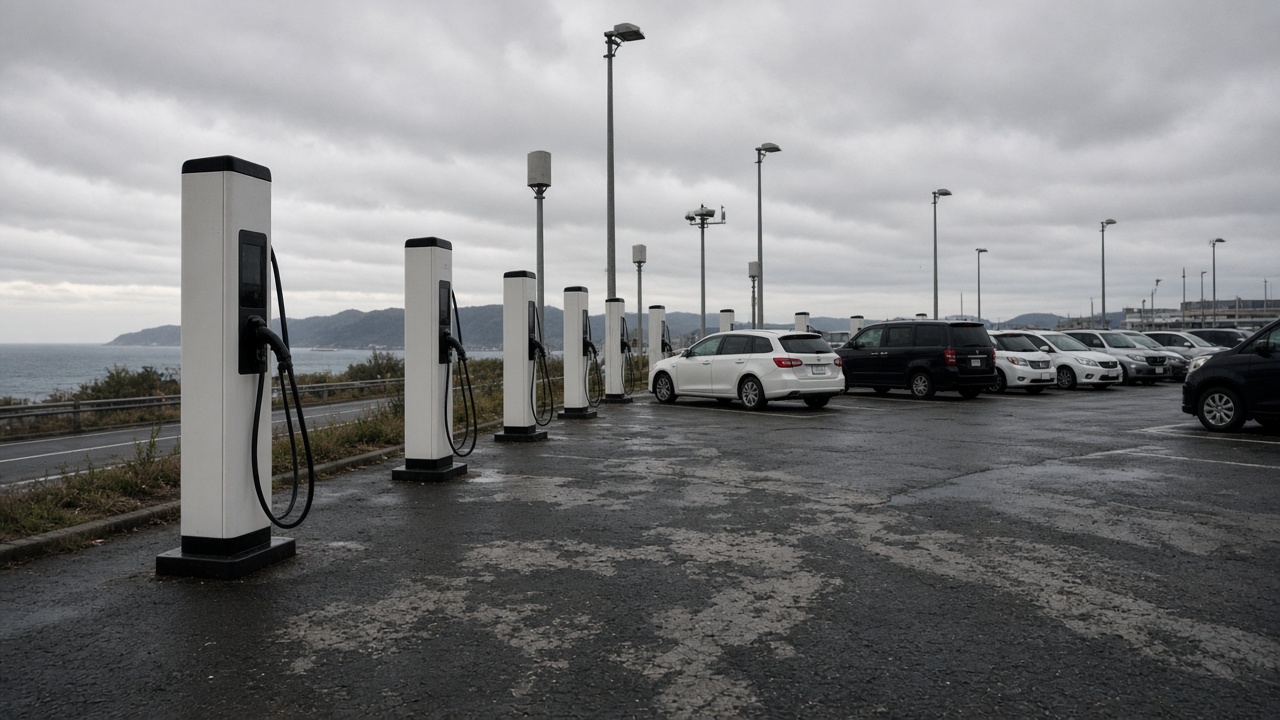
ENEOS Holdings has told municipal partners in Chiba Prefecture that a cluster of planned 150-kilowatt fast-charging bays along the Tokyo Bay Aqua-Line corridor will slip into early 2027, citing a double-digit jump in contracted demand charges from Tokyo Electric Power Company Holdings. The decision is narrow—roughly eighteen public sites—but it lands as Japan’s largest fuel retailer tries to square EV infrastructure pledges with grid economics that worsened after summer peak pricing reviews.
Why Chiba became the pinch point
Chiba hosts both commuter spillover from Tokyo and heavy logistics traffic serving Narita International Airport and the Keiyo industrial belt. ENEOS had mapped chargers beside existing service stations where land was already leased and transformer capacity looked sufficient on paper. TEPCO Power Grid’s revised fee tables for high-load connections, effective from July 2026, changed that math: several bays would need upgraded substations whose payback periods exceed the five-year targets ENEOS uses for mobility capex.
Prefectural officials said the company remains committed to fleet depots serving parcel carriers and rental fleets near Ichikawa and Funabashi, where utilization is predictable and off-peak charging can be scheduled. Retail plazas aimed at holiday drivers on the Aqua-Line, by contrast, would spike demand during short afternoon windows—exactly the profile grid operators price aggressively.
Policy context and competitor moves
Ministry of Economy, Trade and Industry guidelines still call for 150,000 public chargers nationwide by 2030, and ENEOS publicly tracks its install count in sustainability disclosures. Rivals Idemitsu and petroleum cooperatives have leaned on slower AC posts at rural stations where demand charges stay flat. ENEOS’s Chiba pause does not alter national totals materially, but it signals that DC rollouts along urban expressways are no longer automatic when yen-funded grid upgrades must compete with dollar-priced equipment imports.
Industry groups asked METI this month to clarify whether demand-response credits can offset fast-charger peaks. Until that guidance firms up, ENEOS is concentrating Chiba spending on software to manage load at existing hubs rather than pouring concrete at new ones.
Silver Week and traveler expectations
Respect for the Aged Day on September 21 and the autumn equinox holidays will push highway traffic higher just as the delayed sites were supposed to open. Rental-car agencies operating from Narita have backup contracts with independent charge point operators in Kisarazu, yet drivers accustomed to ENEOS branding on forecourts may notice fewer new pylons this season.
ENEOS retail teams are instead promoting membership pricing on existing Chiba chargers and mobile-app reservations to reduce simultaneous plug-ins. The refiner’s messaging to franchise dealers stresses that gasoline and diesel availability is unaffected; the slowdown is specific to capital-intensive DC hardware tied to grid tariffs.
Balance sheet and investor read-through
ENEOS does not break out charger ROI by prefecture, but mobility investments sit inside a broader decarbonization budget that already absorbed volatile crude and FX costs this year. Postponing Chiba concrete work frees several billion yen for maintenance at hydrogen pilot stations and for biofuel blending upgrades regulators are watching ahead of winter.
Equity analysts covering Japanese energy said the delay is prudent rather than a strategic retreat from EVs. If TEPCO or the national grid council publishes a simplified tariff for highway-adjacent chargers before fiscal year-end, ENEOS could resurrect the Aqua-Line timeline without revising group-wide charger targets.
What local governments want next
Chiba cities that co-funded signage and parking re-striping for the paused sites want written schedules by October. ENEOS planners have offered to install lower-power 50-kilowatt units where transformers need no upgrade, trading speed for timeline certainty. Prefecture climate officers said they will accept the compromise if fleet depots still open on time, because commercial vans dominate weekday emissions along Route 357.
For drivers, the practical takeaway is to check app maps before Silver Week: capacity is growing, but the fastest new bays along Chiba’s expressway necklace will arrive later than the summer press releases suggested. Grid fees, not battery shortages, set the pace.
Utilities analysts note TEPCO’s fee case mirrors debates in Kansai and Kyushu, where refiners operate smaller charger footprints. A national working group on highway electrification may publish harmonized tariff principles by December, giving ENEOS a template to restart paused sites without renegotiating each substation ad hoc.