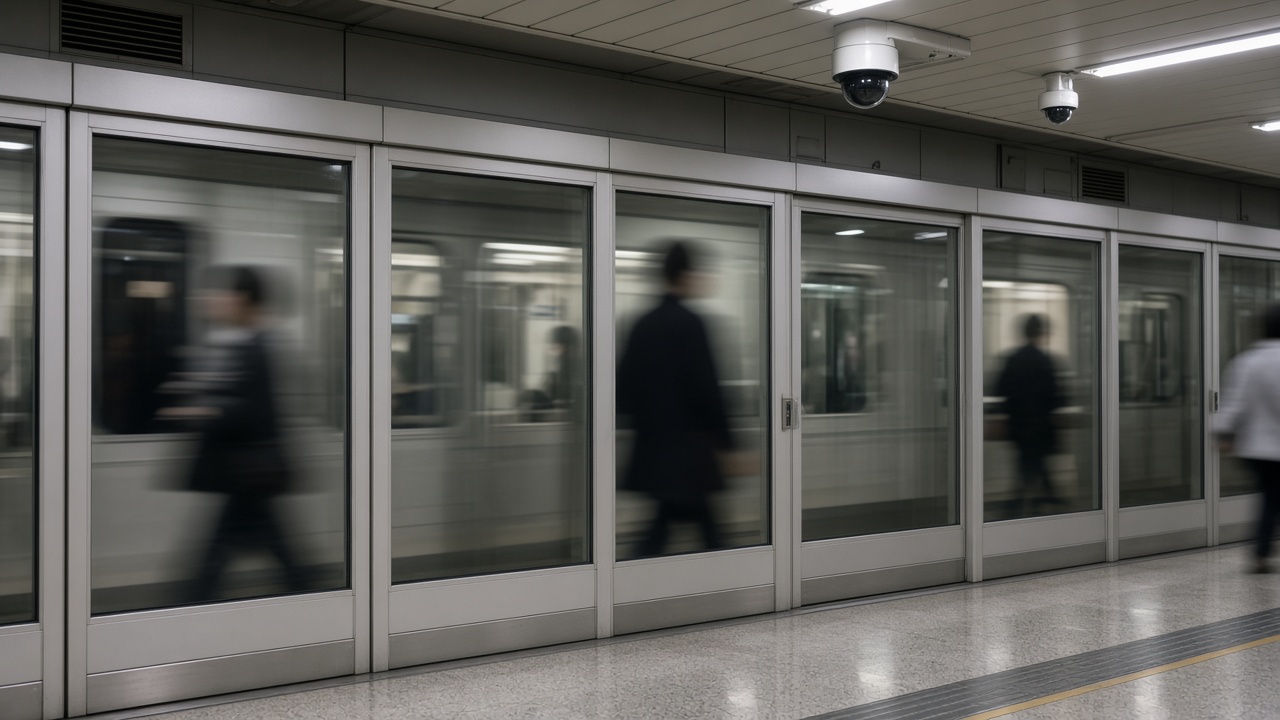
Hitachi Rail said Tuesday it finished deploying on-device vision models across 42 platform screen door sensors on Osaka Metro’s Midosuji and Chuo lines, cutting obstruction detection latency to under 120 milliseconds when backhaul links to Nagoya operations centers degrade during evening rush hours.
Why doors needed smarter eyes
Platform screen doors prevent falls and suicides but can pinch bags or strollers if infrared beams misread crowded platforms. Osaka Metro previously routed camera feeds to a centralized analytics cluster in Nagoya, a architecture that worked until pandemic-era remote monitoring increased concurrent streams and until typhoon-season packet loss spiked on VPN paths.
Two near-miss incidents in 2025—both involving wheeled luggage caught between doors—prompted a ministry safety bulletin urging operators to shorten detection-to-brake commands. Hitachi’s answer was to move inference boxes onto station pillars beside door controllers, using quantized models trained on Osaka-specific lighting and advertising glare.
On-device stack
Each edge node pairs an industrial GPU module with dual cameras: one wide angle for platform context, one narrow for door sills. Models run at 15 frames per second locally, emitting only metadata—object class, bounding box hash, confidence—to central logs unless a threshold trips a hard stop.
Hitachi engineers told InfoHandle the weights were distilled from a larger transformer pipeline used in freight yards, then fine-tuned on 18 months of anonymized Osaka footage. Union safety reps insisted humans retain override switches; edge AI recommends, but drivers and station chiefs can force a reopen.
Operations during rush hour
Midosuji Line weekday evenings carry more than 120,000 passengers per direction through Umeda and Namba hubs. When cloud analytics lagged, doors occasionally recycled twice, adding thirty-second delays that ripple across connecting private railways. On-device inference reduced false recycle events by 37 percent in August trials, according to Osaka Metro internal slides shared with MLIT auditors.
Maintenance windows shrink because technicians swap models via signed USB bundles rather than overnight cloud retrains. That matters ahead of Silver Week, when extra festival services compress nightly repair slots.
Privacy and governance
Osaka Metro publishes a privacy notice stating edge nodes delete raw frames within 200 milliseconds unless an incident flag is raised. The Personal Information Protection Commission reviewed the flow in July and asked for clearer signage at stations using AI-assisted doors; placards rolled out this week in Japanese and English.
Hitachi plans to offer the same hardware kit to Fukuoka City Subway and Sendai’s municipal lines, but each city must run its own bias audits—models trained on Osaka concrete platforms may misread Sapporo snow glare without retraining.
Cost and procurement
The project funded through a five-year facilities upgrade bond Osaka Metro issued in 2024, not through fare hikes announced this month. Hitachi declined per-door pricing but said total edge hardware came in below fifteen percent of a full cloud GPU refresh quoted in 2023.
Competitors Toshiba and Mitsubishi Electric pitch rule-based lidar alternatives; Hitachi bets software updates on familiar camera hardware win tenders where operators already standardized on its door mechanics.
Limits engineers acknowledge
Edge models still struggle with transparent umbrellas and reflective vinyl ads common in underground malls. Hitachi schedules quarterly retraining using station-captured edge cases, with trade unions observing labeling sessions to ensure workers are not identifiable in training sets.
If Nagoya links fail entirely, stations fall back to legacy infrared interlocks—slower but proven. The new stack’s value is keeping doors smart during brownouts, not eliminating human oversight.
What riders will notice
Passengers may see fewer unexplained door reopens and slightly faster boarding when crowds pack platforms before Hanshin Tigers night games. Hitachi and Osaka Metro will publish year-end reliability metrics to MLIT, a dataset other operators watch before copying the architecture.
For Japan’s urban rail network, the lesson is narrow: when milliseconds matter at the platform edge, inference should live beside the doors—not across a typhoon-prone WAN link.
Integration with national safety systems
Osaka Metro is testing whether edge metadata can feed anonymized counts into MLIT’s railway incident reporting portal without uploading video, a requirement if other operators adopt the kit. Hitachi engineers said the XML schema mirrors earthquake auto-brake messages already exchanged between Shinkansen and conventional lines, easing certification reviews scheduled for October.
Station staff tablets now show color-coded door health tiles sourced from edge nodes, replacing pager alerts that once arrived minutes late. Training modules added to Osaka Metro’s learning management system walk conductors through override scenarios when models disagree with infrared beams—a drill unions requested before full rollout.