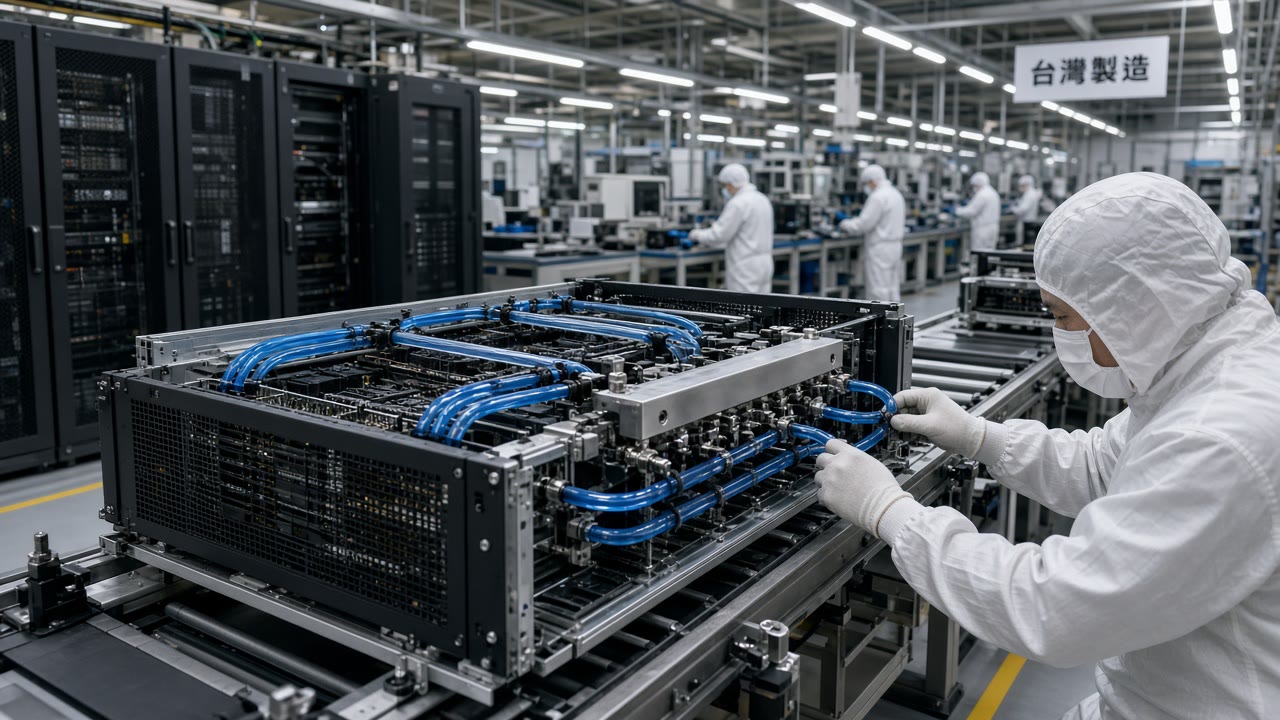
Hon Hai Precision Industry, known globally as Foxconn, is expanding dedicated AI server chassis capacity at Taoyuan and Kaohsiung campuses to feed Taiwan datacenter builds that previously relied on fully integrated racks shipped from Mexico and the Czech Republic, according to supplier notices and factory tour summaries reviewed by InfoHandle.
What changed on the line
The new lines focus on open compute-style trays built for Nvidia HGX and AMD MI300-class GPU modules, but Hon Hai’s Taiwan investment stops short of final GPU integration in some configurations. Instead, engineers assemble power distribution, liquid cooling manifolds, and cable harnesses so local operators can snap in accelerators after customs clearance—a workflow Taipei cloud providers requested when U.S. export paperwork stretched lead times past twelve weeks.
Hon Hai executives told investors in August that AI server revenue would exceed traditional iPhone mechanical parts growth this fiscal year. The Taiwan chassis push is a hedge against tariff chatter and a bet that domestic AI clusters will prefer same-day truck delivery from Taoyuan over air freight from the West Coast.
Who is buying locally
Taiwanese internet companies and semiconductor houses building private inference farms are the first customers. Two chip designers running large language model fine-tuning on Hsinchu campuses said they ordered Hon Hai chassis to standardize rack layouts across floors that mix training and visualization workloads. Colocation operators near Neihu and Bade are quoting “Foxconn-assembled” racks as a premium SKU with faster swap-out when cooling loops fail.
Hyperscalers with existing Taiwan regions are testing smaller batches to see whether local assembly clears fire-safety inspections faster than imported monolithic racks. None have announced public deals; procurement teams describe the trials as “island redundancy” after submarine cable cuts last year.
Cooling and power constraints
Liquid cooling is the differentiator. Hon Hai’s Taoyuan line includes leak-detection harnesses and quick-disconnect manifolds compatible with vendor-supplied cold plates. Technicians on the floor said they run pressure tests longer than Hon Hai uses for consumer electronics because datacenter operators treat a slow drip as a six-figure outage.
Taipower tariffs for high-density loads still worry buyers. Hon Hai is pairing chassis sales with power-monitoring firmware that feeds into building management systems—a feature pitched to Hsinchu science-park landlords renegotiating megawatt contracts with utilities.
Supply chain ripples
Sub-tier suppliers of busbars, PCIe retimers, and redundant PSU modules report double-digit order increases tied to the chassis program. Lotes, a Taiwan connector house, said it allocated extra capacity for high-amperage links used between GPU trays and power shelves.
The program does not replace Hon Hai’s Mexico footprint for U.S. customers subject to CHIPS Act packaging rules. It complements it: Taiwan-finished chassis can ship to Southeast Asia for final GPU integration when export licenses allow, while Mexico continues to serve North American hyperscale.
Labor and automation
Hon Hai is hiring experienced SMT and sheet-metal technicians in Taoyuan, offering retention bonuses uncommon in consumer assembly. Robots handle repetitive torque sequences on manifold bolts, but human inspectors still sign off on coolant loop photos stored for customer audits.
Union organizers in Kaohsiung said they want clarity on shift limits during peak AI server season, echoing debates during iPhone launch years. Hon Hai responded with published heat-stress protocols for factory floors running 24-hour burn-in bays.
Investor read-through
TAIEX traders treat Hon Hai’s AI chassis commentary as a read on domestic capex, not just iPhone build rates. Shares of cooling specialists and power-supply vendors rose alongside Hon Hai after the expansion memo leaked to supply-chain blogs.
Analysts caution that chassis margins are thinner than complete server sales unless Hon Hai also wins GPU integration. For now, the company is content to own the metal, the hoses, and the truck ride to a Taipei datacenter loading dock—exactly where Taiwan operators wanted more control.
Customer support on the island
Hon Hai is staffing a Neihu response center where datacenter operators can order replacement manifolds and PDU modules for same-day courier delivery across northern Taiwan. The center shares inventory codes with Foxconn’s consumer repair network but keeps server-grade parts in a separate clean room to avoid mixing consumer screws with rack-grade torque specs.
Operators said the service level matters more than marginal chassis discounts: when a leak sensor trips at 2 a.m., waiting for a freight forwarder is unacceptable.