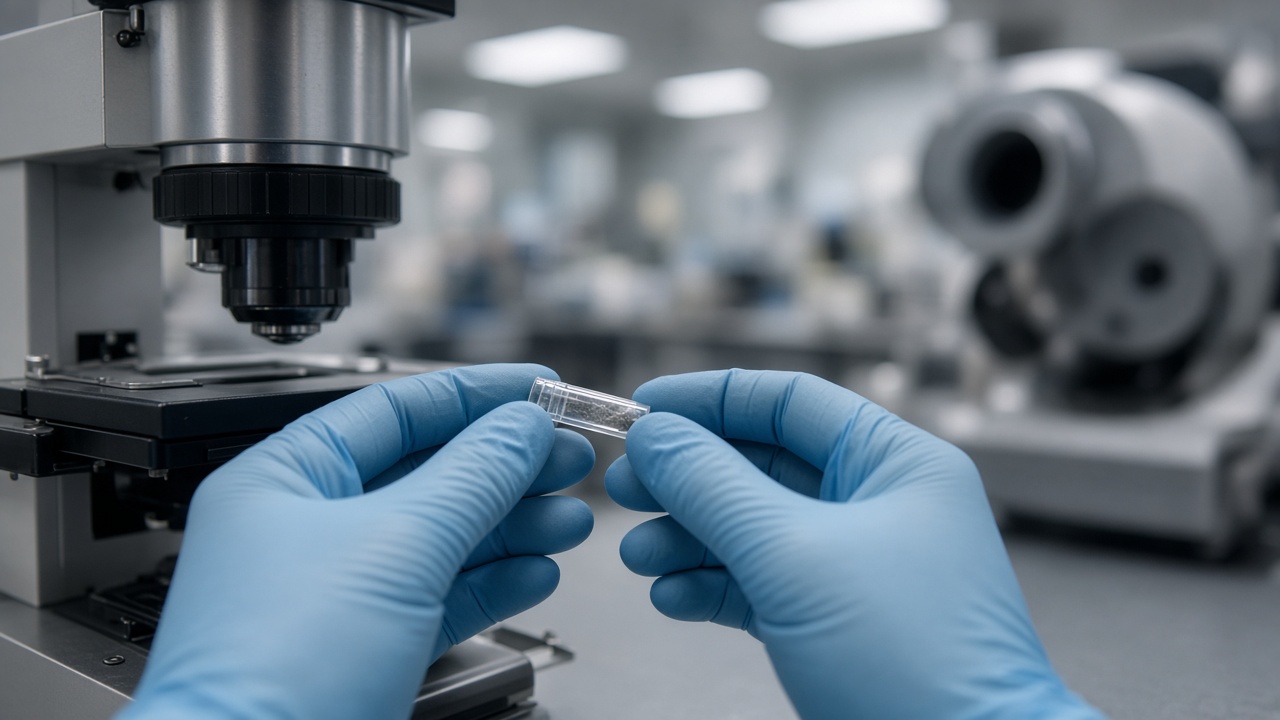
Researchers at the Japan Aerospace Exploration Agency and Spring-8 synchrotron facility published follow-on analyses Thursday showing elevated hydroxyl and fine-grained phyllosilicate signals in two Hayabusa2 Ryugu particles that were initially cataloged as “featureless” after the 2020 return capsule landing in Woomera, Australia. The results do not rewrite the mission’s headline—that Ryugu is a carbon-rich rubble-pile—but they refine how water molecules may have hitchhiked on dust before Earth’s oceans condensed.
Why follow-on work matters years later
Primary curation at JAXA’s Extraterrestrial Sample Curation Center consumed only microtomed slices from each grain, preserving parent chips in nitrogen storage for instruments that did not exist when Hayabusa2 launched in 2014. New nanoscale infrared mapping at Spring-8’s BL43IR beamline resolved 200-nanometer hydroxyl bands on rims previously dismissed as terrestrial contamination because they appeared after brief atmospheric entry exposure.
Team lead Nakamura Eizo told reporters at Sagamihara campus that re-measurement under ultrahigh vacuum ruled out lab moisture for one particle (catalog A0028) while a second (A0041) showed depth profiles consistent with ion implantation from solar wind hydrogen reacting with silicate surfaces—an in-situ weathering path distinct from bulk ice.
Implications for Earth’s water budget
Planetary scientists long debated whether Earth’s water arrived through massive icy comets or incremental dust delivery. Hayabusa2’s earlier bulk measurements suggested Ryugu material matches outer-belt asteroids with about five percent water by mass locked in minerals, not free ice. The follow-on rim signals support a model where fine dust from countless C-type bodies accreted hydrogen over millennia, then released water during planetary accretion heating—less cinematic than a single comet strike, more compatible with isotopic ratios seen in terrestrial mantle samples.
University of Tokyo coauthors cautioned against extrapolating two grains to all near-Earth objects, but noted both came from the same touchdown site, implying local heterogeneity even within a single regolith scoop.
Instrument pipeline
Spring-8 sessions ran in May and August 2026 after pandemic-delayed upgrades to infrared detectors sensitive enough for sub-microgram samples. JAXA shipped grains in triple-sealed containers with continuous shock logging; any vibration above five g aborts beamtime—a lesson from a 2023 near-miss when a truck hit a pothole on the Tomei Expressway.
Data will enter the Hayabusa2 public archive in October alongside computed tomography volumes so overseas teams can reproduce rim-profile fits without requesting new physical splits—an open-science push JAXA accelerated after OSIRIS-REx sample exchanges began.
Link to Hayabusa2 extended mission
While analysts studied grains, Hayabusa2’s spacecraft itself continues its extended mission toward small asteroid 1998 KY26, practicing navigation techniques for future planetary defense demos. Mission managers said water findings do not alter KY26 targeting but bolster political support for JAXA’s sample-return budget line, which Diet negotiators trimmed in spring supplementary debates.
Defense-minded lawmakers cite Hayabusa2’s ion engine endurance; science-minded ones cite water isotopes—both constituencies gain talking points from Thursday’s paper.
International context
NASA’s OSIRIS-REx Bennu samples show overlapping hydration features, though curation labs in Houston use different reference standards. A joint working group met in Kobe last month to harmonize phyllosilicate classification codes before a Nature Astronomy companion article ships. European Space Agency officials watching Hera’s asteroid rendezvous said Ryugu rim chemistry will inform how they interpret dust instruments aboard Juventas, though Hera focuses on impact craters, not returned grains.
Public outreach and Silver Week crowds
JAXA will stream a Sagamihara lab tour during Silver Week, displaying a replica capsule and magnified grain photos without opening new splits—curators stressed that every microgram is budgeted through 2028 instrument proposals. Planetariums in Sendai and Fukuoka updated shows to include “dust delivery” storylines alongside dramatic comet visuals.
What comes next
Remaining Ryugu chips await a combined atom probe and transmission electron microscopy campaign at Nagoya University slated for winter 2026. If rim hydroxyl correlates with organic molecule density, scientists could tie water delivery to prebiotic chemistry on early Earth—a narrative JAXA hopes fuels student applications ahead of the MMX Phobos sample mission launch window.
For Japan’s flagship explorer program, the follow-on is quiet science: not a new asteroid landing, but sharper answers from grains already sitting in Sagamihara—proof that sample return keeps paying dividends long after parachutes land.