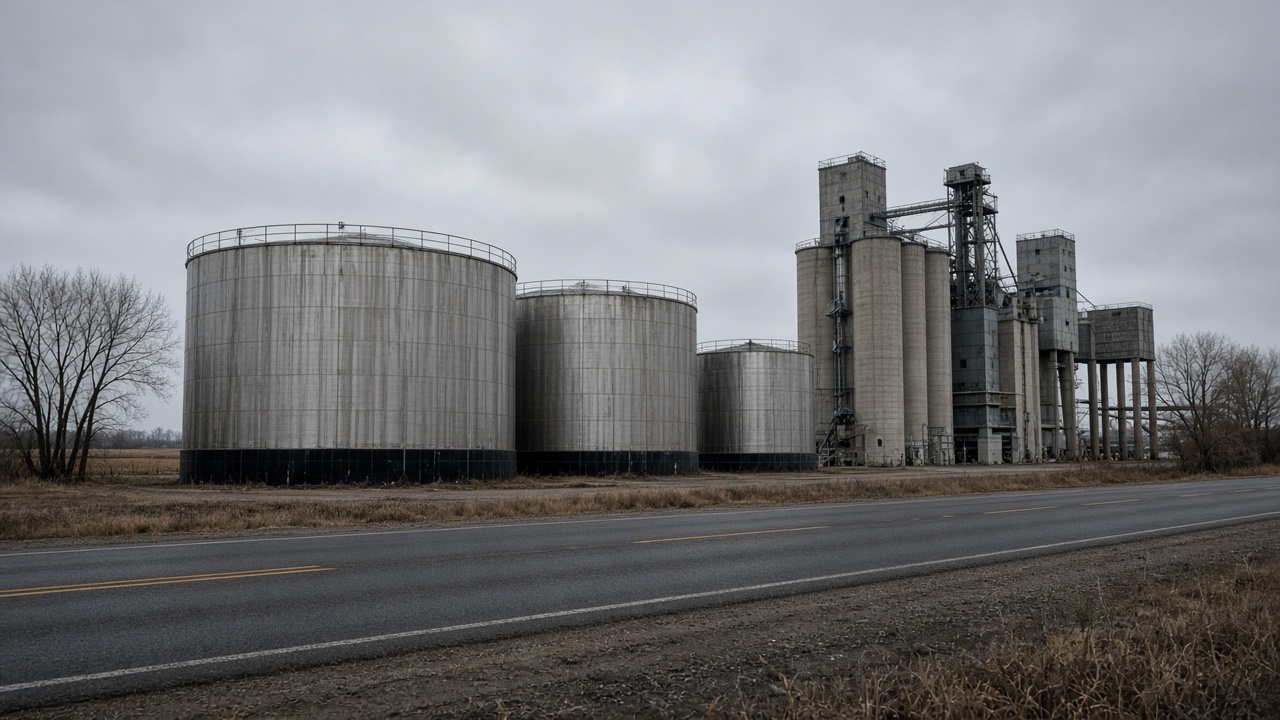
Executives at three Midwest ethanol companies told InfoHandle they cut average run rates by five to eight percentage points this week, not because corn is scarce, but because the money on the fuel side of the plant stopped cooperating. Diesel and other distillates have ripped higher after attacks on Saudi Arabia’s East-West pipeline and fresh shipping anxiety in the Strait of Hormuz, while finished gasoline has lagged the crude move that followed Brent back above $104 a barrel.
What the plants are seeing
At a 110-million-gallon facility near Council Bluffs, Iowa, the chief operating officer said distillate values in the Gulf Coast rack market are pulling more molecules toward diesel blending pools that compete with ethanol’s octane contribution in some export channels. The plant’s weekly margin model, which had shown a positive crush spread through late August, flipped negative on Tuesday when Chicago ethanol bids fell while ULSD differentials widened by more than 18 cents a gallon in two sessions.
Nebraska-based Green Plains and Iowa’s POET, which together account for a large share of U.S. nameplate capacity, have not issued public run-cut notices. People familiar with operations at two POET sites said shift supervisors were told to “hold at 92 percent” until rail economics for dried distillers grains improve. Green Plains declined to comment on day-to-day throughput; a spokesperson said the company monitors distillate spreads because they influence blender demand for ethanol in coast markets.
Why diesel matters to ethanol
Ethanol plants are not diesel refineries, but they sit in the same physical system. When middle distillates trade at scarcity premiums—as Saxo and other commodity desks described this week, with some physical diesel markers cited above $200 a barrel equivalent—pipeline space and barge capacity tilt toward ULSD. That raises the opportunity cost of moving ethanol to the coast and can weaken bids in the Chicago hub even when corn input costs are stable.
Renewable identification numbers have offered only partial relief. D6 RINs rose modestly as gasoline supply concerns surfaced, yet the uplift was smaller than the distillate-driven hit to co-product credits tied to animal feed exports. One treasurer at a privately held Iowa plant said lenders are watching working capital lines more closely because inventory ethanol must be marked against falling rack prices while natural gas feedstock for dryers remains elevated.
Corporate decisions on the margin
The Council Bluffs operator is delaying a planned maintenance turnaround that would have idled a fermenter for ten days, choosing instead to run lightly and preserve optionality if gasoline cracks widen again. A competitor near Sioux City is doing the opposite: accelerating maintenance to avoid selling gallons into a soft spot market. Both decisions reflect the same math—when diesel rallies faster than gasoline, ethanol’s share of the blender’s wallet shrinks.
Export channels add another layer. Brazil’s harvest pressure has kept anhydrous ethanol competition stiff in the Gulf, while European buyers facing their own distillate tightness have renegotiated arrival windows. U.S. Customs data through early September still show solid year-over-year ethanol export volumes, but traders said late-September loadings are being repriced daily as freight insurers widen war-risk premiums on Red Sea routings.
What filings and lenders signal
None of the large public ethanol names have filed material event disclosures this week, but second-quarter 10-Q language from smaller registrants already flagged “volatile crack spreads” as a covenant sensitivity. Regional banks that specialize in ag lending told InfoHandle they are stress-testing borrower models with Brent above $100 and diesel premiums at multiyear highs. The stress is not a liquidity crisis yet; it is a reminder that ethanol margins are a spread business, not a corn business.
Industry lobbyists are quietly asking the Environmental Protection Agency to clarify winter gasoline volatility rules that could pull more ethanol into domestic blends if refiners chase octane. That is a second-half story. For now, plant managers are watching Gulf Coast distillate print more closely than Chicago corn futures.
What happens next quarter
If Saudi loadings at Yanbu remain disrupted and Hormuz transit stays choppy, diesel could keep outperforming gasoline through the harvest peak, when elevators need trucks fueled with the same ULSD that competes for pipeline space. Ethanol producers with flexible gas contracts and deep storage may ride out the squeeze; single-plant operators without export optionality may extend run cuts into October.
The firms that win on the next earnings call will be those that telegraphed early throttle decisions to co-op members and avoided dumping inventory into a rack market distorted by a distillate rally that ethanol executives did not cause—but still have to price.