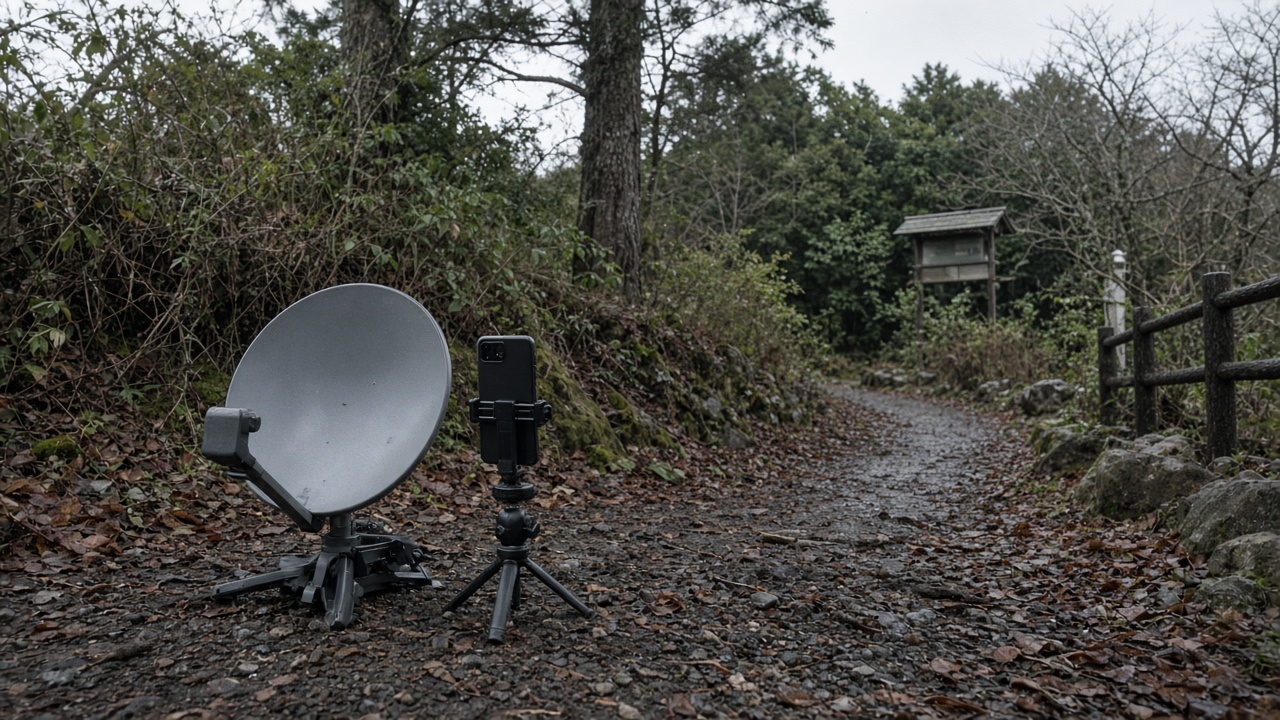
NTT Docomo said Wednesday it will delay a consumer satellite-to-smartphone pilot that was slated to begin field tests this autumn, citing an internal debris review tied to Japan Aerospace Exploration Agency conjunction forecasts on a low-Earth-orbit test shell. The slip pushes the first outdoor SOS trials into early 2027 and leaves hikers and offshore fishers without the overlay Docomo marketed at spring briefings.
What the pilot promised
Docomo had planned to let select Android handsets send short emergency texts through a partner satellite bus when cellular grids fail, using spectrum the Ministry of Internal Affairs and Communications cleared for non-terrestrial trials. Retail decks shown to enterprise customers in July promised beta badges on rugged phones sold through Docomo shops in Hokkaido and Okinawa prefectures—two regions where typhoons routinely knock out macro sites for days.
The carrier never named the spacecraft vendor in public filings, but regulatory appendices list a 600-kilometer inclination band shared with several commercial messaging constellations. Engineers intended to validate handover between terrestrial LTE and satellite bearers without forcing users to aim phones at the sky, a usability bar Docomo product managers said would differentiate the service from legacy Thuraya-style handsets.
Why debris review mattered now
JAXA’s Space Debris Office updated conjunction scenarios in August after tracked fragments from a 2024 breakup drifted into the planned test shell’s argument of perigee. Docomo’s safety board asked for a pause until partner operators could document collision-avoidance maneuvers and until ground terminals completed new radiation tolerance tests for the Silver Week travel window, when support desks would be thinly staffed.
People familiar with the review said the risk was not an imminent crash but insurance: maritime and aviation regulators wanted signed letters before emergency beacons could route through the satellite link. Docomo’s statement emphasized “alignment with national space safety guidance,” language JAXA uses when commercial pilots must show debris monitoring hooks.
Competitive and partner context
Rakuten Mobile and KDDI have their own non-terrestrial experiments, mostly fixed-wireless backhaul rather than handset SOS. SoftBank’s HAPOD consortium focuses on high-altitude platforms over urban corridors. Docomo’s delay therefore does not freeze the industry, but it cedes narrative ground to U.S. carriers already marketing satellite texting with Globalstar and SpaceX partners.
Domestic handset makers told InfoHandle they built dual-mode RF front ends into 2026 flagship SKUs assuming Docomo’s autumn pilot would supply test vectors. Those phones will still ship; only the satellite profile stays disabled pending new schedules.
Enterprise and government users
Prefectural disaster offices that signed memoranda with Docomo for mesh backups said the slip forces them to rely another winter on satellite phones stored in regional warehouses. Fire agencies in Shizuoka and Kochi planned autumn drills pairing the smartphone overlay with digital 171 disaster messaging; drills will downgrade to terrestrial-only scenarios unless Docomo supplies a lab environment.
METI officials monitoring critical-infrastructure resilience noted the delay in a weekly telecom resilience bulletin without criticizing the carrier, framing debris diligence as preferable to launching a pilot that fails during a live typhoon.
Technical work remaining
Docomo must finish updating ephemeris ingestion so handsets can predict satellite passes without constant server pulls—a battery concern raised by handset OEMs. Ground segment vendors must also certify that amplified uplinks stay within MIC power-density limits when users stand under tree canopy, a common hiking condition in Japan’s national parks.
Security reviewers asked for logs proving satellite bearers cannot be hijacked to exfiltrate contact lists, a bar terrestrial VoLTE already meets. Penetration tests scheduled for October will now run in December, according to two contractors on the program.
What subscribers should expect
Consumer pricing remains undecided. Docomo hinted at a modest monthly surcharge bundled with family safety plans, not per-message billing. Until early 2027, marketing will pivot to existing area-mail alerts and Wi-Fi calling on supported devices.
Analysts at a Tokyo brokerage cut near-term ARPU uplift estimates by a few yen per user, calling the delay prudent rather than catastrophic. For hikers watching autumn typhoon tracks, the practical message is unchanged: carry a fully charged phone, but do not count on satellite SOS from Docomo until the debris review closes and JAXA signs off on the revised ephemeris plan.