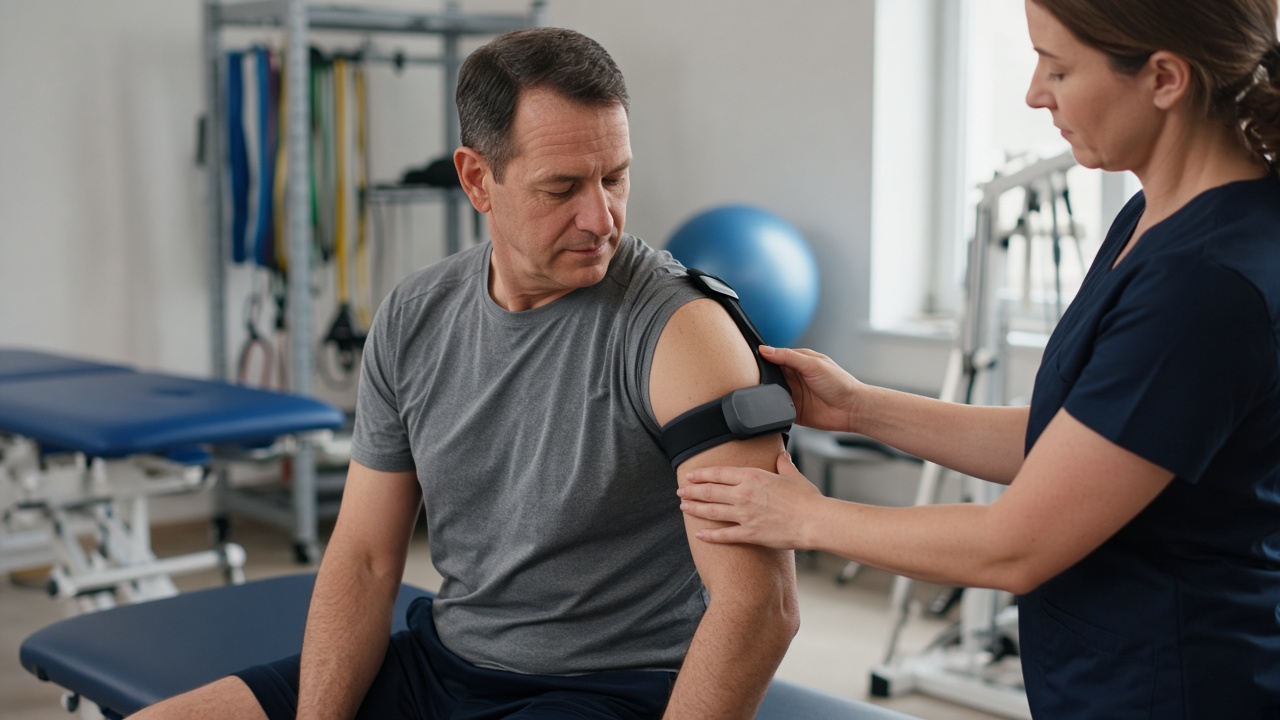
NeuroWeave, a Sendai medtech startup, closed a ¥780 million Series A led by UTokyo Innovation Platform and SMBC Venture Capital to manufacture shoulder wearables that cue mirror therapy exercises for post-stroke hemiparesis, expanding pilots with Tohoku University Hospital and two municipal insurers experimenting with outcome-based rehab payments.
Clinical problem
Stroke survivors with arm weakness often abandon home exercises when feedback is vague. Standard paper sheets cannot tell whether a patient actually reached range-of-motion targets between weekly physiotherapy visits. NeuroWeave’s fabric sensors measure shoulder abduction and forearm supination, vibrating when mirrors displayed on a tablet show asymmetric movement beyond clinician-set thresholds.
Dr. Kenji Sato, rehabilitation chief at Tohoku University Hospital, said a twelve-week pilot with forty patients cut missed home sessions by twenty-eight percent compared with pamphlet-only controls, though the study awaits peer review.
Hardware and software
The wearable pairs Bluetooth low-energy inertial units sewn into washable sleeves with a tablet app hosting recorded therapist avatars—not generative coaches—to avoid hallucinated instructions. Data stays on-device by default; clinics sync encrypted summaries over hospital VPNs when patients consent.
Manufacturing will move from Miyagi subcontract clean rooms to a Sendai headquarters line funded by the Series A, targeting five thousand units by March 2027. NeuroWeave chose domestic assembly to satisfy MHLW procurement preferences for Class II medical-adjacent devices even before full regulatory certification.
Funding use
The round also covers a randomized trial across Sendai and Morioka municipal hospitals, plus hiring twelve clinical liaisons who train community nurses to fit sleeves on elderly patients living alone. SMBC’s venture arm attached a milestone: if patients hit Fugl-Meyer motor improvement scores above a preset delta, a regional insurer will pilot bundled per-patient reimbursements instead of fee-for-service physio visits.
UTokyo IPC joined because NeuroWeave spun out of a robotics lab that previously built tsunami debris drones—sensor fusion expertise transferred to human motion tracking.
Reimbursement experiments
Japan’s public insurance still reimburses most outpatient rehab per session, discouraging long-tail digital coaching. Sendai City’s welfare bureau co-funded the insurer pilot to see whether vibration-cued home work reduces readmissions—a metric mayors watch as Silver Week travel strains caregiver availability.
MHLW officials have not endorsed nationwide coverage but cited NeuroWeave in a September digital health working paper as an example of “objective adherence measurement,” language startups read as a path toward future fee codes.
Competition and partners
Tokyo rivals CureApp and Jolly Good sell VR rehab content; NeuroWeave differentiates with sleeves usable while cooking or dressing, not only during headset sessions. Omron Healthcare explored distribution talks but paused until durability tests finish after fifty laundry cycles.
Tohoku Electric Power’s corporate venture unit joined as a strategic investor, interested in aging-grid regions where tele-rehab could cut daytime clinic trips.
Risks investors flagged
Clinical evidence must generalize beyond Sendai’s cooperative hospitals. Rural patients with poor Wi-Fi still benefit from on-device cues, but cloud sync failures complicate insurer audits—NeuroWeave is building USB export sticks for nurses who visit homes.
Founder Aiko Mori, a former physical therapist, said the company turned down a U.S. acquirer pitch to keep pricing in yen for Japan’s super-aging municipalities.
What patients will see
Rollout starts with hospital discharge kits: sleeve, tablet, and a QR code linking to city-supported helplines. NeuroWeave will not sell direct-to-consumer until the randomized trial finishes, avoiding the wellness gadget trap that plagued earlier posture wearables.
If insurer pilots hit targets, Mori hopes prefectural governments bundle sleeves into long-term care prevention programs—turning a Sendai startup raise into a template for stroke rehab outside megacity hospitals.
For Tohoku, the measurable bet is simple: cheaper sensors, clearer cues, and insurers willing to pay when arms move at home—not only when patients sit in clinic gyms.
Manufacturing and quality systems
NeuroWeave hired former Toyota production engineers to adapt andon-style stop lines for sensor calibration, halving defect returns during the Miyagi pilot build. Each sleeve ships with a QR-linked calibration certificate stored on hospital servers, satisfying Tohoku University Hospital’s procurement rules for reusable devices.
The company is applying for ISO 13485 certification while keeping the product in a wellness-adjacent category until clinical endpoints clear. Mori said that dual track lets insurers experiment without waiting for full pharmaceutical-style approvals, but also prevents advertising claims about stroke recovery rates until the randomized data matures.