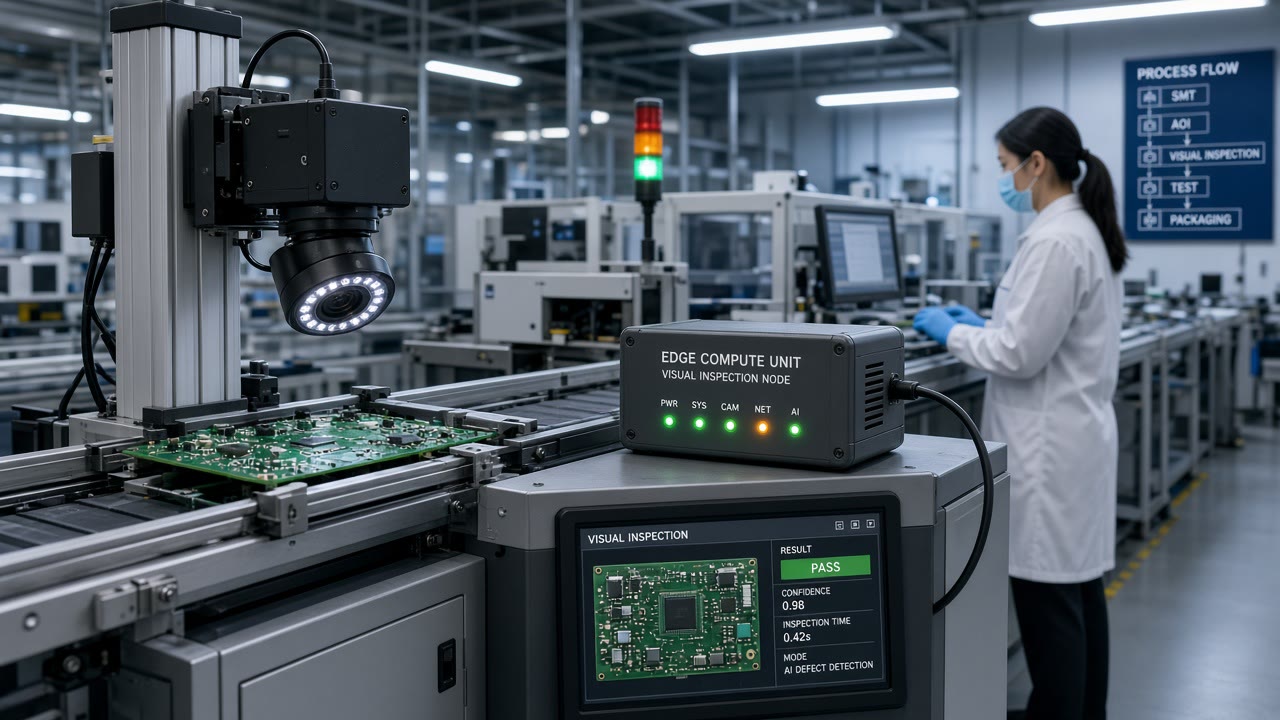
Contract manufacturers in New Taipei and Taoyuan are piloting edge-hosted computer-vision models on assembly lines to flag solder bridges and connector misalignments without streaming every camera frame to cloud GPUs in Hsinchu, according to factory engineers and a Ministry of Economic Affairs smart-manufacturing grant roster.
Why edge beats cloud here
Visual inspection for consumer electronics runs at line rates exceeding 30 boards per minute. Uploading uncompressed frames over factory Wi-Fi introduced latency that let defects reach packaging before cloud inference returned a verdict. Edge boxes sitting beside AOI cameras now run quantized models in under 40 milliseconds per frame, fast enough to trigger reject gates.
Privacy is a secondary benefit: some boards carry unreleased handset layouts under NDA. Keeping inference on-prem avoids arguments about whether cloud retention policies satisfy Apple and Samsung supplier agreements.
Hardware on the line
Pilots mix industrial PCs with Nvidia Jetson AGX modules and newer ARM accelerators from Taiwanese chip houses. Engineers mount cameras on existing conveyors rather than rebuilding lines—a requirement because Golden Week orders leave little downtime.
One New Taipei plant routes inference results into its manufacturing execution system so technicians see heat-map overlays on tablets at the rework station. False positives dropped after the plant fine-tuned models on a week of labeled rejects from the same line, not a generic ImageNet-style dataset.
Model sourcing and eval
Factories start from open vision backbones, then distill them with supplier-provided defect libraries. ITRI’s smart-manufacturing office offers a benchmark harness that scores precision/recall on solder-ball and BGA void classes common in Taiwan assembly.
Quality managers insist on shadow mode for two weeks: edge models annotate boards but humans still make the final call. Only after agreement rates exceed 95 percent do plants wire models to pneumatic reject arms.
Workforce impact
Line inspectors are not disappearing; they shift to labeling edge cases and auditing model drift when suppliers change solder paste recipes. Unions at two sites asked for retraining budgets tied to automation grants; MOEA templates now include upskilling line items.
Night-shift supervisors report fewer ergonomic injuries because workers spend less time leaning over magnifying lamps for repetitive checks.
Limits and failures
Edge models struggle with novel cosmetic finishes—matte glass backs and new anodizing colors confuse classifiers trained on last year’s SKUs. Plants keep a “cloud escalation” path for the first 48 hours after a product change, then pull frames back on-prem once enough labels exist.
Power blips remain a risk: edge boxes without battery backup can miss frames during brief outages, so plants pair them with UPS units sized for camera and gate actuators, not entire lines.
Scaling across Taiwan
Success in New Taipei is persuading Kaohsiung metal-stamping suppliers to test the same stack on scratch detection. The economics differ—lower line speeds—but the pattern holds: quantize, deploy beside the tool, keep GPUs in the science park for training only.
For Taiwan’s AI story on the factory floor, the win is mundane and measurable: fewer bad boards shipped before Golden Week, without another submarine cable worth of image traffic leaving the building.
Supplier scorecards
Brand-name OEMs now ask contract manufacturers to report edge-model precision metrics alongside traditional yield data. A missed recall because a model drifted after a solder-paste change can void quarterly bonuses, giving plant managers leverage to fund retraining instead of cutting headcount.
Regulatory filings
MOEA grant recipients must file semi-annual reports listing energy saved by avoiding cloud image uploads. One Taoyuan plant claimed a 12 percent drop in line-side switch power draw after moving inference local—a number auditors can verify against utility meters.
What's next on the line
Plants experimenting with multimodal checks—combining vision with acoustic signatures from pick-and-place heads—still route training jobs to Hsinchu GPU farms. The split is deliberate: train big in the science park, run small on the factory floor.
Contract manufacturers told InfoHandle they will publish edge-model change logs alongside ECN paperwork so customers can trace when a vision classifier last retrained—a request Apple supplier audits began asking for in 2026.