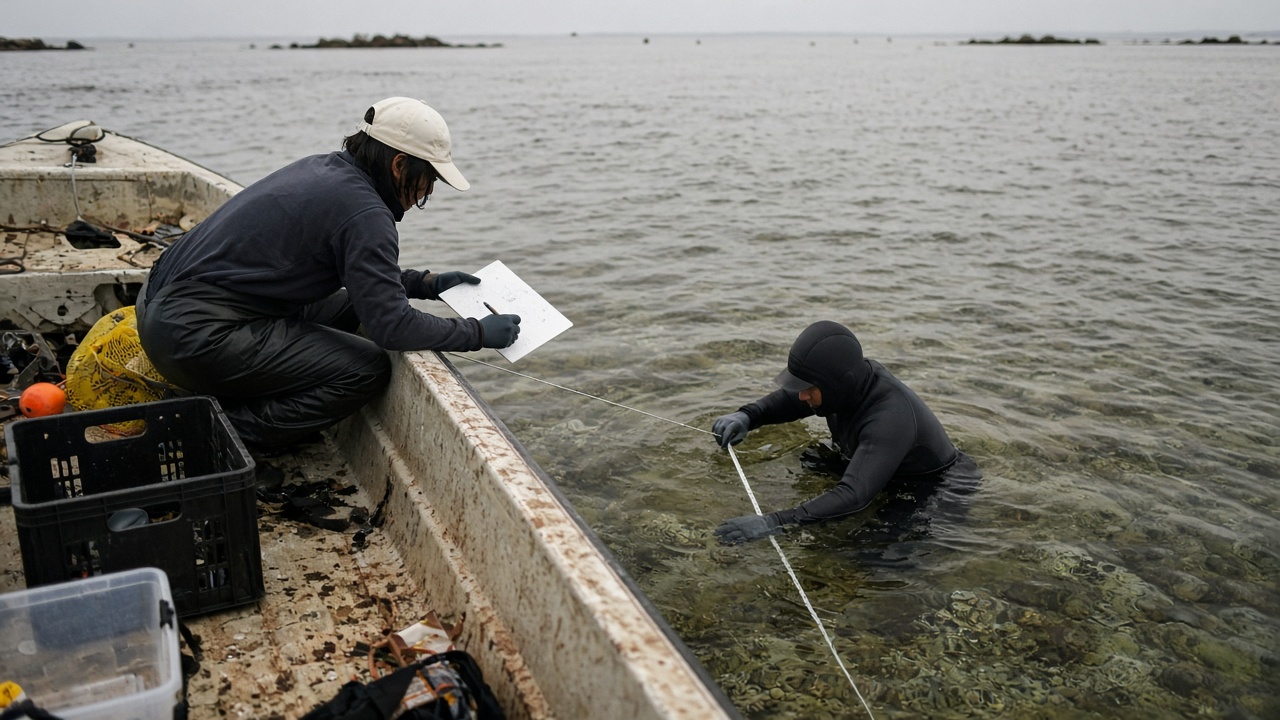
Researchers at Academia Sinica’s Biodiversity Research Center published a bleaching-recovery model for Penghu’s inner-lagoon corals Wednesday, estimating how many cumulative heat-degree weeks reefs can absorb before the probability of recovery within two years falls below 50 percent.
Methods
The team combined 2019–2025 transect surveys at four lagoon sites with satellite sea-surface temperatures tuned against in situ loggers deployed at 3-meter depth. They fit a survival model to branching Acropora and massive Porites colonies tagged with resin markers, not lifestyle claims about reef tourism.
Lead author Mei-Ling Tsao said the model intentionally excludes outer-shelf sites pounded by winter monsoon waves; Penghu’s sheltered lagoons heat faster but also cool overnight, a pattern satellite grids smooth out unless corrected with local loggers.
Results
Published in Frontiers in Marine Science, the paper reports a threshold near 9.2 degree-weeks above the lagoon’s climatology before recovery odds drop sharply for Acropora. Porites tolerated roughly two additional degree-weeks before the same odds line, consistent with prior Taiwan reef studies but quantified with Penghu-specific bathymetry.
The authors do not claim the model predicts fishery yields or tourism revenue. They do provide county planners a map layer showing which embayments approach the threshold under NOAA’s 2025 outlook scenarios.
Limits
Sample sizes are modest—112 tagged colonies—because repeated bleaching events reduced accessible plots. Genetic adaptation and algal symbiont shuffling are not parameterized; the model is a planning tool, not a forecast of evolution.
What happens next
Penghu County’s environment bureau said it will test the map in siting discussions for floating solar pilots that shade shallow flats. Academia Sinica plans a winter dive to see whether cooler months reset degree-week counters as the model assumes.
For scientists, the takeaway is narrow: Penghu lagoons have a measurable heat budget, and crossing it costs recovery time measured in years—not a moral about reef selfies.
Policy interface
Fishermen’s associations asked whether the county would pause jetty work that stirs sediment during recovery windows; the paper does not model sediment but flags months when diving surveys showed lowest polyp counts.
NOAA’s Coral Reef Watch data fed the degree-week calculations; Tsao’s team said they will open code repositories after peer review so harbor engineers can stress-test shading proposals without treating tourism slogans as science.
Replication
Colleagues in Okinawa and Palau have requested the logger mounting specs to compare lagoon versus reef-slope thresholds. Academia Sinica said replication cohorts must include their own loggers—satellite-only fits were rejected in peer review for underestimating afternoon spikes.
Winter surveys will test whether typhoon-cooled weeks reset cumulative stress the way the model assumes. If not, county planners will receive a revised map before the 2026 tourism season marketing push.
Marine park managers asked whether dive operators should avoid sites above the 9-degree-week contour during heat spikes; the authors declined to set tourism rules but supplied coordinates for voluntary closures tested with two pilot operators this autumn.