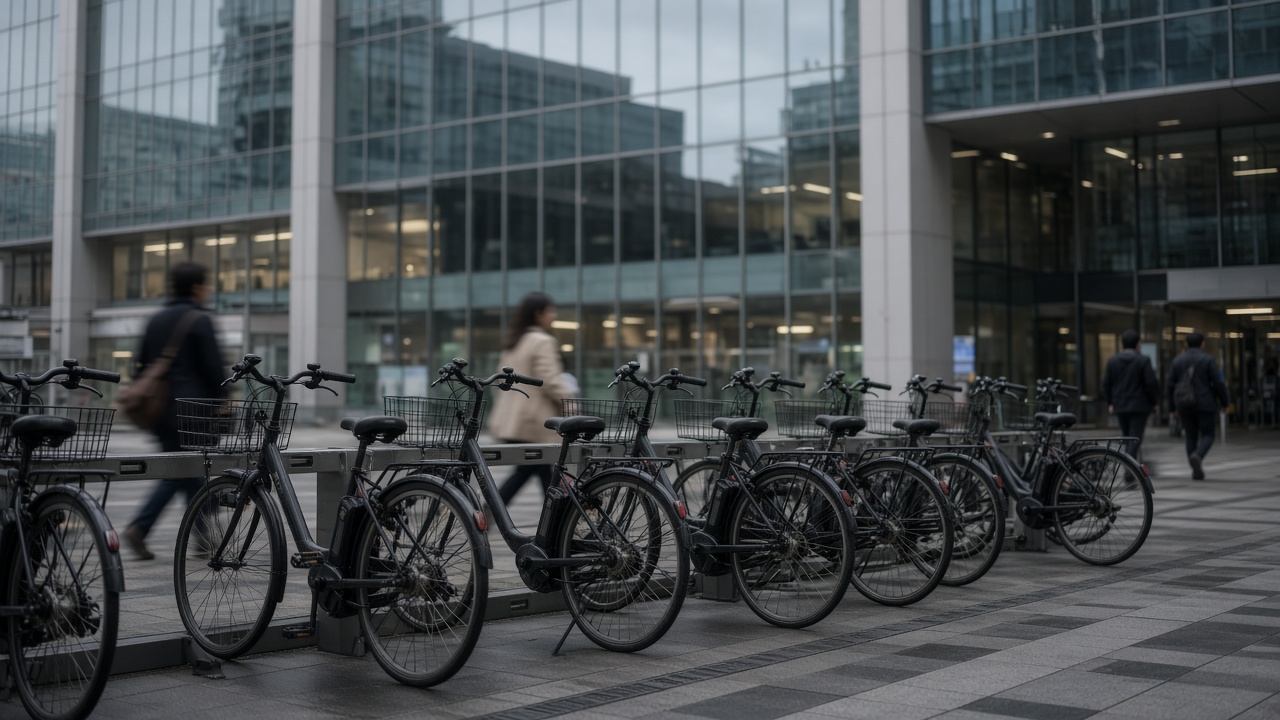
Micromo Mobility Inc., a Nagoya startup founded by former automotive supply-chain engineers, won a three-year contract with Aichi Prefecture and Nagoya City to deploy 420 docked electric-assist bicycles at JR station plazas and adjacent office-tower forecourts, according to contract summaries published Friday and interviews with municipal mobility planners.
Where the fleet lands
The first phase targets Nagoya Station’s Sakura-dori and Taiko-dori exits, Kanayama Station’s multimodal plaza, and Sakae’s subway interchanges—locations where existing share-cycle ports cluster manual bikes operated by Meitetsu’s Cariteco and OpenStreet’s Charichari programs. Micromo’s docks add motor-assisted frames for hills and longer hops to suburban manufacturing offices that commuter rail does not serve directly.
City officials said the placement complements Nagoya’s consolidated share-cycle web map launched in 2025, which aggregates port locations across operators. Micromo data will feed that map through an API so riders can compare battery levels and dock availability alongside incumbents.
Business model and pricing
Rides will price at 220 yen for the first fifteen minutes and 15 yen per additional minute, with a 1,800-yen daily cap aimed at office workers making multiple short trips. Corporate accounts can reserve blocks of docks near tower basements; two landlords at Nagoya Cross Court and Century Toyota Building participated in early negotiations because their tenants requested e-assist for warehouse-to-desk commutes across the station’s wide forecourts.
Micromo raised a 680-million-yen Series A in spring 2026 led by a Nagoya-based fund and a logistics REIT; the prefecture contract guarantees minimum dock fees during ramp-up, reducing the capital risk of buying frames upfront.
Why government backed a fourth operator
Nagoya’s Transport Plan 2030 emphasizes last-mile links that keep cars out of the core while boosting retail foot traffic. Planners argue manual share bikes already reduced illegal parking near stations; e-bikes extend the catchment for workers unwilling to sweat through summer humidity. Aichi’s subsidy covers civil engineering for powered docks—charging cabinets require heavier electrical work than Charichari’s mechanical ports.
Safety rules mandate geofenced speed limits of 20 km/h on sidewalks and automatic motor cutoffs in crowded plaza zones detected via onboard GPS. Helmets are not provided; marketing will echo national police guidance encouraging riders to bring their own.
Incumbent reaction
Cariteco and Charichari operators declined to comment on pricing war fears but noted their contracts remain non-exclusive. Micromo must allow cross-return only at designated hybrid ports to avoid cluttering legacy docks unequipped for charging. Meitetsu Kyosho, which runs Cariteco, is evaluating whether to license Micromo batteries for its own fleet upgrades in 2027.
Local taxi groups filed a routine protest citing unfair public subsidy; the prefecture response cited emissions targets and peak-hour subway crowding during Silver Week events.
Operational rollout
Installation begins in October with 120 bikes; full deployment finishes before the February manufacturing trade show season when foreign visitors crowd Sakae hotels. Micromo will staff a night maintenance depot near Sasashima-Raibu Station and use predictive swaps based on commute patterns learned during a 2025 proof of concept on private office plazas.
Micromo’s frames use mid-drive motors rated for five years of dock charging cycles; battery swaps happen at the depot rather than in the field to keep plaza wiring simple. Insurance underwriters required GPS theft recovery and remote motor disable before the prefecture signed; premiums are bundled into the per-ride fee rather than a separate rider surcharge.
University researchers at Nagoya Institute of Technology will receive anonymized trip data to study whether e-bike lanes planned along Hisaya-odori reduce bus bunching; Micromo agreed to share origin-destination heat maps quarterly. Retailers near Kanayama Station lobbied for docks facing shopping arcades, winning two ports with higher rent offsets from the city.
If utilization exceeds seventy percent at peak docks, the contract allows expansion to 600 bikes tied to upcoming Linear Chuo Shinkansen construction workforce shuttles. For Nagoya’s startup scene, the win is a rare municipal anchor contract that is not a mobile-game billboard—hardware on the street, revenue linked to rides, and a visible test of whether micromobility can shoulder commuter rail overflow without new parking garages.