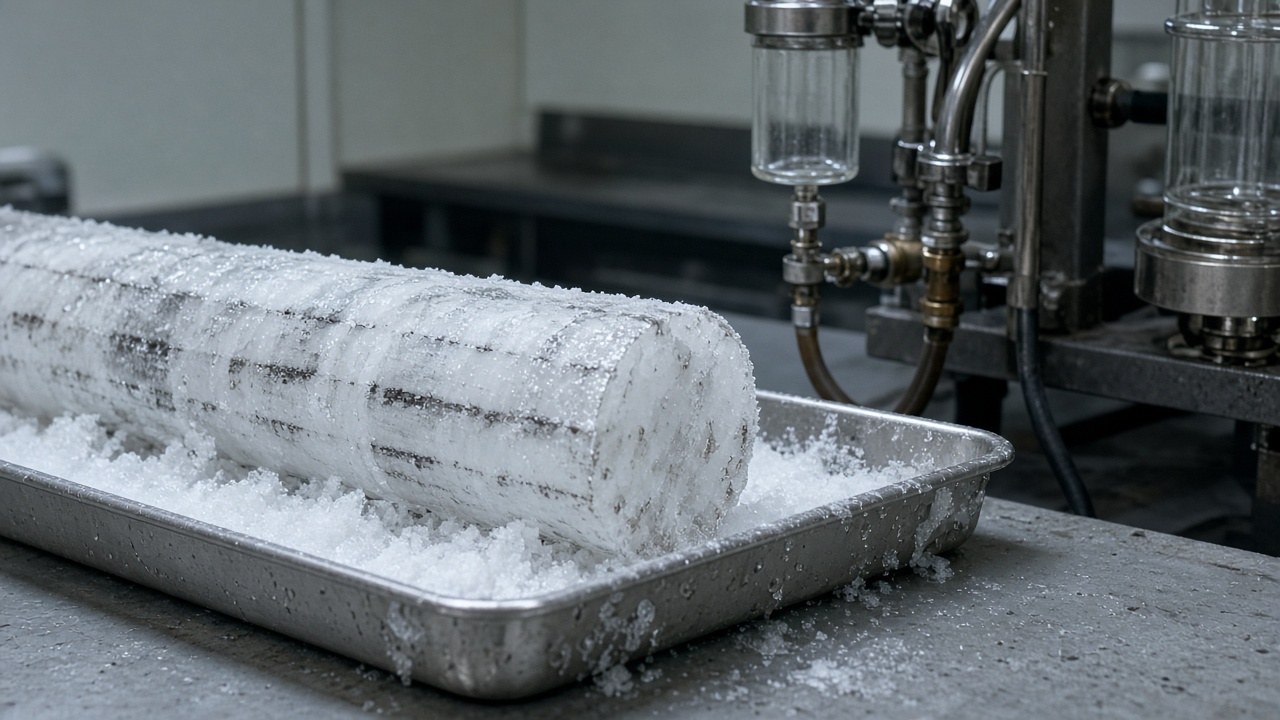
CSIRO scientists published refreshed Law Dome ice-core methane readings this week that tie industrial-era concentration jumps to expanded Southern Ocean shipping traffic, a finding made possible by shipping air samples by sea rather than air freight to avoid cosmic-ray exposure that can scramble radiocarbon tracers.
What the cores measured
Researchers melted segments drilled near Australia’s Casey station and extracted trapped bubbles dating to the late 1800s, when direct atmospheric monitoring did not exist. Methane rose more than 150 percent since pre-industrial times; the new dataset sharpens isotope splits between fossil and biogenic sources, showing fossil-share bumps that align with bunker-fuel growth along routes south of the Roaring Forties.
Dr David Etheridge’s team at CSIRO’s Climate Science Centre contributed Law Dome archives that have underpinned greenhouse-gas records for decades. This release adds rule-based quality filters from the ICELAB extraction pipeline and pairs methane with carbon monoxide fractions prepared for accelerator mass spectrometry at ANSTO.
Why shipping mattered
Collaborators at the University of Rochester separated methane and carbon monoxide from extracted air after cylinders traveled by ship—air transport would have exposed rare carbon-14 signals to high-altitude radiation, biasing fossil-methane attribution. That logistics choice mirrors how Southern Ocean science itself depends on marine supply chains whose emissions the paper now partially fingerprints.
The irony is deliberate: understanding shipping’s climate footprint required the same cautious freight discipline tankers use when carrying ice cores instead of ore. Field teams at Taylor Glacier and Law Dome used on-site melting and sublimation rigs so gases never warmed unpredictably before embarkation.
Limits and replication
Authors caution that ice-core methane integrates global signals; Southern Ocean shipping is one contributor among agriculture, wetlands, and fossil extraction. Correlation timelines near 1950–1980 strengthen the maritime hypothesis but do not close attribution without fleet fuel logs, which were sparse in early decades.
Replication would require fresh Law Dome drilling or parallel cores from Dronning Maud Land, plus blind repeats at ANSTO’s Centre for Accelerator Science. CSIRO posted extraction protocols so other labs can test whether firn diffusion corrections shift the shipping-aligned peaks.
What policymakers might use
International Maritime Organization delegates debating black-carbon and methane slip rules in polar-adjacent waters may cite the ice-core alignment as independent evidence that bunker trends left fingerprints before satellite monitoring. Australian Antarctic Division officials said the work supports continued high-snowfall drilling sites because they preserve air faster than interior plateaus.
For readers, the takeaway is methodological as much as political: the same Southern Ocean routes that carry ice home for analysis also carried the emissions those cores record—making sea freight both the subject and the safeguard of the measurement.
Casey station crews said the drilling season added two weeks of cargo coordination so cylinders could sail on the same resupply route that carries fuel to icebreakers—another data point linking operational traffic to the gases trapped in the cores below.