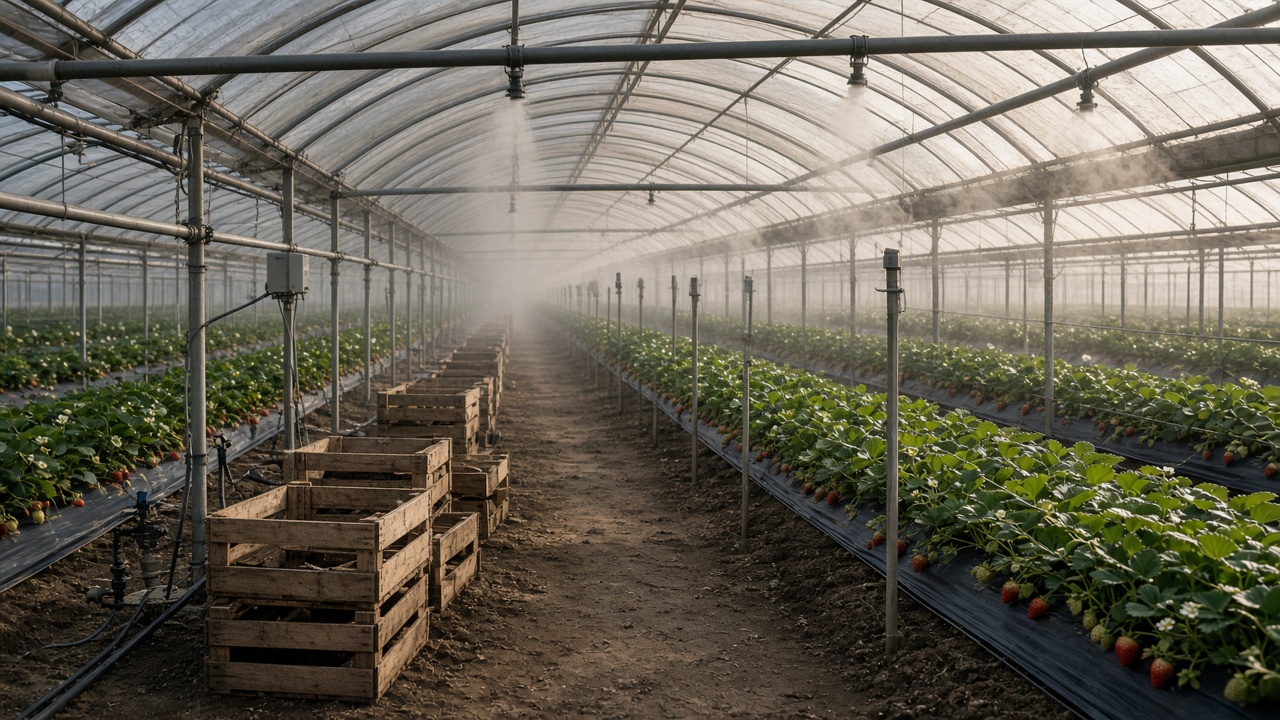
MistBerry Co., a Jeonbuk agritech startup, filed a pre-Series A disclosure with the Financial Supervisory Service’s alternative investment registry to deploy greenhouse mist and humidity sensors that log export-grade strawberry cold-chain data for Japanese buyers ahead of Chuseok air cargo peaks, according to founding investors and a pitch deck MistBerry shared with Jeonbuk’s agricultural research institute.
What the sensors measure
MistBerry installs capacitive humidity probes and flow meters on misting lines inside polyethylene greenhouses near Imsil and Namwon, regions known for winter strawberry production. Nodes record droplet cycles, canopy wetness duration, and nighttime temperature dips that affect brix and shelf life. Data lands on a gateway that signs hourly bundles for export inspectors and trading houses, reducing paper logs buyers rejected last season when handwriting disagreed with refrigerated truck thermometers.
The startup’s pre-Series A target is four billion won to manufacture five hundred node kits and hire field technicians who calibrate nozzles during monsoon humidity swings. Lead investor Hanul Agrifund, a Jeonbuk-focused vehicle, said MistBerry must prove revenue from sensor subscriptions, not just hardware markups.
Export angle
Japanese supermarket buyers tightened proof-of-chain requirements after several shipments arrived with condensation damage blamed on inconsistent misting during pre-cool. MistBerry’s dashboards show time-stamped mist intervals correlated with pallet probe readings, giving export agents audit trails in Korean and Japanese. aT trade counselors said such logs could speed phytosanitary clearance when multiple growers share consolidation centers in Incheon.
Chuseok air freight slots are scarce; growers who miss humidity windows lose premium prices. MistBerry pitches alerts that pause harvesting when canopy wetness exceeds export thresholds, synced to mobile push notifications for farm managers overseeing migrant workers on holiday schedules.
Smart farm alignment
The Rural Development Administration’s smart-farm subsidies cover partial hardware costs when startups partner with research institutes. Jeonbuk Agricultural Research Institute hosts MistBerry trial beds comparing sensor-driven misting to manual timers, early results show water use down twelve percent with similar yields, though researchers caution one season is insufficient for statistical claims.
MistBerry open-sourced a lightweight MQTT schema so other greenhouse software vendors can ingest mist logs without vendor lock-in, a concession investors demanded before committing capital.
Risks investors flagged
Greenhouse farmers operate on thin margins; MistBerry offers lease-to-own pricing but still faces skepticism from elders who trust visual wilting over graphs. The startup hired agronomists who speak Jeolla dialect to run onboarding sessions and documented battery replacement cycles for sensors mounted near corrosive mist heads.
Competitors including Seoul-based IoT firms sell generic humidity kits without export formatting; MistBerry’s differentiation is compliance packaging and on-site calibration included in annual fees.
What happens if the round closes
MistBerry plans to expand to blueberry cold stores in Gunsan if strawberry deployments hit eighty percent renewal after one year. Export partners in Osaka asked for API access to live mist data during transit, a feature slated for 2027 roadmap items pending cybersecurity review.
For Jeonbuk, the round is a test of whether regional startups can capture value from high-value fruit exports without moving headquarters to Seoul. For growers, it is a bet that logged mist intervals can prevent another season of rejected pallets when holiday demand peaks.
Co-op packaging
MistBerry signed a memorandum with a Namwon grower co-op to bundle sensor leases into export packing fees, letting smallholders access dashboards without upfront capex. Co-op leaders said they will vote on the fee surcharge after harvest when members compare rejection rates against last year’s paper logs.
Workforce training
The startup runs evening classes at county offices teaching farm managers to read mist curves on phones, part of a Rural Development Administration smart-farm literacy program that subsidizes trainer hours. Attendance counts toward co-op votes on whether to renew leases after the first export season with digital logs.
MistBerry also documents pesticide blackout windows in the same dashboard so misting does not collide with spray schedules, a compliance detail Japanese inspectors flagged when prior shipments lacked synchronized chemical and humidity records.