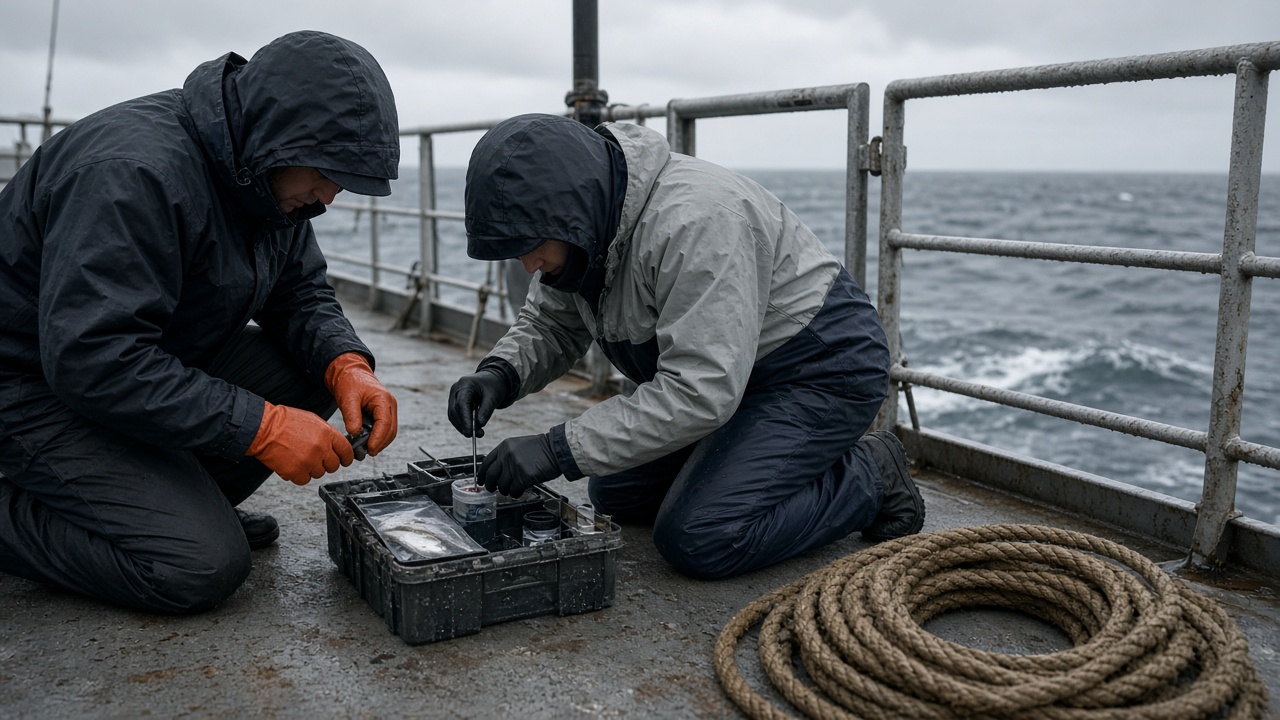
Researchers at the Korea Institute of Ocean Science and Technology tagged 120 juvenile Japanese eels off Busan this month and followed their dives along thermocline corridors where the warm Tsushima Current mixes with cooler coastal water, data the Ministry of Oceans and Fisheries will use to tune autumn catch quotas on glass-eel arrivals.
Methods and limits
Teams aboard the R/V Isabu released acoustic-tagged juveniles near Gijang canyon slopes, then mapped depth preferences with CTD casts every two hours. Preliminary tracks show fish hugging 18–22 degree Celsius layers within five kilometers of shore at night, drifting offshore when surface temperatures spiked above 26 degrees during a September heat pulse. Sample size is modest—120 tags with 94 still reporting as of Friday—and excludes estuary stages upstream.
KIOST cautioned that thermocline sharpness varied after typhoon outer bands stirred the water column; replication will require at least two more monsoon seasons. Peer review is slated for a fisheries journal in early 2027, but ministry advisers already requested weekly dashboards during the legal fishing window.
Why Busan corridors matter
Glass eels recruit along the Korean south coast before river ascent; illegal poaching and habitat loss have collapsed wild populations. Thermocline maps help patrol boats focus on layers where juveniles cluster, rather than blanket trawling that kills bycatch. National Institute of Fisheries Science models will merge tag depths with salinity fronts detected by satellite altimetry—a pairing untested at this resolution last season.
Policy timing
Fisheries officials plan a quota hearing in October, weighing tag results against trader reports from Jeju landings. Conservation groups want night closures when thermoclines flatten and eels disperse; processors argue shorter windows will raise prices for licensed aquaculture farms that depend on wild seed stock. KIOST will not prescribe politics, but lead biologist Park Min-jung said “if we ignore temperature seams, we manage maps—not fish.”
What replication would show
Independent labs at Pusan National University asked for tag kits to repeat the study near Tongyeong; KIOST agreed to share calibration files but not proprietary drift-correction code until publication. Replication success would mean Seoul and Busan teams produce overlapping depth histograms on the same tide cycle—a bar fisheries managers could cite when defending quota cuts to coastal towns.
Gear on deck
Technicians swapped tag batteries in rolling seas when September swells topped two meters, losing six fish to predation before dives could be logged. KIOST engineers said consumer-grade tags failed in 2024 pilots; this year’s kits carry depth-rated housings tested in the East Sea lab tank. Those mundane hardware details decide whether policymakers trust the thermocline story or dismiss it as another short cruise dataset.
Aquaculture farms watching wild seed prices asked for embargoed access to tag dashboards; ministry lawyers refused, citing poaching risk. The tension between open science and enforcement will not resolve this season, but the Busan tracks at least give managers a temperature seam to argue about instead of anecdote alone.