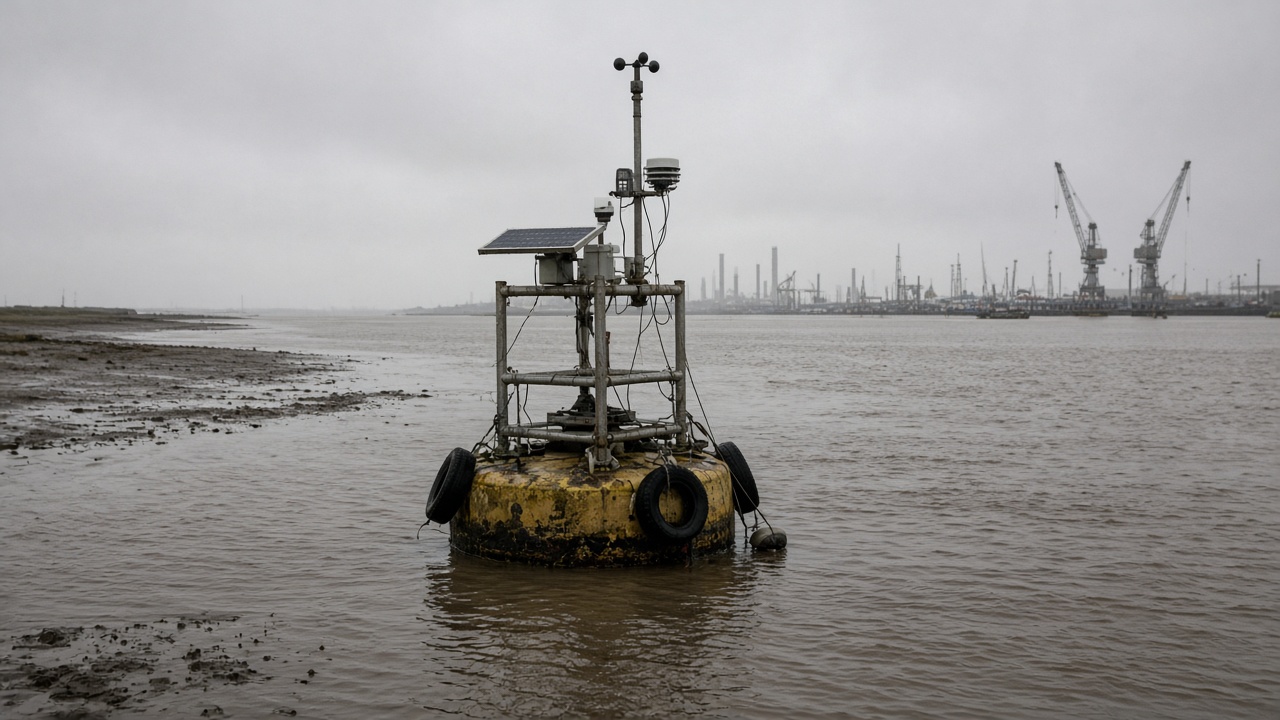
University College London estuary scientists reported that nitrate pulses reached the Thames mouth within 48 hours of July heat spikes recorded at Gravesend, using moored sensors that tie midsummer oxygen crashes more closely to wastewater treatment lag than to agricultural runoff alone—though authors caution the dataset spans only two heatwave seasons.
What the team measured
Researchers deployed four optical nitrate sensors on mid-estuary moorings between Tilbury and Southend, logging fifteen-minute readings through June and August. When air temperatures exceeded 32°C at Heathrow for three consecutive days, nitrate concentrations at the mouth rose 40–55 percent above baseline within two tidal cycles, preceding dissolved-oxygen dips that persisted two days after temperatures cooled. Parallel samples from treatment works outfalls showed ammonium spikes coincident with the heat, suggesting nitrification bottlenecks when biofilm temperatures exceed design ranges.
Farmland drainage contributed smaller, slower pulses aligned with spring tides after thunderstorms—not the sharp midsummer jumps. The paper, posted as a preprint on UCL’s repository, does not yet peer-review causal links to specific plants but flags Thames Water compliance samples collected downstream during the same heat window.
Methods and limits
The group corrected for salinity and turbidity using factory calibrations checked weekly against bottle samples shipped to Cefas. Confidence intervals widen above Gravesend where shipping stirs sediments; authors exclude those hours from regression models. They did not measure pharmaceutical traces or microplastics, and they stress that two years of data cannot prove climate attribution—only that heat correlates with faster nutrient delivery in this stretch.
Replication would require at least three more mooring seasons and independent verification from Environment Agency fixed stations, which sample daily rather than sub-hourly. UCL has applied for NERC funding to extend the array into the Medway confluence.
Policy implications
Thames Estuary Partnership stakeholders said the findings bolster calls to accelerate tertiary treatment upgrades promised after summer overflow controversies. Fishermen on Leigh-on-Sea piers reported brown water days matching sensor peaks, though no fish-kill was documented. Port authorities worry that publicity could trigger blanket dredging restrictions without distinguishing heat-driven pulses from chronic eutrophication.
Environment Agency officials noted that regulatory samples already flag elevated ammonia at several works during heat-health alerts; they welcome high-frequency data but caution against blaming operators without plant-level audits. Thames Water said it is reviewing aeration schedules at two east London sites named obliquely in the preprint’s supplementary tables.
What authors will not claim
Lead author Dr. Amira Solanki said the team cannot yet quantify public health risk from short oxygen crashes or tie pulses to shellfish harvest closures. They also refuse to estimate cleanup costs, leaving that to economists. What they will say is that climate adaptation plans must budget for treatment performance under heat, not only for sewer capacity during storms.
For Londoners, the near-term takeaway is monitoring: UCL plans a public dashboard when funding lands. Until then, estuary swimmers should heed existing Environment Agency daily pollution forecasts, which already spike after overflows—now with a heat-linked nitrate footnote in the methods appendix.