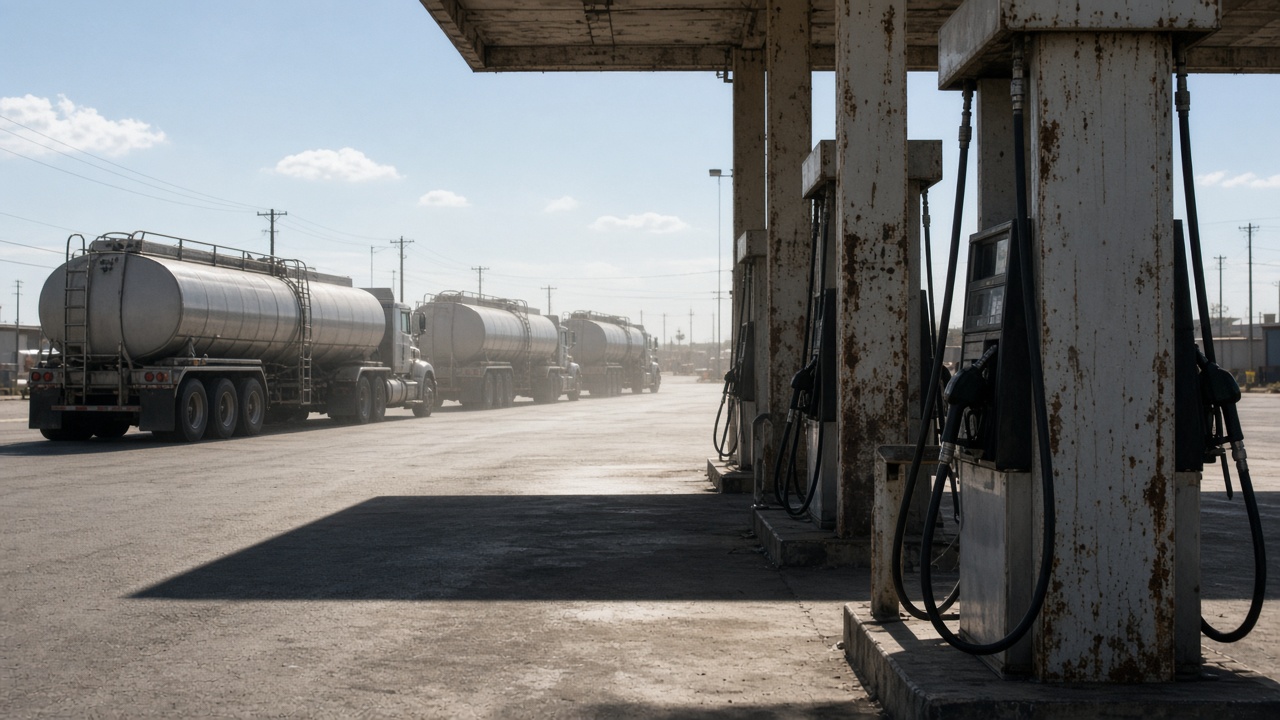
The energy shock from the Iran war is showing up less in crude benchmarks than at the petrol station and the truck stop. Global output of gasoline, diesel, and other refined products was more than 4 million barrels a day lower in August than a year earlier, according to industry tallies cited by the Financial Times, and wholesale diesel in the United States and Europe has traded above $200 a barrel equivalent — a level that feeds straight into freight bills and food logistics.
From crude spike to pump pain
Brent and WTI have dominated headlines for months, but traders and policymakers say the binding constraint is now refining and distribution. Attacks on shipping through the Strait of Hormuz and the Bab el-Mandeb corridor have made it harder to move both crude and products, while Saudi pipeline damage and Gulf export disruptions leave import-dependent economies bidding for scarce cargoes. The result is not only higher prices but intermittent shortages of specific grades, especially diesel used by trucking, farming, and backup generators.
The Financial Times reported that diesel prices in the U.S. and Europe have surpassed $200 a barrel on a crude-equivalent basis, while petrol shortages have appeared in pockets of Asia and Latin America where governments ration foreign exchange for fuel imports. Iran International summarized the FT’s finding that 94 countries have cut fuel taxes, capped retail prices, or subsidized consumption to shield households — a fiscal strain that central banks are fighting with rate hikes even as growth slows.
Who is absorbing the cost
Airlines and shipping lines pass fuel surcharges to customers within weeks; manufacturers with thin margins cannot always do the same. U.S. logistics firms have warned clients that autumn contract renewals will embed diesel indices that are double last year’s assumptions. In Europe, where gasoil stocks were already tight before the Hormuz crisis, some distributors have allocated volumes to emergency services and public transport first, delaying deliveries to industrial users.
Emerging markets that import both crude and refined products face a double squeeze: weaker currencies raise the local-currency cost of dollars-priced cargoes, while competition for spot shipments intensifies whenever a Gulf refinery or export terminal goes offline. India’s commerce ministry has said it is in contact with Washington over new U.S. sanctions legislation, partly because replacing discounted Russian barrels has become harder while alternative routes are congested.
What officials are watching
Uncertainty over how much product remains in storage — and where — makes it difficult for governments to calibrate how long emergency measures can last. Several Asian economies have drawn down strategic petroleum reserves of refined fuels, not just crude, to cover harvest-season diesel demand. European Union energy ministers are scheduled to review stockholding rules this month, with some member states arguing for mandatory minimum levels of diesel and heating oil separate from crude inventories.
U.S. President Donald Trump has said “very big things” could happen soon in the Middle East, language markets read as either renewed military pressure on Iran or a diplomatic opening. Either path would move crude first, but refiners say product cracks — the margin between crude and diesel — may stay elevated until shipping insurers return to Hormuz routes at scale.
What changes next
Until refining throughput recovers or demand softens sharply, the operative numbers for households and businesses are retail diesel and petrol, not Brent alone. Analysts expect third-quarter earnings at integrated oil majors to show record downstream profits even as upstream volumes are disrupted — a political flashpoint in countries where voters blame traders for pump prices. For logistics-dependent economies, the question is whether autumn harvests and holiday freight peaks can clear without rationing letters at the depot gate.
Governments that have already spent billions on subsidies will face pressure to extend them into 2027 if the 4-million-barrel refining gap persists. Central banks, meanwhile, must decide whether fuel-led inflation is a one-time shock or a reason to keep rates higher into next year — a judgment that will land on trading floors before it reaches kitchen tables.